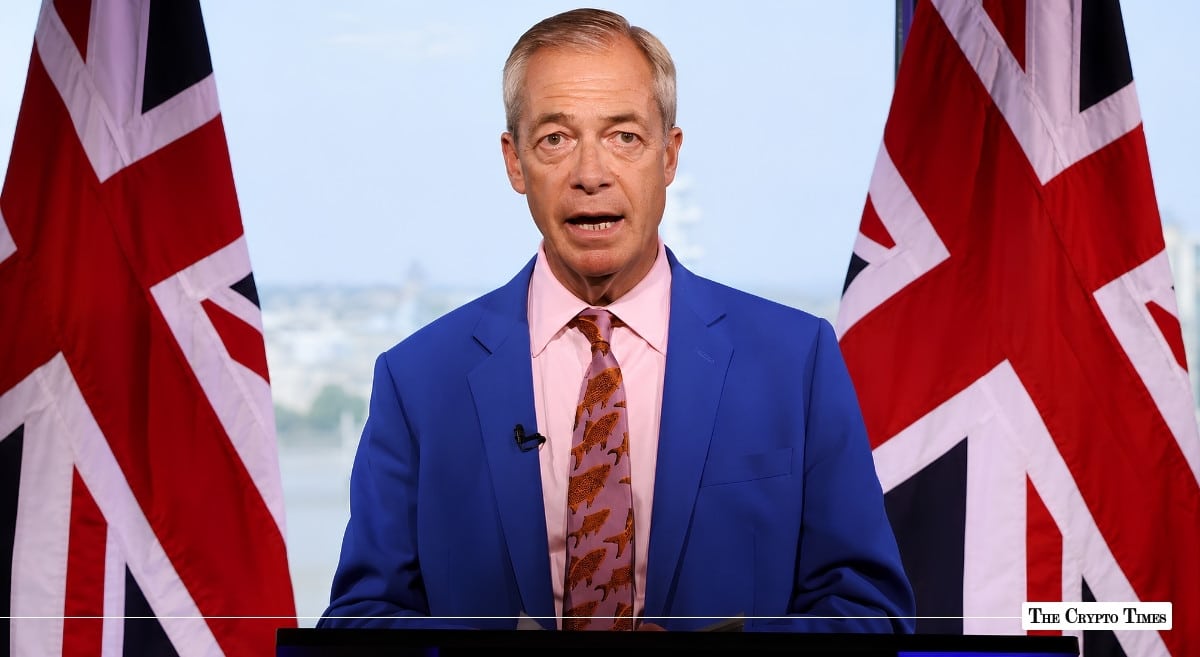
Nigel Farage, the Reform United Kingdom leader and Britain’s most vocal political backer of cryptocurrency, resigned on Tuesday as the Member of Parliament for Clacton, triggering a by-election he says he will contest and framing the vote as a public verdict on both his conduct and the Westminster establishment that has been investigating him.
In a video statement recorded at Millbank Tower in central London and released by Reform UK with no opportunity for media questions, Farage insisted he had “not broken the law in any way at all” and had “not misused public money,” and said the voters of his Essex constituency, not parliamentary standards officers, should decide whether he keeps his seat.
“I’ve decided that the people of Clacton should be the judges of my actions,” Farage said. “This will be a people versus the establishment by-election. It’s a chance to stick two fingers up to the entire establishment.”
He added that he had “never been angrier in his life,” accusing sections of the press of harassing his family.
The £5 Million Gift at the Centre of the Scandal
The resignation lands squarely in the middle of a crypto-linked political scandal that has been building since April. At issue is an undeclared £5 million personal gift Farage received from British-Thai billionaire Christopher Harborne, one of the largest shareholders in stablecoin issuer Tether and the single biggest donor in Reform UK’s history.
Harborne, who holds an estimated 12% stake in Tether Limited, transferred the £5 million to Farage in June 2024, weeks before Farage reversed his earlier decision to sit out the general election and stood for the Clacton seat. The gift was never entered on the parliamentary register of interests.
The Parliamentary Commissioner for Standards, Daniel Greenberg, formally opened an inquiry into the payment in May 2026, escalating what began as party-political complaints from Labour and the Conservatives into a full standards investigation that carries the theoretical risk of suspension and, ultimately, a recall petition.
Farage has offered shifting explanations for the money. He originally described it as funding for lifelong personal security following past attacks on him, and later as a “reward” for his decades of Brexit campaigning. Reform UK’s official position remains that the payment was a “personal, unconditional gift,” and therefore exempt from the rules that require MPs to declare political benefits received in the twelve months before entering Parliament.
A Reform UK Balance Sheet Built on Crypto Wealth
The £5 million to Farage personally is only one strand in a much larger crypto money pipeline into Reform UK.
Harborne has separately donated more than £22 million to Reform since the party was founded, including a £9 million transfer in August 2025 that ranks as the largest single donation ever made to a UK political party by a living individual, and a further £3 million in March 2026. BitMEX co-founder Ben Delo has added roughly £4 million to the party’s coffers since the start of this year. Combined, those inflows pushed Reform past both Labour and the Liberal Democrats as the best-funded political force in the first quarter of 2026.
Reform UK last year became the first UK political party to formally accept cryptocurrency donations. Its now-withdrawn Cryptoassets and Digital Finance Bill, unveiled at the Bitcoin 2025 conference in Las Vegas, proposed cutting crypto capital gains tax to 10%, establishing a UK Bitcoin reserve, and prohibiting banks from de-platforming customers over crypto activity.
Lobbying, the Bank of England, and a Second Complaint
The scrutiny has widened well beyond the original gift. Only days before Tuesday’s resignation, Labour MP Phil Brickell asked Commissioner Greenberg to open a second inquiry into whether Farage improperly lobbied Bank of England Governor Andrew Bailey against the proposed digital pound during a private meeting in September 2025.
Critics argue that Farage’s public campaign against a UK central bank digital currency and his advocacy for private stablecoins align closely with the commercial interests of Tether and, by extension, its major shareholder.
Additional pressure has come from reporting on financial support provided to Farage by his long-time aide George Cottrell, a convicted fraudster with crypto and gambling links, who reportedly funded aspects of Farage’s security and staffing operation in the year before he stood for Clacton.
Political Fallout
Prime Minister Keir Starmer had already turned the “£5 million question” into a fixture of Prime Minister’s Questions over the past two months, pressing Farage on why the gift was not disclosed and warning of tougher rules on “foreign influence and dirty money” in British politics.
Conservative leader Kemi Badenoch dismissed Farage’s resignation as a “gimmick.” Rupert Lowe, the former Reform MP who now leads Restore Britain, accused Farage of “weaponising” a by-election to bypass the standards process, and said his party would not put up a candidate in the vote Farage himself has triggered, choosing instead to wait for a “second” by-election if the inquiries conclude against him.
Liberal Democrat leader Ed Davey described the resignation as Farage’s “latest attempt to escape consequences.” Green Party leader Zack Polanski called it the act of “a grifter brought down by his own grifting.”
Liberal Democrat deputy leader Daisy Cooper has separately asked the Financial Conduct Authority to examine Farage’s public promotion of Bitcoin alongside his personal investment in the London-listed bitcoin treasury company Stack BTC, drawing parallels with what she has called Donald Trump’s “crypto playbook”.
Why This Matters for Crypto Policy
The scandal has already reshaped the UK’s regulatory conversation on crypto political funding. In March 2026, the government imposed an immediate moratorium on cryptocurrency donations to political parties, citing the Rycroft democracy review’s warning that digital assets could be used to channel foreign money into British politics.
A separate proposal now moving through Parliament would cap overseas political donations at £100,000 a year, a threshold that would effectively sever the Harborne pipeline that has bankrolled Reform UK.
For an industry that has spent the last two years lobbying for lighter treatment on stablecoins, staking, custody, and capital gains, the collapse of its most crypto-friendly parliamentary champion into a standards investigation is a serious setback, and one that hands ammunition to lawmakers pushing for stricter disclosure rules on crypto-derived wealth in politics.
What Comes Next
A by-election date in Clacton has not yet been confirmed, but is expected within weeks once Farage’s procedural resignation via the Chiltern Hundreds is formally accepted. Farage carried the seat in July 2024 with a majority of 8,405 votes and 46.2% of the vote. Reform UK insiders remain publicly confident of his re-election.
Should he return to the Commons, neither the standards inquiry into the £5 million gift nor the lobbying complaint linked to the Bank of England meeting is expected to be dropped. Both proceedings, according to parliamentary officials familiar with standards procedure, would resume once the newly re-elected MP is sworn in.
Also Read: Peter Schiff Predicts Lawsuit Storm Over Trump’s Crypto Empire