In a striking convergence of conservation and crypto compliance, some of the digital-asset industry’s most prominent tracing firms have signed up to help dismantle one of the world’s largest criminal economies.
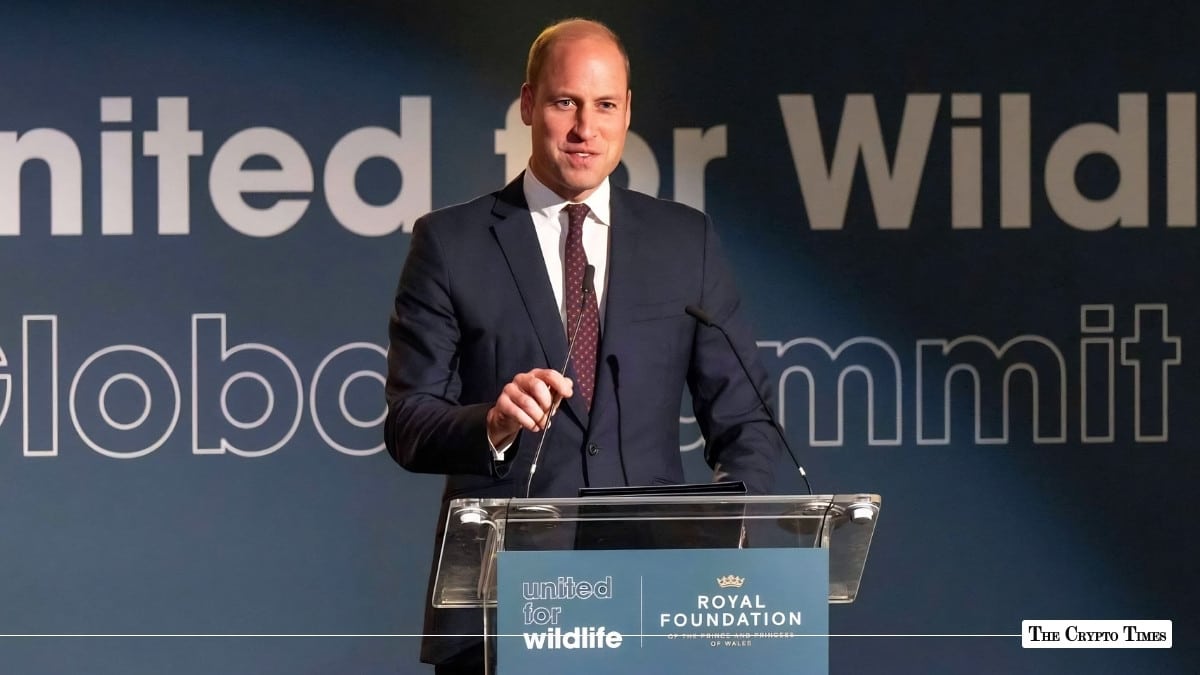
At a business forum convened by Prince William and his Royal Foundation’s United for Wildlife initiative during London Climate Action Week, a newly minted coalition of crypto and blockchain analytics companies, including Chainalysis, TRM Labs, the exchange Luno, and payments firm PayPal, formally committed to disrupt the financial flows that bankroll the global illegal wildlife trade.
It is a notable milestone for an asset class more often associated in mainstream coverage with the crimes it enables than the ones it helps solve. Crucially, the logic behind the commitment flips a common public misconception about cryptocurrency entirely on its head.
Why blockchain firms are an asset here
The immediate retail instinct is to assume traffickers favor crypto because it is completely anonymous. The reality is closer to the opposite. As the Basel Institute on Governance has documented, public ledgers are far less opaque than outside observers believe; sophisticated blockchain analysis can routinely trace transaction flows, deanonymize wallet clusters, and occasionally pinpoint real-world geolocation data.
Because criminal networks eventually need to cash out their illicit funds into fiat currency, they are forced to funnel assets through centralized cryptocurrency exchanges. Under current Financial Action Task Force (FATF) standards, these platforms are legally obliged to monitor transaction trails and conduct strict customer due diligence (CDD).
This is precisely the choke point where the coalition’s expertise will be deployed:
- Chainalysis: Long regarded as a benchmark for on-chain investigations, the firm has assisted global law enforcement in freezing or recovering over $34 billion in illicit cryptocurrency, with its algorithmic tracing models regularly tested and validated in federal courtrooms.
- TRM Labs: Operating as a high-velocity compliance partner, TRM’s specialty lies in real-time, AI-driven cross-chain screening, allowing national security teams to track multi-hop asset movements across disjointed layer-1 networks.
- Luno: The exchange’s inclusion provides a critical on-ramp defensive layer. Given Luno’s deep infrastructure roots across emerging economies and Africa—the geographical origin point for a massive portion of global poaching operations—it is positioned to flag suspicious wallet interactions before funds enter the wider global financial system.
A coalition far bigger than crypto
The crypto pledge is one piece of a broad private-sector mobilization. Per the announcement, technology platforms including Google, Meta, TikTok, and Alibaba, together representing about a fifth of the global e-commerce market and 90% of the world’s social-media users, committed to end trafficking on their platforms and to hunt down online listings using AI-enabled detection. Telecom operators Vodafone, Vodacom and Safaricom agreed to deploy AI in anti-money-laundering and transaction-monitoring across the M-Pesa mobile-money network, while British Airways and Heathrow will run a public-awareness campaign.
United for Wildlife co-chair David Fein framed the moment as the private sector recognizing the trade as both an environmental and a business issue. The scale explains the urgency: a UN Environment Programme report cited at the forum values the illegal wildlife trade at up to $23 billion a year, ranking it among the largest illicit economies on earth, with roughly one million plant and animal species threatened with extinction.
The honest caveat
A credible reading of the landscape must acknowledge the ongoing dual-use tension. The exact same digital rails now being marshaled against smugglers have also been heavily exploited by them.
Wildlife trafficking has increasingly migrated onto deep darknet marketplaces. Across illicit finance lines, highly sophisticated actors are continuously attempting to route funds into privacy-centric tokens like Monero (XMR) or passing funds through non-custodial, no-KYC instant-swap services explicitly engineered to break the heuristic tracing models this coalition relies upon.
Blockchain analytics heavily narrows the operational playing field for these cartels, but it does not completely seal it off. The commitment is best understood not as a standalone silver bullet, but as the deliberate wiring of crypto’s compliance stack into a global conservation cause for the first time at this scale.
Still, the structural symbolism here is difficult to overstate. A British royal-led conservation coalition placing Chainalysis and TRM Labs alongside Google and PayPal as core enforcement partners is a clear marker of how mature blockchain forensics has become—and a reminder that the public visibility critics cite as crypto’s vulnerability is precisely what makes it a potent weapon.
Also Read: Weekly Wrap: $122M Liquidated After FOMC Holds Rates, Morgan Stanley Enters ETH ETF Race