A new proposal from an Ethereum Foundation researcher aims to help users protect their accounts against future quantum computing threats without requiring changes to the blockchain’s core protocol. The approach would allow users to add quantum-resistant security using Ethereum’s existing infrastructure at a cost of roughly seven cents per account.
The proposal was outlined by Ethereum Foundation researcher Nicolas Consigny, who said, “Ethereum can already start preparing accounts for a post quantum world, without waiting for a hard fork. Today, it would be just 0.07$.”
The proposal has quickly gained traction among developers looking to outrun the long-term systemic risks that rapidly advancing quantum hardware poses to standard public-key cryptography.
New signature design targets quantum threats
The proposal introduces SPHINCS-, an Ethereum-optimized variant of the SPHINCS+ signature standard. Researchers designed the system to defend against future quantum attacks while remaining compatible with the Ethereum Virtual Machine (EVM).
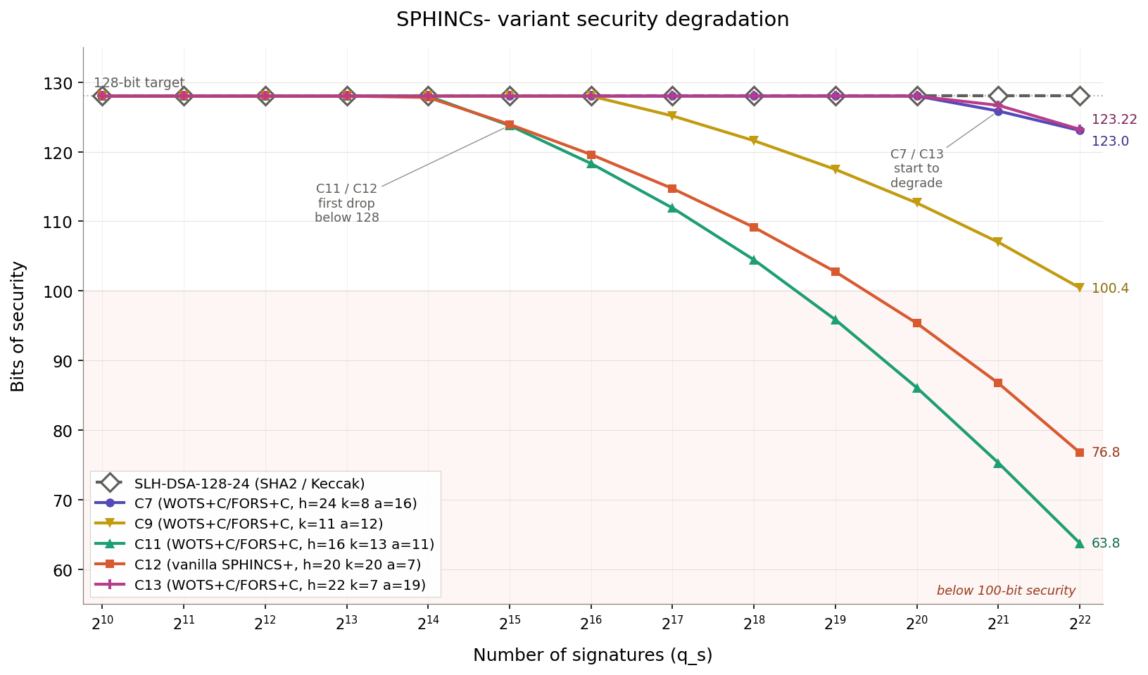
While SPHINCS+ is globally recognized as highly secure against quantum attacks, verifying its massive signatures directly on a blockchain is typically too computationally expensive to be practical for retail users. Consigny’s design tackles this economic barrier by replacing the standard SHAKE256 hashing function with KECCAK256, Ethereum’s native hashing primitive.
Because the EVM is already built to compute KECCAK256 hyper-efficiently, this substitution drastically lowers execution costs. According to the research documentation, the change allows Ethereum smart contracts to verify a post-quantum signature for approximately 150,000 gas. The project also introduces optimized variants that reduce signature sizes and verification expenses.
Consigny credited several contributors for the work, including Ethereum Co-Founder Vitalik Buterin, researcher Justin Drake, and members of Ethereum’s cryptography team. Their discussions helped shape the final design and parameter choices.
Quantum risks move closer to reality
The proposal comes as concerns about quantum computing continue to grow across the crypto industry. Experts have long warned that sufficiently powerful quantum computers could one day break the cryptographic systems that protect Ethereum, Bitcoin, and many other blockchain networks.
Recent developments have added urgency to those concerns. In April, Project Eleven awarded researcher Giancarlo Lelli after he successfully used a quantum computer and a variation of Shor’s algorithm to crack a 15-bit elliptic-curve key. While the test involved a much smaller key than those used by major blockchains, researchers viewed it as a notable step forward in quantum computing capabilities.
For now, Bitcoin and Ethereum remain secure because they rely on far stronger 256-bit cryptography. Still, the experiment highlighted the long-term challenge facing the industry. Blockchain analytics firm Glassnode has estimated that roughly 1.92 million Bitcoin could be exposed to structural risks if quantum computers eventually become powerful enough to break today’s encryption standards.
The remaining industry has yet to match Ethereum’s organized response. Bitcoin, Solana, and several other networks still rely heavily on ECDSA. However, none have announced dedicated post-quantum security initiatives on the same scale.
Therefore, the recent proposal by Ethereum is not just an improvement from a technical perspective. Rather, it seems that there is now a concerted effort to prepare the blockchain technology platform before quantum computing changes everything when it comes to digital security.
Also Read: 15 Days to MiCA: 75% of EU Crypto Firms Race Against July 1 Cutoff