Key Highlights
- A wallet sent 1 LINK as a test transfer, followed by 98,589.875 LINK to the same address.
- The receiving wallet then forwarded 98,590.875 LINK, worth about $767,037, to Coinbase Prime 1.
- The movement appears to be asset transfer/custody activity, not confirmed selling.
A wallet linked to U.S. government-seized FTX and Alameda assets moved nearly 98,591 Chainlink (LINK) tokens to Coinbase Prime on Wednesday, according to on-chain data.
The transfer began with a small test transaction of 1 LINK from wallet 0x3e3740…0fF7C to 0x6351e6…cA08D at 2:17 PM UTC. Minutes later, the same wallet sent another 98,589.87578196 LINK, valued by Etherscan at about $767,029 at the time of transfer.
The receiving wallet then moved the full balance, 98,590.87578196 LINK, worth roughly $767,037, to an address labeled Coinbase Prime 1 at 2:24 PM UTC.
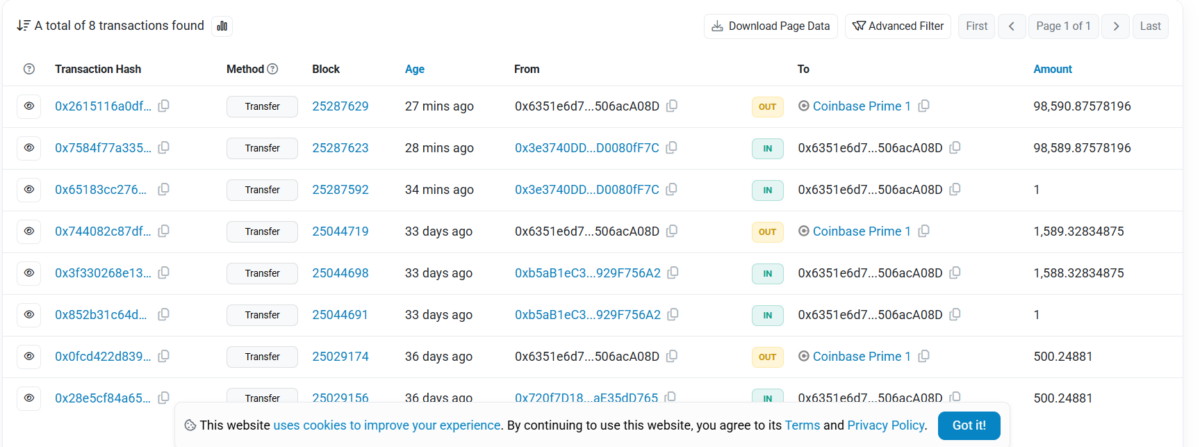
The intermediate receiving address was also previously funded by Coinbase Prime: Deposit Funder 1, according to Etherscan address data, supporting that the final destination was part of Coinbase Prime’s deposit flow.
The transaction follows earlier movements of FTX and Alameda-linked seized assets by U.S. government-controlled wallets. Arkham had previously said Alameda-linked funds seized by the U.S. government were labeled under its U.S. Government entity, including assets seized as part of forfeiture actions tied to FTX and Alameda.
Why the Coinbase Prime Transfer Matters
The destination matters because Coinbase Prime is already part of the U.S. government’s digital asset forfeiture infrastructure.
In July 2024, Coinbase said the U.S. Marshals Service, a Department of Justice agency responsible for asset forfeiture, selected Coinbase Prime to provide custody and advanced trading services for its large-cap digital assets.
That means a transfer to Coinbase Prime can indicate custody, administrative asset management, or preparation for trading. It does not, by itself, prove that the tokens have been sold into the market.
Still, the movement is notable because seized crypto transfers to institutional trading and custody platforms often attract market attention, especially when the asset is not Bitcoin.
U.S. Policy Treats Bitcoin and Other Crypto Differently
The sale question is more important because the U.S. government’s treatment of forfeited crypto changed under the March 2025 executive order establishing the Strategic Bitcoin Reserve and the United States Digital Asset Stockpile.
Under that order, forfeited Bitcoin deposited into the Strategic Bitcoin Reserve shall not be sold and must be maintained as a reserve asset of the United States.
Non-Bitcoin assets are treated differently. The order created a separate U.S. Digital Asset Stockpile for other digital assets owned by the government, including assets finally forfeited through criminal or civil forfeiture proceedings.
LINK falls into the non-Bitcoin category. That means it does not receive the same no-sale treatment as Bitcoin under the Strategic Bitcoin Reserve framework.
The order says the Treasury Secretary will determine responsible stewardship strategies for the Digital Asset Stockpile under applicable law. It also allows government digital assets to be sold or otherwise disposed of under Treasury authority, court orders, victim restitution, law enforcement needs, equitable sharing, or other asset forfeiture requirements.
Does This Mean the U.S. Government Sold LINK?
No, the transaction does not confirm a sale.
The movement only confirms that FTX-seized LINK was transferred to a Coinbase Prime receiving wallet. There is no on-chain evidence from these transactions alone showing a market sale, order execution, or distribution to external buyers.
However, the transfer raises sale speculation because Coinbase Prime provides both custody and advanced trading services for U.S. Marshals Service-managed digital assets.
That makes the move more than a routine wallet transfer, but still short of confirmed liquidation.
What Comes Next?
The next signal would be whether the LINK remains in Coinbase Prime custody or whether further transfers appear from Coinbase-linked wallets.
If the tokens are held, the movement may reflect custody or administrative consolidation. If additional outflows appear, it could point toward liquidation, restitution processing, or another form of government asset handling.
For now, the safest conclusion is that the U.S. government-controlled FTX seizure wallet moved LINK to Coinbase Prime, but on-chain data does not confirm that the tokens were sold.
Update:
Following these LINK transfer to Coinbase Prime, the government moved over 332K Aave (AAVE) worth $210K, 184K Chiliz (CHZ) worth $5.2K, and 10.29K Balancer (BAL) worth $1000 to different wallets.
Also Read: FIFA’s Official Prediction Partner and a Tom Lee-Backed Rival Both Bet on Chainlink