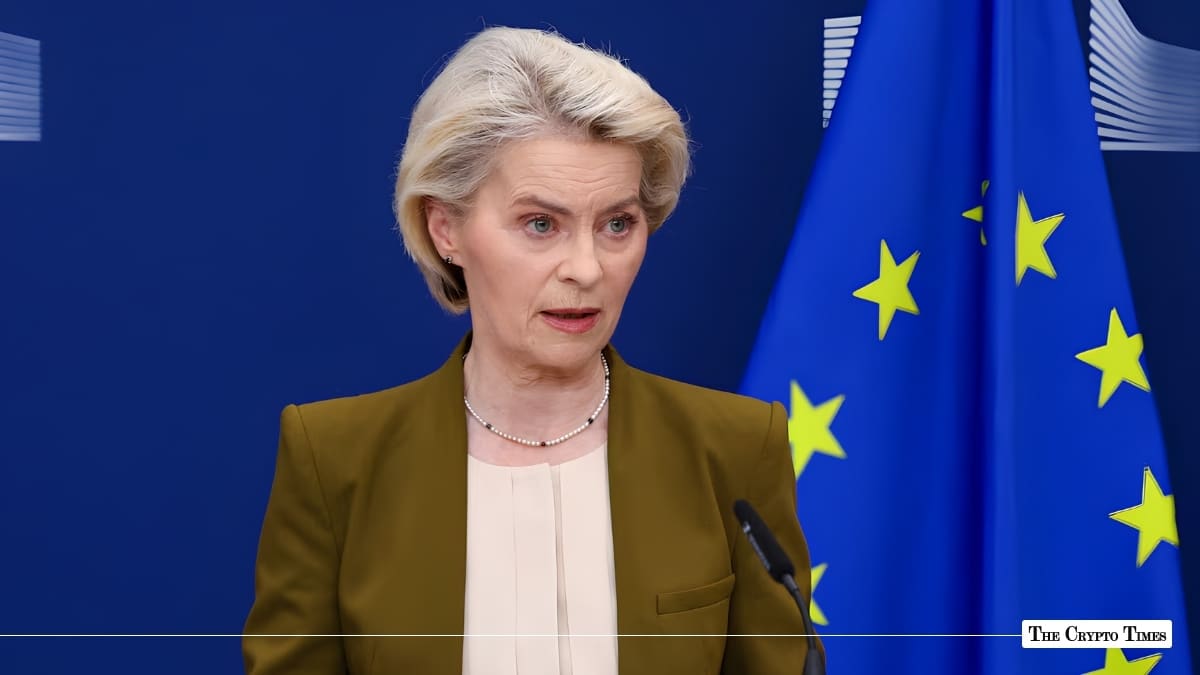
The European Commission has proposed a 21st sanctions package against Russia that, for the first time, would let the EU ban an entire country’s crypto-asset services if that jurisdiction hosts platforms helping Moscow evade sanctions. Announced by President Ursula von der Leyen, it blacklists 11 crypto platforms outright and still needs unanimous approval from all 27 member states.
A Jurisdiction-Level Crackdown
The European Commission unveiled the crypto core of its proposed 21st sanctions package against Russia, escalating a campaign that has steadily tightened around Russia’s digital-asset evasion rails. President Ursula von der Leyen said the package would extend transaction bans to roughly 20 non-EU entities — banks, crypto platforms, and oil traders that have serviced sanctioned Russian entities — and, blacklist 11 specific crypto platforms outright. It arrives alongside a broader expansion of the EU’s banking blacklist to 31 Russian institutions.
From Platforms to Whole Countries
The headline measure is a mechanism with no precedent in earlier EU rounds: a full, country-level ban on crypto-asset services from non-EU jurisdictions that host platforms helping Russia dodge sanctions. Every prior package named targets one at a time — individual exchanges, specific stablecoins, and named protocols. This shifts the threat from the platform to the jurisdiction. Von der Leyen framed it as a “strong deterrent” for countries that shelter such platforms, a doctrinal change that puts entire national crypto sectors on notice rather than waiting for each successor venue to be designated.
The $93 Billion Evasion Pipeline
Because the evasion has scaled. Russia-linked actors have leaned on ruble-backed stablecoins routed through third-country hubs — chiefly Kyrgyzstan and the UAE — to move value outside the banking system. Chainalysis has tied the A7A5 ruble stablecoin alone to roughly $93.3 billion in transaction volume, and estimated that illicit crypto addresses received about $154 billion in 2025. The pattern, documented across enforcement rounds, is rebranding: a designated platform shuts down and a near-identical successor appears in a friendly jurisdiction. TCT has previously detailed how Russia uses crypto to settle sanctioned oil sales to buyers in China and India.
Four Years of Escalation
It’s the next rung on a ladder that started in 2022, when the EU’s 5th package capped crypto wallet services at €10,000. The decisive shift came with the 20th package’s total sectoral ban on Russian crypto providers, adopted in April and effective May 24, which also banned the RUBx stablecoin and the still-unreleased digital ruble. Where the 20th treated Russia’s domestic crypto sector as a single banned category, the 21st reaches outward — to the third-country platforms and jurisdictions that picked up the slack. The same logic has driven parallel Western action, including the UK’s move to choke Russia’s crypto-powered shadow economy and its sanctioning of the HTX exchange.
The Unanimity Hurdle
The package is a proposal, not law. It requires unanimous approval from all 27 EU member states, a process that has slowed or diluted past rounds. Even if adopted, enforcement will test whether a jurisdiction-level threat actually deters host countries or simply pushes activity further offshore — especially as Russia prepares its own licensed crypto-trading framework, expected in July, and moves toward a digital-ruble rollout later this year. The structural question Brussels keeps chasing remains open: each package closes the last gap, and the next venue opens somewhere new.