Bitcoin (BTC) price is under pressure today as traders remain defensive, ETF demand stays weak, and BTC continues to trade below key technical resistance.
BTC was trading near $62,500 on June 9, down around 1.3% over the past 24 hours, after failing to hold its latest rebound above the $63,000 zone. The weakness comes despite a brief recovery attempt that pushed Bitcoin toward $63,700 before sellers returned.
The latest pressure is not coming from one trigger. Instead, Bitcoin is facing three linked headwinds: rising stablecoin dominance, continued ETF outflows, and a bearish short-term technical setup.
USDT Golden Cross Shows Defensive Positioning
The first warning sign comes from USDT dominance.
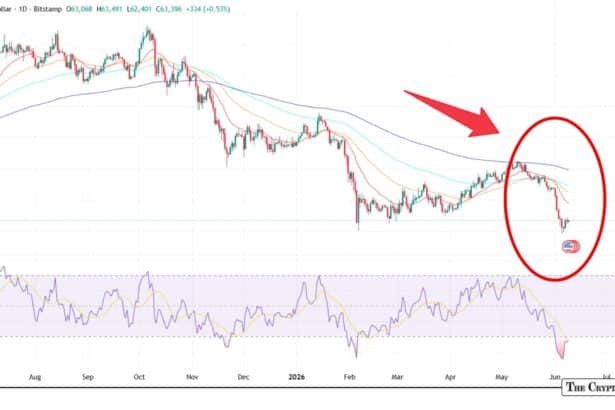
Tether’s dominance rate has flashed a golden cross, a technical signal that shows USDT’s share of the broader crypto market is gaining momentum. A golden cross is usually treated as bullish when it appears on a price chart, but this signal is different because it is forming on stablecoin dominance.
That means traders may be increasing exposure to dollar-pegged assets rather than Bitcoin, Ether or altcoins.
In simple terms, the market is not reading this as a bullish signal for Tether’s price. USDT is designed to trade close to $1. The signal matters because it shows that stablecoin market share is rising while risk appetite remains weak.
When traders move into USDT, it often means they are waiting on the sidelines, reducing volatility exposure, or preparing for further downside. That makes Bitcoin’s rebound vulnerable unless capital begins rotating back from stablecoins into risk assets.
ETF Outflows Keep Pressure on Bitcoin
Bitcoin is also facing continued pressure from U.S. spot Bitcoin ETFs. According to Farside Investors data, U.S. spot Bitcoin ETFs recorded a net outflow of $91.4 million on June 8. The outflow came even as Fidelity’s FBTC, Bitwise’s BITB and Ark’s ARKB saw inflows.
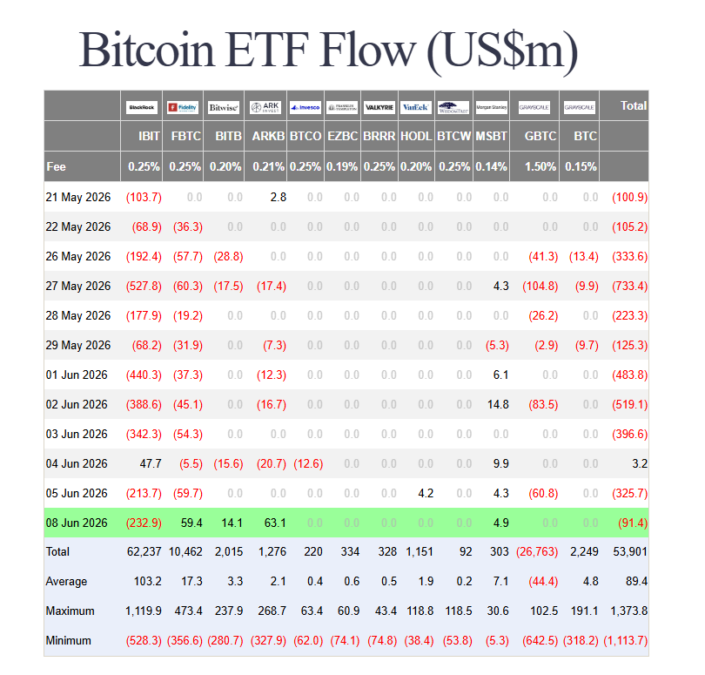
The main drag came from BlackRock’s IBIT, which recorded $232.9 million in outflows on the day. ETF pressure is no longer only a Grayscale issue. IBIT has been one of the strongest institutional demand channels for Bitcoin, and redemptions from the fund weaken the broader ETF-support narrative.
The recent flow trend also remains weak. From May 21 to June 8, Farside data shows only one small positive net-flow day, June 4, when Bitcoin ETFs brought in just $3.2 million. Most other sessions during the period were negative.
This makes the current Bitcoin rebound harder to trust. Spot ETF inflows have often acted as a demand cushion during earlier selloffs, but the latest data shows institutions are still not adding enough fresh support.
Bitcoin Fails to Reclaim Key Resistance
Bitcoin’s technical structure also remains weak. BTC is trading well below its 30-day Simple Moving Average of $73,102 and its 200-day Simple Moving Average of $78,245.91 . That keeps the broader trend structure bearish, even after short-term rebound attempts.
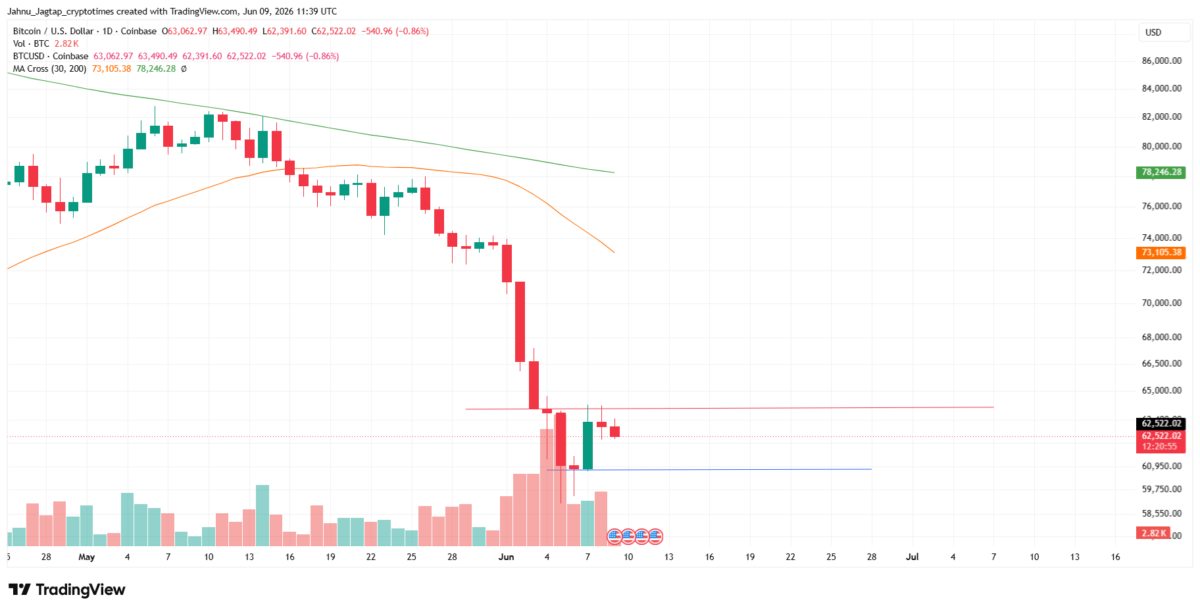
The immediate resistance sits near $64,100, which aligns with the 78.6% Fibonacci retracement level. Bitcoin needs a clear daily close above this zone to show that sellers are losing control.
So far, that has not happened.
Instead, Bitcoin’s latest move has faded below resistance, keeping the market exposed to another downside attempt. If BTC fails to hold the $59,100 area, the next leg lower could open the path toward the $50,000 region.
Near-Term Market Outlook
The path of least resistance remains down until Bitcoin reclaims the $64,100 resistance zone.
A daily close above that level would suggest that the current selloff is losing momentum and that a short-term bottom may be forming. However, failure to reclaim it keeps Bitcoin vulnerable, especially if ETF outflows continue and USDT dominance keeps rising.
One possible relief factor is the next Bitcoin mining difficulty adjustment, projected around June 13. A lower difficulty adjustment could ease some pressure on miners by making block production less competitive. However, this would likely be a secondary support factor, not a full market reversal trigger.
For now, Bitcoin’s near-term outlook depends on whether liquidity rotates back into risk assets.
Bitcoin is down today because the market is still defensive. The USDT dominance golden cross shows traders are staying in stablecoins. ETF data shows institutional demand remains weak. Technical levels show BTC has not yet reclaimed the resistance needed to confirm a recovery.
Until that changes, Bitcoin’s rebound remains fragile. Watch for a daily close above $64,100 to suggest a near-term bottom is forming. A break below $59,100 would increase the risk of a deeper move toward $50,000.
Also Read: Peter Schiff Calls Strategy’s $101M Bitcoin Buy ‘Damage Control’