
Key Highlights
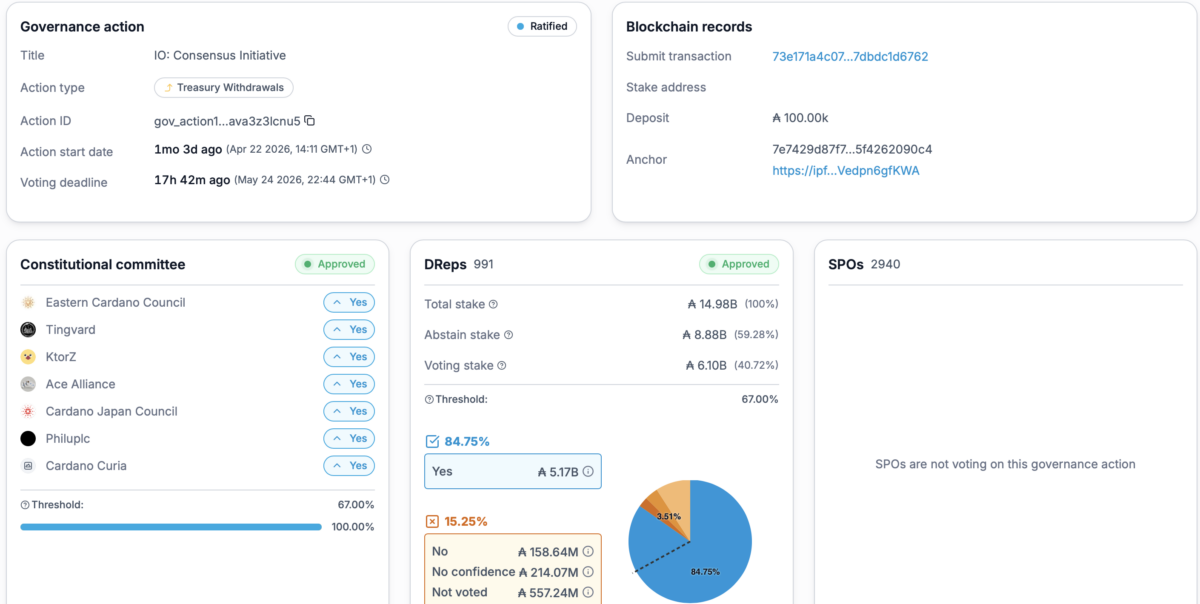
- The Leios proposal passed with about 84% DRep approval, unlocking 27.7 million ADA for development.
- The upgrade aims to scale Cardano from about 800,000 to over 27 million monthly transactions as part of the 2030 vision.
- ADA saw a small short-term price increase (~1.32%), but overall remains weak year-to-date despite the news.
The Leios proposal, a major funding request submitted by Input Output Global to the Cardano community treasury, was approved on Sunday after getting strong support from delegated representatives known as DReps.
According to Cexplorer data, the Consensus Initiative (Leios) passed with about 84% of DReps voting yes, meaning the project can now move forward with funding from the treasury, which is set at 27.7 million ADA.
Treasury approval and funding unlock
The approval comes at an important time for the project. Input Output, the team behind the proposal, previously said Leios is built to increase the network’s capacity and support long-term growth. The proposal was part of a group of governance proposals submitted in April, and it is tied to Cardano’s long-term goal of improving blockchain efficiency and capacity.
According to the development plan, the Leios testnet is scheduled to launch on June 23, 2026. Before this stage, developers have already demonstrated early results using an alpha, feature-complete version of the system on a dedicated public test environment.
The funding from the treasury will help continue development after the current budget cycle ends. Work will also continue into the 2026 and 2027 cycle, where the focus will be on turning Leios from an early version into a final product that can be used on the main network. During this time, the project will move through different development stages known as Software Readiness Levels 5 to 8.
The long-term goal behind Leios is part of Cardano’s 2030 plan. Input Output previously said its goal is to increase the network’s activity to about 800,000 monthly transactions to over 27 million.
In simple terms, the network wants to handle much more activity without slowing down or becoming expensive to use. Input Output described Leios as “the mechanism purpose-built to get there,” showing that it is one of the main tools designed to reach this target.
Other proposals approved while some were rejected
Aside from Leios, five other proposals from Input Output were approved. These included the Cardano Maintenance Initiative, Cardano Upgrades, Higher Assurance Technical Collaboration, Developer Experience Initiative, and improvements to Plutus, which focuses on smart contract development.
The Plutus proposal received a separate treasury allocation request of 11.8 million ADA and is designed to make smart contracts more efficient, cost-effective, and easier to verify.
However, not all proposals passed. The Pogun proposal, which aimed to build an end-to-end Bitcoin DeFi system, failed to gain enough support, receiving only 32.4% approval from DReps.
ADA shows mild market reaction
Meanwhile, Cardano’s native token ADA seems to have a mild reaction following the governance results.
At the time of writing, the token was trading for $0.24, recording a small increase of about 1.32% within the last 24 hours.
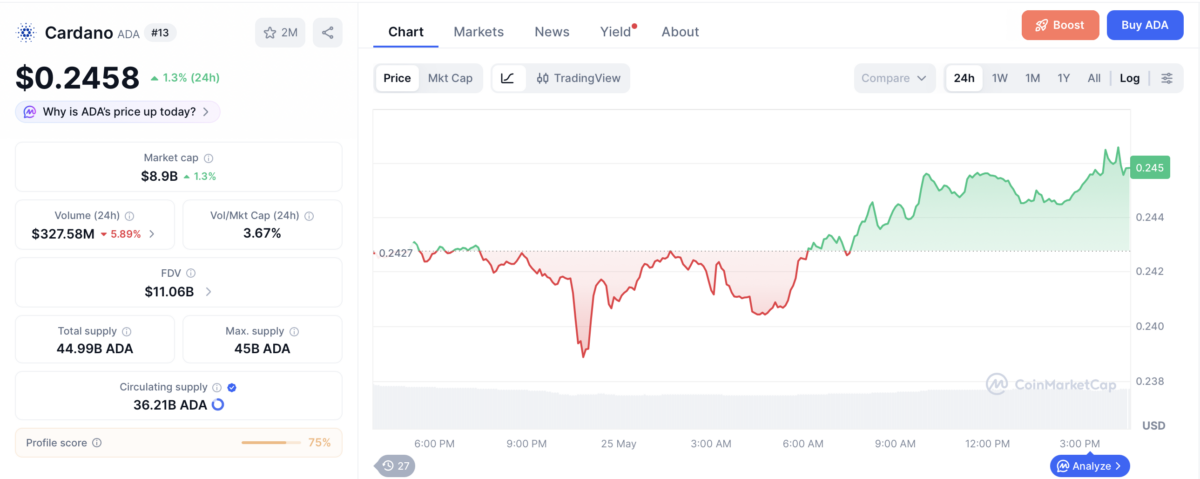
However, the long-term view shows that ADA is in a consolidating state, with just a 2% drop in a month, and 66% down year to date.
Also Read: CoinSwitch Posts ₹613 Cr Reserve Cushion Amid Crypto Recovery