The crypto industry woke up to a gut punch this morning. Late-night negotiations between a small group of bipartisan senators on the remaining unresolved issues in the Digital Asset Market Clarity Act ended without a deal.
The breakdown comes just hours before the Senate Banking Committee is set to hold its long-awaited markup session at 10:30 AM ET today, leaving the fate of the most important crypto legislation in U.S. history hanging in the balance.
Fox Business journalist Eleanor Terrett broke the news, reporting that talks aimed at bringing Democrats to a better place on at least two outstanding issues wrapped without any resolution.
Senator Lummis says they are 99% there
One of the lead Republican negotiators, Senator Cynthia Lummis, issued a pointed statement after the session ended.
“Ultimately, we have an agreement on 99% of the bill. I hope my colleagues across the aisle will work with me to get the remaining 1% resolved after we pass this bill out of committee. Otherwise, when or if another FTX happens, we will have no one to blame but ourselves.”
The statement is significant. Lummis is essentially signaling that Republicans are prepared to push the bill through committee on a party-line basis and deal with the remaining disagreements later on the Senate floor. The FTX reference is deliberate. She is reminding colleagues that regulatory inaction has real consequences, and the 2022 collapse of FTX still serves as a cautionary tale for everyone involved in this debate.
Two major sticking points derailed the talks
According to sources close to the negotiations, the two unresolved issues are ethics provisions related to the First Family and language tied to the Blockchain Regulatory Certainty Act (BRCA).
Ethics and conflicts of interest
Democrats, including Senators Adam Schiff and Ruben Gallego, had been pushing to reach a compromise on ethics and conflicts of interest involving the First Family ahead of today’s markup. This has been a recurring flashpoint in the negotiations. Senate Banking Committee ranking member Elizabeth Warren has argued that the bill, as written, could enable public officials to profit from the crypto industry without adequate safeguards.
At Consensus Miami 2026, Senator Kirsten Gillibrand went further, saying Democrats would not support the legislation without conflict-of-interest language.
Sources indicate that meaningful progress was made on the ethics front during these late-night talks. But a full deal remained out of reach.
Committee Chairman Tim Scott has maintained that ethics provisions fall outside the Banking Committee’s jurisdiction and should be addressed later on the Senate floor. The White House has signaled it supports ethics rules that apply uniformly across all government positions rather than targeting a specific officeholder, according to White House crypto adviser Patrick Witt.
BRCA language and DeFi protections
The second and ultimately more damaging sticking point was the BRCA language. The Blockchain Regulatory Certainty Act is embedded within the broader CLARITY Act and is designed to protect non-custodial software developers, wallet providers, and blockchain infrastructure operators from being classified as money transmitters under federal and state laws. This protection has been a top priority for the DeFi community and open source developers for years.
However, some Democrats voiced eleventh-hour concerns about changes to the BRCA provisions. Senator Jack Reed had earlier filed an amendment to completely strip the BRCA section from the bill. Senator Catherine Cortez Masto, backed by law enforcement groups, has also pushed for changes, arguing the protections could create blind spots for anti-money laundering enforcement.
On the Republican side, Senators Chuck Grassley and Cynthia Lummis reportedly reached a compromise that addresses prosecutors’ ability to pursue financial crimes involving digital assets while preserving core developer protections. The DeFi Education Fund had previously noted that the most important provisions for developers and infrastructure providers remain intact in the latest text.
Despite this earlier progress, last-minute disagreements over specific BRCA language ultimately prevented the full deal from coming together last night.
Recent update: What the 309-page bill actually contains
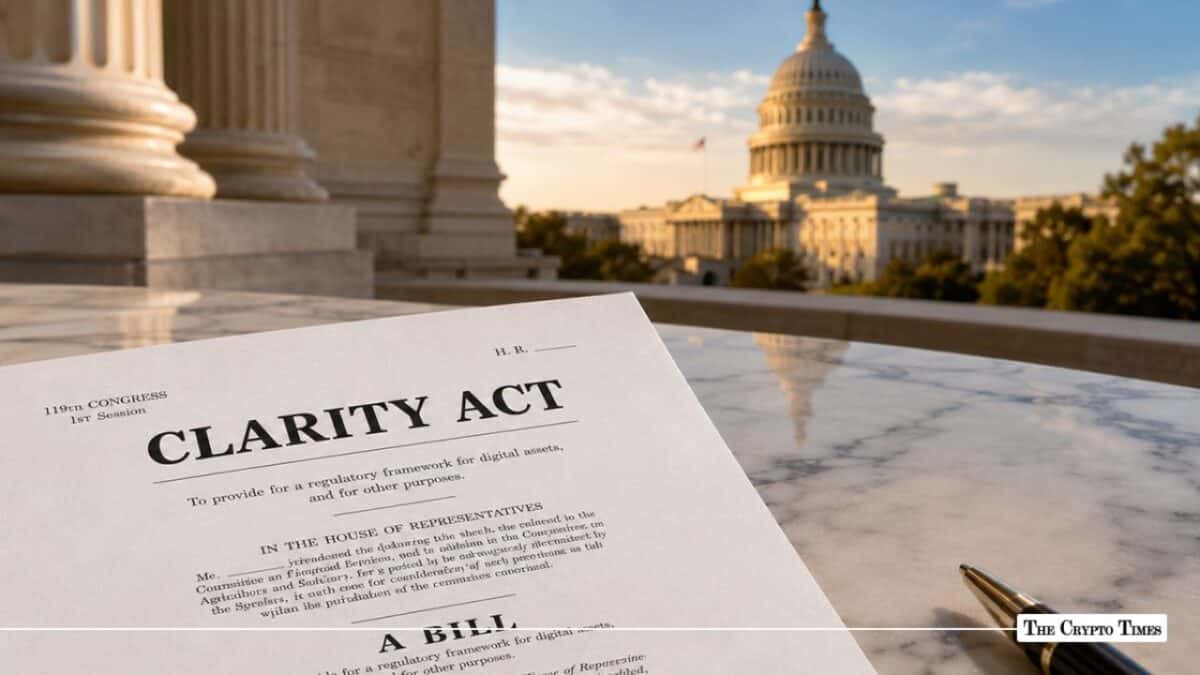
The latest version of the CLARITY Act draft was publicly released on May 12 by Senate Banking Committee Chairman Tim Scott, Senator Lummis, and Senator Thom Tillis. The 309-page text is the product of months of negotiations between lawmakers from both parties, regulators, law enforcement agencies, and industry stakeholders. Here is what the updated bill includes:
A three-tier classification system for digital assets that draws clear lines between which tokens fall under SEC jurisdiction and which fall under CFTC oversight. Permanent exemptions for sufficiently decentralized blockchains like Bitcoin and Ethereum in certain regulatory scenarios. Enhanced anti-money laundering rules designed to address national security concerns.
A stablecoin yield compromise negotiated by Senators Thom Tillis and Angela Alsobrooks that blocks passive yield paid solely for holding stablecoins while permitting certain activity-based incentives tied to payments and platform use. The BRCA developer safeguards that protect non-custodial software developers from being prosecuted under money transmitter laws.
This marks the most advanced stage the crypto market structure bill has ever reached in the Senate. The House of Representatives passed its own version of the CLARITY Act last year with a strong bipartisan vote of 294 to 134.
Over 130 proposed amendments have been filed ahead of today’s markup, with 44 coming from Senator Elizabeth Warren alone. Most of these are expected to be voted down during the session.
Five pro-crypto democrats hold the key
As the committee prepares for today’s session, all eyes are on the five pro-crypto Democrats on the Senate Banking Committee. The panel splits 13 Republicans to 11 Democrats, and while Republicans need all 13 of their votes to push the bill through, bipartisan support would give the legislation much stronger momentum heading into the full Senate floor vote.
Senator John Kennedy of Louisiana, who had been the sole Republican holdout, reportedly told Semafor earlier this week that he plans to support the bill. That clears the Republican side. But the question now is whether any Democrats will cross the aisle or if the markup becomes a strictly partisan affair.
As of early this morning, the expectation is that the vote will be partisan.
How much time is left for the CLARITY Act?
The clock is ticking, and there is almost no margin for error. Here is the timeline that matters:
Today, May 14, is the Senate Banking Committee markup at 10:30 AM ET. If the bill passes out of committee, it becomes eligible for the full Senate calendar. Congress heads into Memorial Day recess on May 21, which means there are barely a week of working days left before the break. There are four working Senate weeks in June for a potential floor vote, where the bill would need 60 votes to pass, requiring meaningful Democratic support.
The White House has set a July 4 target for full congressional passage. White House crypto adviser Patrick Witt described the date as “a tremendous birthday present for America, celebrating our 250th.” After Senate passage, the bill would need to be reconciled with the House version and then sent to President Trump’s desk.
Senator Lummis has repeatedly warned that missing this window could push meaningful crypto legislation past the 2026 midterms and potentially all the way to 2030. The legislative calendar beyond the summer gets packed with FISA reauthorization, the budget resolution, and DHS funding, leaving almost no floor time for crypto bills.
Polymarket traders currently give the CLARITY Act a roughly 60% chance of passing this year, down from earlier highs as negotiation difficulties have become clearer.
What happens next?
Today’s markup is not the finish line. It is the first major Senate gate. If the bill clears the committee, it still needs to survive the full Senate floor, be reconciled with the Senate Agriculture Committee’s related text, align with the House version, and reach the President’s desk.
But if the bill stalls today, the consequences are real. The crypto industry would face another indefinite stretch of regulatory uncertainty, builders would continue operating in legal gray areas, and the United States would risk falling further behind jurisdictions like the EU, Hong Kong, and the UAE, all of which have already implemented clearer frameworks for digital assets.
The GENIUS Act showed last year that crypto legislation can attract strong bipartisan support in a final vote, passing the Senate 68 to 30. Supporters of the CLARITY Act are hoping for a similar trajectory, even if today’s committee vote ends up being partisan.
The industry is watching. The markup starts at 10:30 AM ET. The stakes for America’s position as a global leader in digital assets have never been higher.
Also Read: Crypto Lobby Battles ‘Anti-DeFi’ Amendments Ahead of CLARITY Act Vote