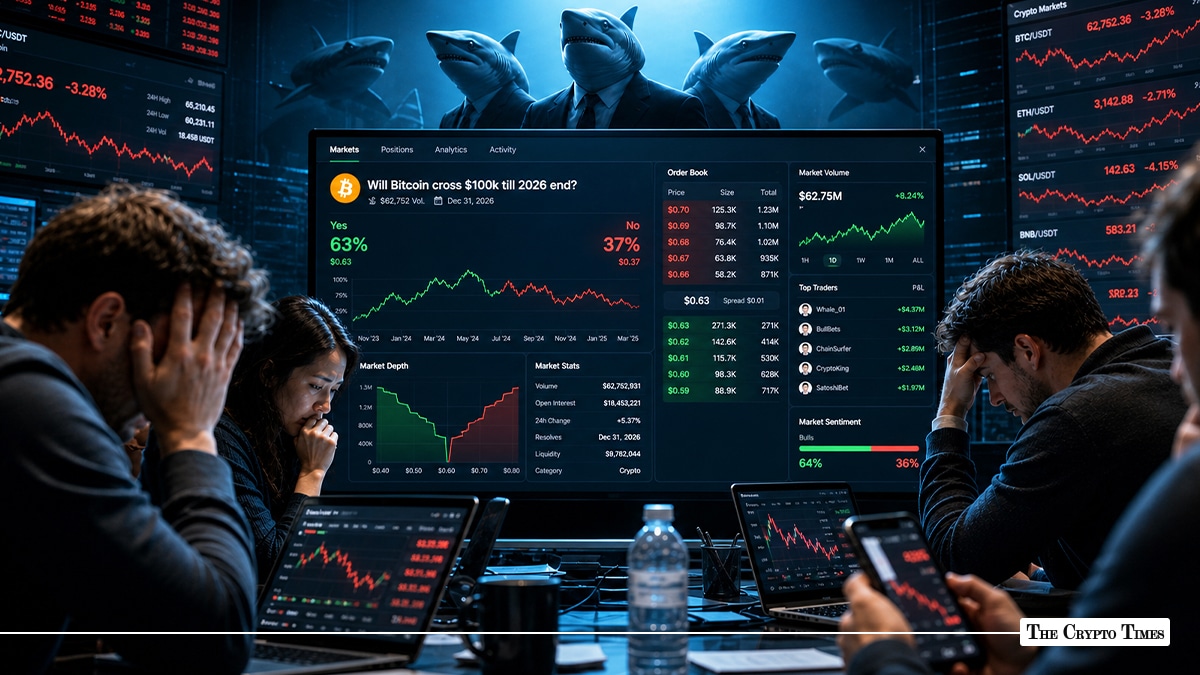
A new Wall Street Journal investigation has produced the most detailed empirical evidence to date on what insiders have called prediction markets’ “sharks and fish” structure: a small group of sophisticated professional traders, including major Wall Street firms with access to vast data streams, is systematically profiting at the expense of casual retail traders who advertise the platforms as “life-changing tools.”
The findings cut directly against the marketing pitches Kalshi and Polymarket have used to attract retail interest. “I was about to be unable to pay my rent, but I got two years of rent through Kalshi’s predictions,” reads one woman’s testimonial in a Kalshi TikTok ad cited in the WSJ piece. The Journal’s analysis of platform data tells a starkly different story for most users.
The Numbers
The WSJ analysis found:
- 70% of Polymarket users lose money — a finding consistent with separate academic research published last month by researchers in France and Canada, who concluded that gains on prediction markets “go almost entirely to sophisticated traders, while long-shot bets and unsophisticated traders take losses.”
- 67% of profits go to just 0.1% of accounts — meaning fewer than 2,000 accounts have netted nearly half a billion dollars in cumulative gains.
- The typical Polymarket user is down between $1 and $100.
- The least successful 10% of Polymarket traders have lost an average of $4,000 each.
- On Kalshi prediction markets—bets on whether public figures will say a specific word on TV — the Journal analyzed more than 35,000 markets and found that average “yes” bettors lose 11% of what they wager, a return the WSJ described as “worse than most Las Vegas slot machines.”
The Sharks: Wall Street’s Entry
The structural advantage held by the winning 0.1% is increasingly being formalized by professional trading firms entering the space:
Susquehanna International Group, the firm co-founded by billionaire Jeff Yass, is reportedly trading hundreds of millions of dollars per week through Kalshi, according to traders monitoring the platform’s order book.
Jump Trading is also active on the platform.
Citadel Securities President Jim Esposito told the Journal his firm is “absolutely keeping an eye” on the space.
Yass himself has been explicit about the opportunity. On a 2020 sports betting podcast cited in the WSJ piece, he described his role supporting what would become prediction markets as “an MFG, a mission from God”—before adding that he also expected “to make a lot of money.”
The presence of these firms creates a fundamental information asymmetry. Where retail traders are typically following gut instinct or news commentary, professional firms are deploying the following:
- Real-time data feeds from sports leagues, news wires, and government statistical agencies
- Proprietary models and algorithmic execution
- Latency advantages on order placement
- Cross-market arbitrage between prediction markets and adjacent betting venues
- Automated copy-trading detection (Polymarket itself has published research on copycat trading patterns)
The Anatomy of a Loss
The WSJ piece foregrounds the story of John Pederson, 33, a former Outback Steakhouse line cook in Detroit recovering from a car crash. Pederson took out a variable-interest loan and started betting on Kalshi.
Initially, the strategy worked. He turned $2,000 into roughly $8,000 betting on Detroit snowfall totals, then parlayed that into $41,000 trading sports using a strategy he developed with AI assistance. Then he placed his most audacious bet: all $41,000 that a celebrity would say a particular word on TV. He lost it all.
Pederson is a textbook example of the structural pattern. His sequence—small wins on niche local data (snowfall), larger wins where his amateur edge plausibly held (sports), and catastrophic loss on a market dominated by sophisticated traders (mention markets)—illustrates how prediction markets channel gambler-style risk-taking through the marketing language of finance.
Other cases cited by the WSJ include:
- A self-described problem gambler in Connecticut who lost $2,000 in one day betting on the Super Bowl on Kalshi during the fourth quarter
- A 31-year-old in Indiana who lost approximately $5,000 betting nearly daily on sports on Kalshi in the first months of 2026, describing the trading as “like a drug”
The Industry’s Response: It’s Working as Designed
Notably, prediction market insiders have not contested the structural pattern. Former Kalshi employee Adhi Rajaprabhakaran — who described casual traders as “fish” in a Substack post last year — told the WSJ that while he still considers casual traders fish in general, he believes the presence of uninformed traders is a powerful incentive for sophisticated traders to enter the markets, which results in more accurate forecasts.
“Everyone, when they make a trade, thinks they’re the more informed trader,” Rajaprabhakaran said. “In the long run, the people who are right more win more money. No one is being forced to do this.”
That framing — that retail losses are the fee that funds price discovery — is mathematically coherent but morally contested. It mirrors the long-standing argument used by sports books and casinos: that gambling is voluntary, transparent, and serves a legitimate informational or entertainment function.
The Industry’s Trajectory
The WSJ findings land at a moment when prediction markets are attracting unprecedented capital:
Kalshi is in funding talks at a roughly $22 billion valuation, with a revenue run rate reportedly above $1 billion annually and potentially reaching $1.5 billion. Sports-related contracts alone reportedly generate over $1 billion annually for Kalshi.
Polymarket is in talks to raise $400 million at a $15 billion valuation, with Intercontinental Exchange having previously committed up to $2 billion. The platform has also recently partnered with Chainalysis for compliance monitoring and Palantir for AI-powered surveillance.
Both platforms are now expanding beyond event contracts into perpetual futures, creating continuous trading exposure that could intensify the asymmetry the WSJ documented. Where event contracts settle and disappear, perps offer infinite duration—and infinite opportunities for the same retail-vs.-professional pattern to compound.
The Regulatory Backdrop
The WSJ findings will compound existing regulatory pressure. Multiple state and federal authorities have already taken action:
- Wisconsin sued Kalshi, Polymarket, Coinbase, Robinhood, and Crypto.com in April, alleging the platforms operate “unlicensed commercial gambling hubs.”
- California Governor Gavin Newsom signed an executive order in March banning state officials from using non-public information to trade on prediction markets.
- The U.S. Senate passed a resolution last week banning senators from participating in prediction markets.
- Federal prosecutors have already charged an active-duty Army soldier with insider trading on Polymarket using classified intelligence about U.S. military operations involving Nicolás Maduro.
Lawmakers Adam Schiff and John Curtis have proposed legislation that would severely restrict prediction contracts tied to sports and gambling-style events. The CFTC has also signaled an enforcement focus on insider trading, market manipulation, spoofing, retail scams, and money laundering on prediction platforms.