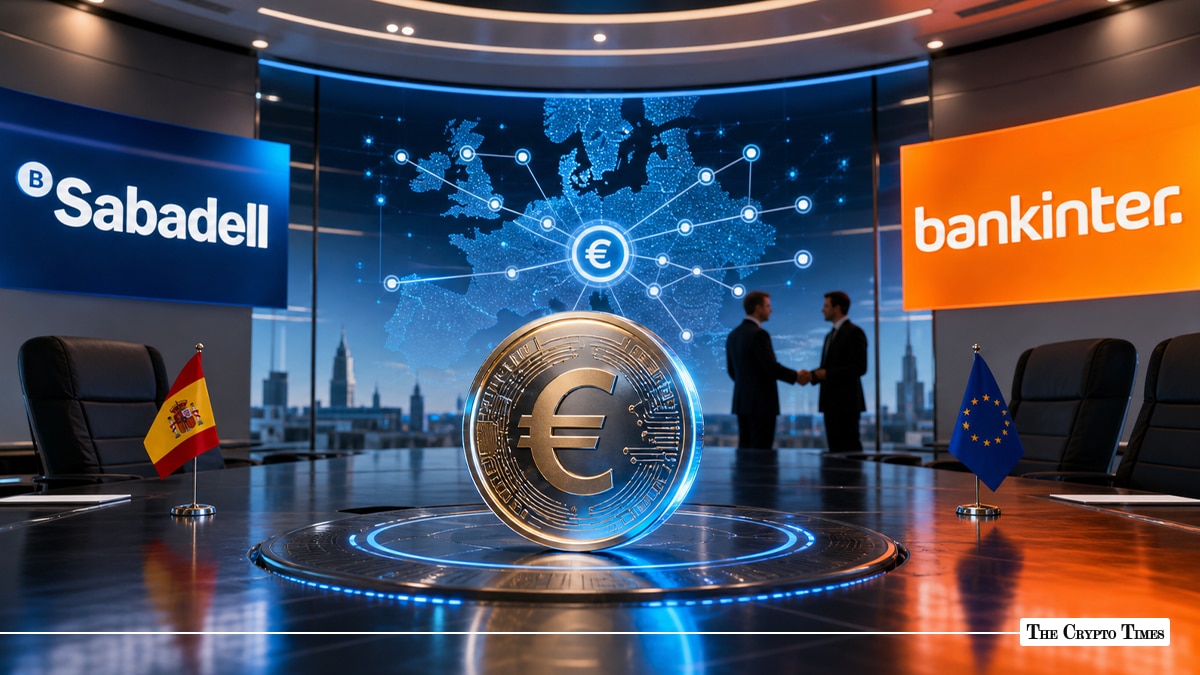
Europe’s banking sector is accelerating its push into digital assets, as more institutions move to join the Qivalis consortium—a powerful banking alliance focused on launching a euro-denominated stablecoin. Spanish lenders Banco Sabadell and Bankinter are in advanced discussions to join the Amsterdam-based initiative, alongside other institutions such as Kutxabank, Abanca, and Cecabank.
According to a report by Expansion, the consortium is expected to formally announce new members in the coming weeks as it finalizes participation, with a broader rollout of its stablecoin planned for the second half of 2026.
Strength across Europe
Qivalis was formally incorporated on December 2, 2025 by CaixaBank and nine other major European banks: Banca Sella, CaixaBank, Danske Bank, DekaBank, ING, KBC, Raiffeisen Bank International, SEB, and UniCredit. Since then, the alliance has expanded to include key players such as BNP Paribas, BBVA, and ING.
Sources at Bankinter indicate that more banks are exploring participation, highlighting growing industry alignment around stablecoin adoption. Notably, BBVA had previously planned to launch its own stablecoin but later opted to collaborate within the consortium to combine efforts.
A spokesperson familiar with the matter noted that discussions are ongoing, with updates expected in early summer as banks finalize their roles within the project.
The consortium is led by CEO Jan-Oliver Sell, the former CEO of Coinbase Germany, with Sir Howard Davies, former Chairman of NatWest Group and the UK Financial Services Authority, serving as Chairman of the Supervisory Board.
European payment independence
A primary motivation behind the Qivalis initiative is geopolitical: strengthening Europe’s autonomy in digital payments. Currently, the global stablecoin market is heavily skewed toward U.S. dollar-pegged assets like USDT and USDC, which account for roughly 99% of all on-chain liquidity.
By developing a European-made stablecoin, institutions aim to stay competitive and avoid falling behind in the rapidly evolving global financial ecosystem. The initiative leverages blockchain technology to streamline financial operations. Unlike traditional payment systems, where institutions operate separate databases, a shared blockchain infrastructure allows for synchronized, real-time data access.
This unified approach eliminates intermediaries, reduces operational inefficiencies, and enables faster, lower-cost global transactions. The growing involvement of major banks in stablecoin projects also signals a broader shift in traditional finance—from cautious observation to active participation in blockchain innovation.
As regulatory clarity improves and use cases expand, stablecoins are emerging as a critical bridge between traditional banking and the digital asset economy.
With Qivalis gaining momentum, Europe appears increasingly determined to carve out its own space in the future of global digital payments.
Also read: Circle Secures MiCA Approval to Expand Crypto Services Across Europe