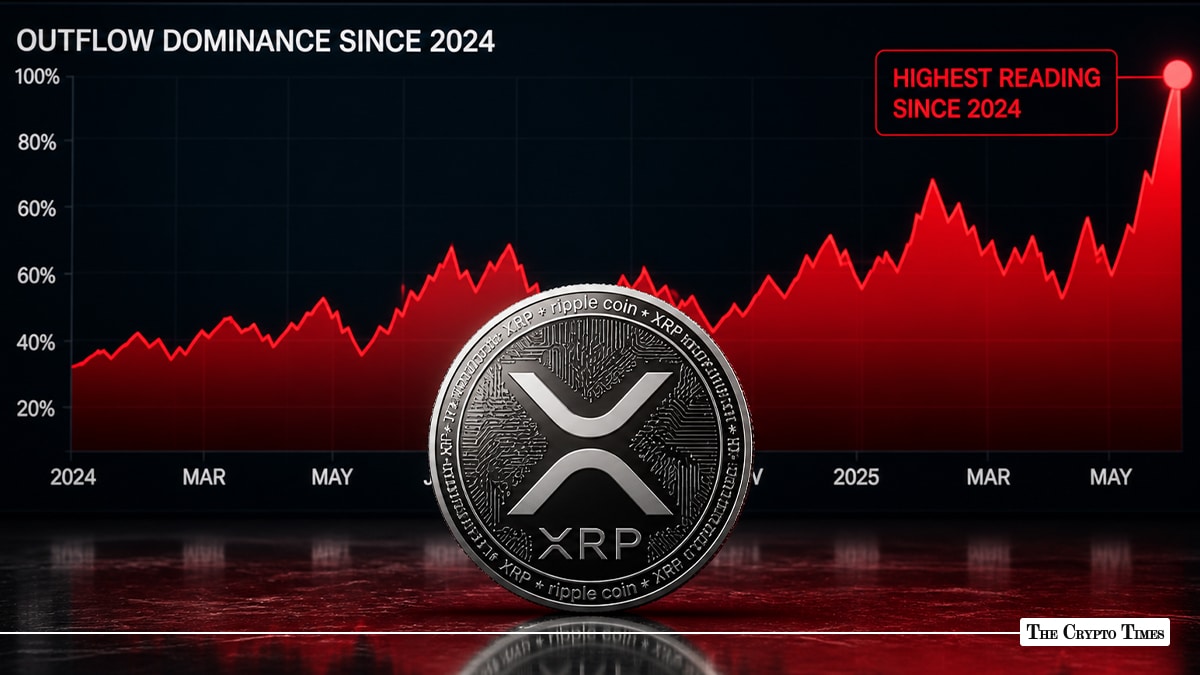
XRP’s centralised exchange outflow structure has shifted sharply toward large holders, producing one of the clearest whale-led readings since 2024 — and creating an exact structural inversion of the retail-driven setup that preceded the token’s 61%+ decline from its July 2025 cycle peak.
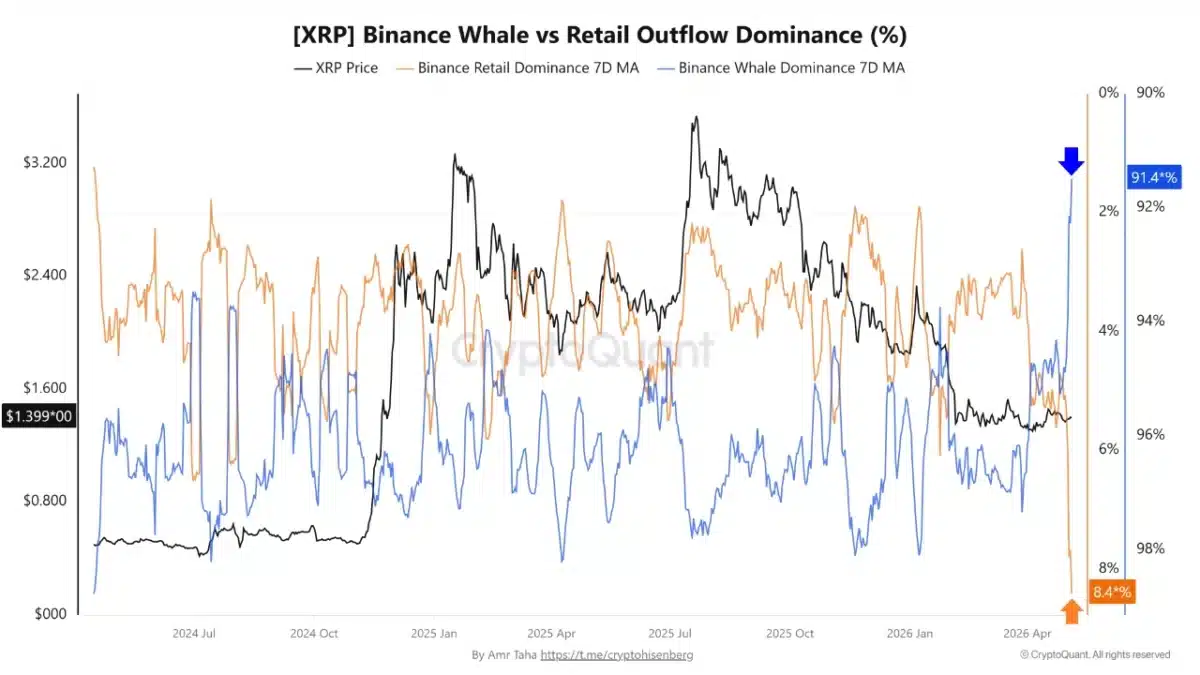
According to a CryptoQuant Quicktake post by analyst Amr Taha, Binance’s XRP Whale Outflow Dominance has climbed to 91.4%, while Retail Outflow Dominance has dropped to 8.4% — meaning the overwhelming majority of XRP leaving Binance is now being driven by whale-sized transfers rather than smaller retail-sized flows.
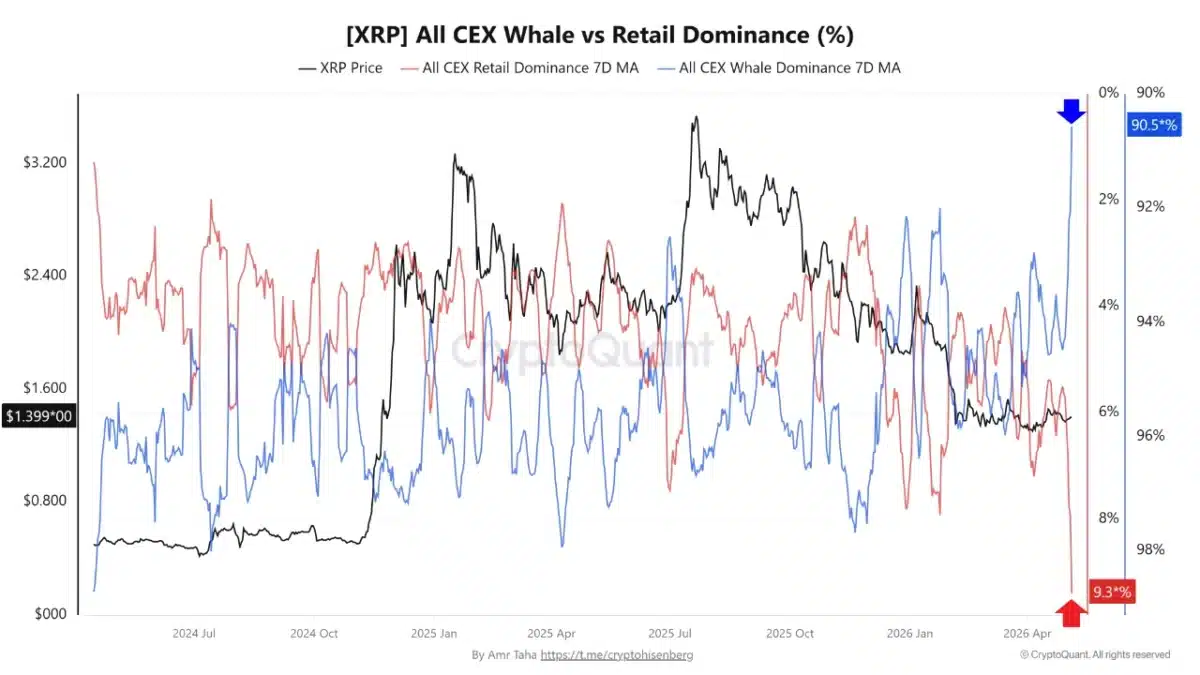
The same pattern is also visible across the broader exchange market. All CEX Whale Dominance has climbed to 90.5% — its highest level since 2024 — while All CEX Retail Dominance has fallen to 9.3%, its lowest level since 2024. This confirms that the whale-led outflow regime is not isolated to Binance but extends across the centralised exchange complex.
XRP currently trades at approximately $1.40, having spent recent weeks consolidating in a tight range while testing the upper boundary of a symmetrical triangle pattern that traders have been watching for breakout direction. Per TCT’s prior coverage, a daily close above $1.45 would mark a breakout from the nearly three-month consolidation, with measured-move targets toward $2.15.
The Mechanics of the Signal
The Outflow Dominance metric tracks who is responsible for moving XRP off exchanges, classified by transaction size. Whale-sized transfers (typically wallets handling >1 million XRP) being responsible for 91.4% of Binance outflow value means that for every 100 XRP units leaving the exchange, approximately 91 are tied to large-holder activity.
Taha noted that when readings on the metric reach the current levels — meaning whale dominance climbs significantly above 85-90% — it signals that “larger-sized transfers are taking over.” Historically, October 2024 was one such moment, followed by a similar reading in June 2025. Both of those instances preceded notable upside moves in XRP’s price.
That said, the analyst was careful to caveat the interpretation: exchange outflows can occur for several reasons, including movement to cold storage, custody changes, internal exchange operations, OTC settlement, and strategic repositioning. Whale-led outflow does not automatically confirm accumulation. What it does confirm with certainty is that larger players, not retail traders, are responsible for current outflow activity — and that distinction is itself the signal.
The Mirror Image of July 2025
The most editorially significant context in Taha’s analysis is the explicit comparison to July 2025, when the dominance configuration was reversed and XRP was approaching its cycle peak.
At the time, retail dominance reached one of its strongest levels on the indicator near 2%, while XRP traded close to its cycle peak around $3.5. The retail-heavy outflow structure was followed by a sharp decline of more than 61%, illustrating how fragile the market became when smaller participants were highly visible near the top.
The mirror image is striking. In July 2025, when XRP traded at $3.5 with retail dominance near 2%, the token was structurally vulnerable. In May 2026, with XRP at $1.40 and whale dominance near 91% (Binance) and 90.5% (all CEXs), the structural configuration is the inverse — at least on the outflow signal alone.
This does not automatically confirm a bullish reversal. But it does mean that the on-chain data is presenting the cleanest mirror image of the pre-crash setup that XRP has shown since the July 2025 top — a structural shift that on-chain analysts argue has predictive value when paired with other accumulation signals.
The Broader Whale Activity Context
The May reading lands within an established multi-month pattern of XRP whale activity. Per Santiment data, the XRP network has added a net 42 millionaire wallets (addresses holding at least 1 million XRP) since the start of 2026 — the first increase in that specific cohort since September 2025.
Goldman Sachs has emerged as the single largest disclosed institutional XRP ETF holder, with a $153.8 million position spread across four ETF products.
XRP ETF flows have similarly turned positive in April 2026, with inflows on 11 of the last 13 trading days totalling roughly $81.59 million per SoSoValue data — reversing March’s $31.16 million of outflows and putting the products on track for their strongest monthly inflows since December 2025.
The current 91.4% / 90.5% whale dominance reading is therefore not an isolated signal. It compounds with rising ETF inflows, growing millionaire-wallet counts, declining exchange balances, and whale-flow indicators that have all moved in the same direction since March.
What’s Different This Time
Three things distinguish the current setup from prior whale-dominance readings:
1. The breadth. Earlier whale-outflow signals were typically Binance-specific. The current reading shows the pattern extending across the entire CEX complex, with All CEX dominance at 90.5%. That breadth makes the signal harder to dismiss as exchange-specific behaviour.
2. The retail collapse. It’s not just that whales are dominant — retail outflow share has collapsed to 8.4% on Binance and 9.3% across all CEXs, the lowest readings since 2024. This is a regime change in the composition of outflow flow, not just a temporary tilt.
3. The timing relative to the cycle. Whale-led outflow at $3.5 (July 2025 peak) would suggest distribution. Whale-led outflow at $1.40 (current) — after a 61% drawdown from peak — suggests accumulation by holders who are buying weakness. The timing alignment is materially different.
What the Analyst Did NOT Say
Taha explicitly said: “This does not automatically confirm accumulation, because exchange outflows can happen for several reasons. However, the structure clearly shows that XRP’s current outflow activity is being led by larger players rather than retail traders.”
The cleanest read, then: the on-chain data has set up a structurally bullish configuration that mirrors the inverse of the pre-crash July 2025 setup. Whether that translates into a price-level breakout depends on whether the whale-led outflow ultimately proves to be accumulation or redistribution — a distinction that will only become clear in retrospect.
Also Read: Bitcoin ETFs See $532M Inflows as Institutional Demand Holds