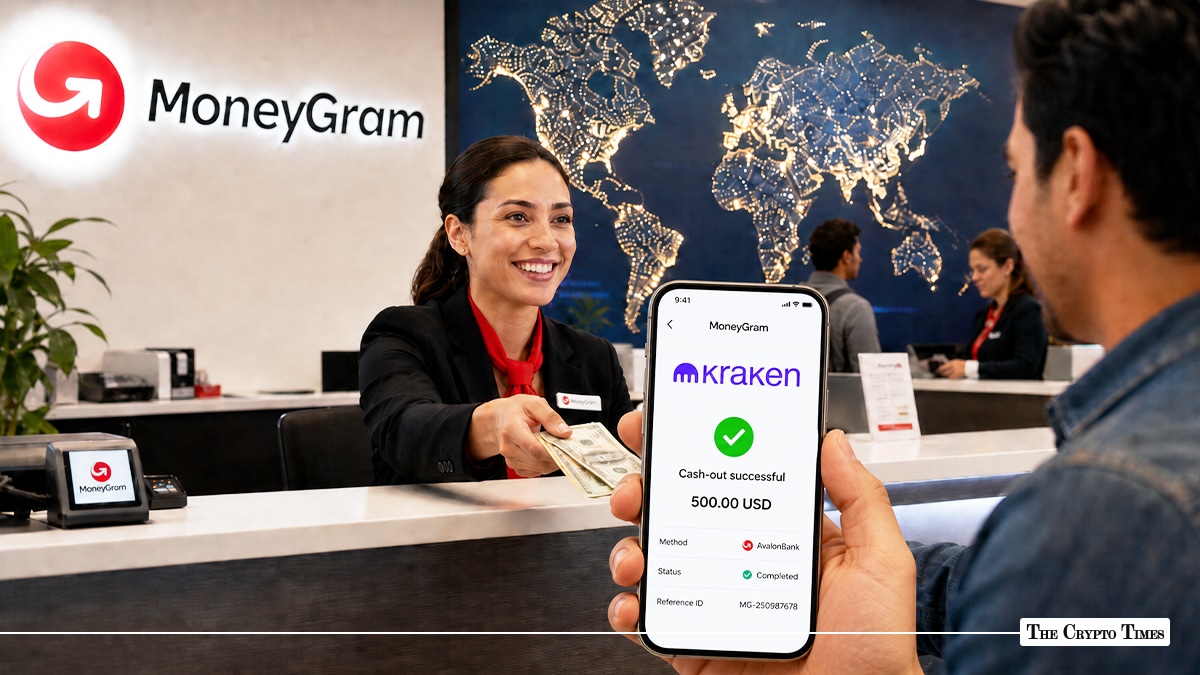
Kraken, one of the leading crypto exchanges, has partnered with MoneyGram to let users cash out digital assets at nearly 500,000 physical locations spanning more than 100 countries.
The tie-up, announced exclusively by Fortune, will allow Kraken customers to convert their crypto into fiat and withdraw cash through MoneyGram’s extensive global network. Variable fees will apply depending on location and transaction size.
MoneyGram is a one of the leading global financial technology companies specializing in international money transfers, remittances, and payment services, operating one of the world’s largest cash networks.
The partnership seeks to address the core frustration of slow, expensive, or geographically limited off-ramping—the process of converting cryptocurrency into traditional fiat currencies—for many users.
While on-chain crypto transfers are often instant, converting those holdings back into spendable cash has remained a major bottleneck, particularly for users outside major financial hubs who rely on limited bank wires or face regulatory restrictions.
Pain point for users in volatile markets
Kraken co-CEO Arjun Sethi told Fortune that the exchange’s customers, especially those in countries with unstable local currencies, increasingly treat the platform like a bank. They hold USD or stable assets, earn yield, make payments, and transfer funds across borders. Yet the final step — getting money out — has long been a weak link.
“That off-ramp is really important,” Sethi said.The service could be particularly useful in emerging markets, where cash is still dominant and reliable banking options are limited.
By plugging into MoneyGram’s brick-and-mortar footprint, Kraken hopes to make crypto more functional for daily needs beyond trading and speculation. This development is especially timely as many users in regions like Latin America, Africa, and parts of Asia have turned to stablecoins and crypto exchanges as hedges against inflation, currency devaluation, and capital controls.
In countries where local banks impose strict withdrawal limits or charge exorbitant fees, the ability to access physical cash quickly through a trusted network like MoneyGram could significantly boost adoption.
It bridges the gap between digital finance and everyday economic realities, allowing users to pay for groceries, bills, or emergencies without relying solely on volatile local banking systems or informal channels.
MoneyGram’s digital push
The agreement reflects MoneyGram’s ongoing transformation. Long associated with traditional money transfers and paper orders, the company has faced rising pressure from fintech competitors.
In response, it has rolled out a noncustodial crypto wallet, integrated stablecoins, and expanded its digital offerings. CEO Anthony Soohoo described the Kraken collaboration as “just another step in that process of digitizing.”
MoneyGram was taken private by a private equity firm in 2023 to support its modernization. Over the past several years, the company has actively embraced blockchain technology to remain competitive in a rapidly evolving payments landscape. Its partnerships with networks like Stellar have enabled faster, lower-cost remittances using stablecoins, while its noncustodial wallet allows users to hold and transfer digital assets without fully relinquishing control.
This shift from legacy money-order services to hybrid fiat-crypto solutions reflects broader industry trends, where traditional players are digitizing to capture growing demand for cross-border payments.
The Kraken deal further strengthens MoneyGram’s position by leveraging its massive physical agent network as a critical on-and-off ramp for digital assets, potentially increasing transaction volumes and attracting younger, tech-savvy users who prefer seamless crypto-to-cash experiences.
Kraken’s expansion moves
For Kraken, the partnership aligns with its broader push to grow beyond its trading roots. The company filed for an initial public offering (IPO) last November and has acquired futures exchange NinjaTrader and derivatives platform Bitnomial over the past year. Now improving off-ramp options forms part of its effort to boost usability for everyday customers.
Exact rollout dates, supported assets, and full fee details were not released. The companies said the service would launch soon.
While MoneyGram has experimented with crypto before, the scale of this network integration sets it apart. Whether it drives significant usage will depend on pricing competitiveness, regulatory clearance across jurisdictions, and how smoothly the experience works on the ground.
Kraken’s strategy appears focused on building a more comprehensive ecosystem that appeals not only to sophisticated traders but also to retail users seeking practical utility. By enhancing cash-out capabilities, the exchange aims to increase user retention and transaction activity, particularly among its international customer base.
The acquisitions of NinjaTrader and Bitnomial have already expanded its derivatives and futures offerings, positioning Kraken as a full-service platform ahead of its anticipated public debut. This MoneyGram integration complements those moves by tackling infrastructure gaps that have historically hindered wider adoption, potentially differentiating Kraken from competitors still reliant on slower or more restricted fiat channels.
This partnership represents another milestone in the gradual convergence of traditional finance and cryptocurrency infrastructure.
As regulatory environments mature and user expectations evolve, initiatives like this could help normalize crypto as a viable alternative or complement to conventional banking systems. Success will hinge on execution, but the potential to unlock greater accessibility in underserved markets makes it a noteworthy development for the industry.
Also read: Coinbase Slashes 14% of Staff in Major Pivot to ‘AI-Native’ Operating Model