Key Highlights
- Circle submitted comments on the OCC’s GENIUS Act framework.
- It advocates for U.S.-led global standards in stablecoin regulation.
- The firm also distinguishes payment stablecoins from tokenized deposits.
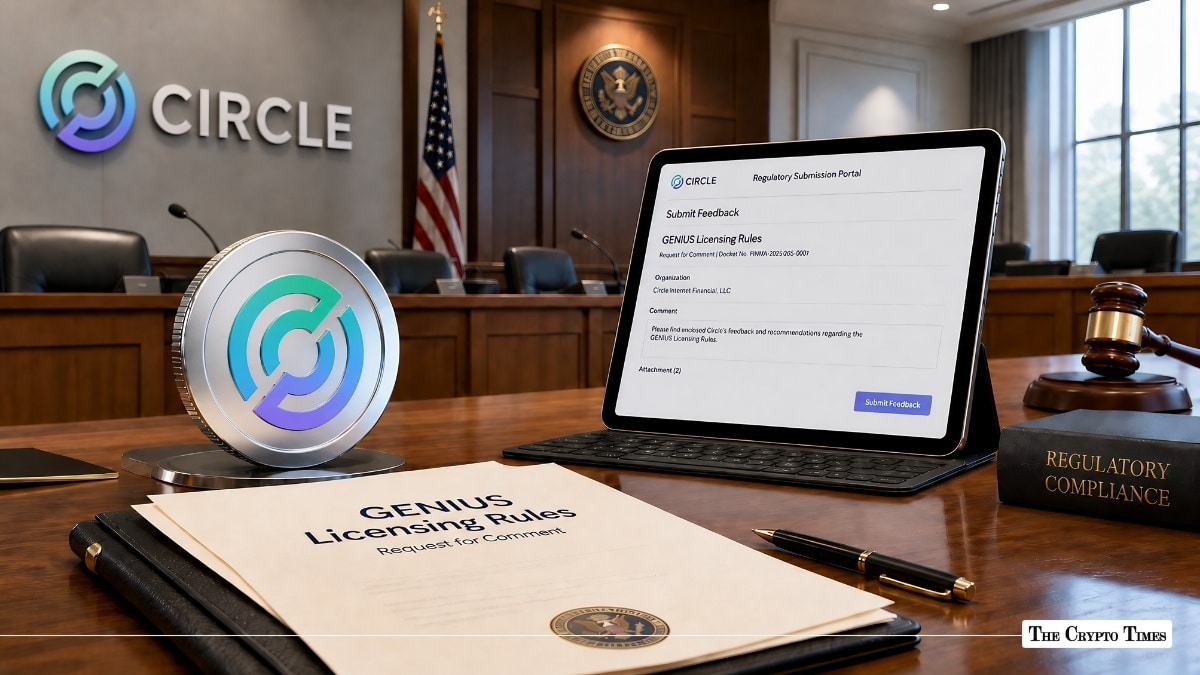
Circle, the issuer of the USDC stablecoin, has officially submitted its comment to the OCC regarding the implementation rule of the GENIUS Act.
With the submission made on May 1, the firm’s participation in regulatory dialogue reflects ongoing efforts in the U.S. to establish a comprehensive national framework for payment stablecoins.
Concerns highlighted by Circle
According to the official blog post, Circle outlined several key principles in its comment. First, U.S. standards should lead the globe, placing American regulation and the rule of law as the international benchmark for trusted digital dollars.
Secondly, they underscored that regulated payment stablecoins must act as one unified instrument, fully transferable, fungible, and interoperable over platforms and borders to ignore fragmentation that could undermine liquidity and redemption.
Consumer protection remains at the forefront of concerns. Circle emphasized that issuers should ensure that there is an effective redemption mechanism for their stablecoin holders around the world, which will bolster confidence in the fundamental commitment of allowing users to exchange their stablecoins for fiat currency whenever they want.
The company also stressed the importance of stringent guidelines that would ensure that products cannot be labeled as “stable” unless they have undergone rigorous oversight processes to protect the interests of consumers and companies without having to analyze the intricacies of disclosure statements.
Further highlighting concerns
Circle further pointed out the necessity of treating all issuers equally, irrespective of whether they are banks or nonbanks and whether they are domestically based or operate overseas. Additionally, the company highlighted the need for risk management frameworks proportionate to stablecoins’ role as payment and settlement instruments, covering credit, liquidity, concentration, operational, and anti-money laundering risks.
One of the distinctions highlighted by the proposal is that between payment stablecoins and tokenized deposits. According to Circle, the Congress specifically excluded tokenized deposits from the scope of the GENIUS Act, given their divergent functions.
Payment stablecoins can be used for wide-scale transfers and settlement. In contrast, tokenized deposits represent a bank’s liability and thus need to be regulated differently.
GENIUS Act and OCC’s proposed rule
The GENIUS Act has become an important step towards the implementation of the first-ever regulatory framework for payment stablecoins. As regards the OCC’s proposed rule, it embodies the key principles of this Act, such as solid reserves, reliable redemptions, prudent risk management, proper supervision, and high compliance standards.
The rule covers aspects like reserve management, information security, operational robustness, and 24/7 operability of the system.
Circle stated that the GENIUS Act is a milestone in the development of USD-backed digital currencies and that the OCC’s rulemaking process is important in translating legislative intent into practical implementation.
Influencing international regulatory approach
The stablecoin ecosystem continues to expand, with payment stablecoins playing a growing role in global finance. The implementation of the GENIUS Act by the OCC could influence regulatory approaches beyond the U.S.
Circle’s participation highlights ongoing industry engagement with regulators. As the comment period continues, it remains to be seen how the U.S. will balance innovation with risk management in shaping future stablecoin policy.
Also Read:Securitize Bets Big on Tokenized Stocks With Solana Push