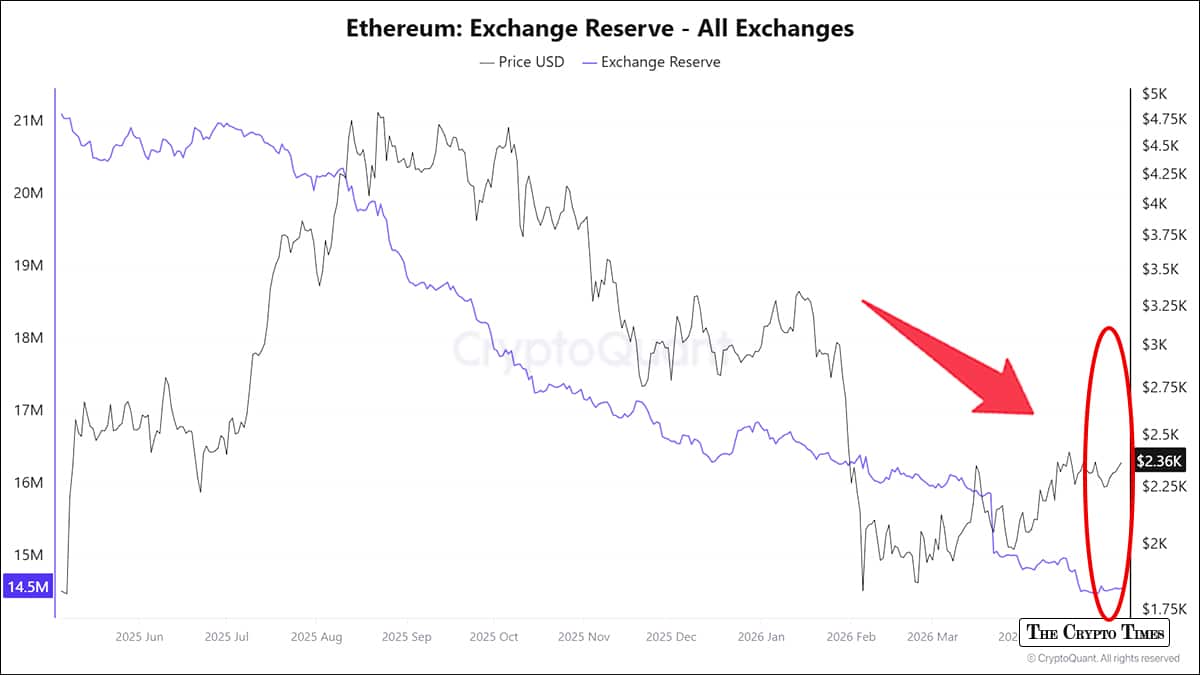
Ethereum holders are pulling coins off centralized exchanges at a record pace, with total reserves dropping to their lowest level in the metric’s history.
As of early May 2026, the amount of ETH sitting on all major exchanges combined has fallen to roughly 14.55 million tokens, according to CryptoQuant’s live exchange-reserve chart.
That figure marks a fresh low, eclipsing the previous troughs seen earlier this year and pushing the metric back to levels last observed when Ethereum was still in its infancy around 2016.
The decline is no blip. From the 2021 bull-market peak near 35 million ETH, reserves have been carved down by more than half. The slide accelerated in 2025 and has continued relentlessly into 2026. At the start of the year the total hovered around 16.2 million; by late April it had already broken below 15 million.
The chart shows an almost unbroken downward slope over the past several months, with only minor daily wiggles that have failed to produce any meaningful rebound.
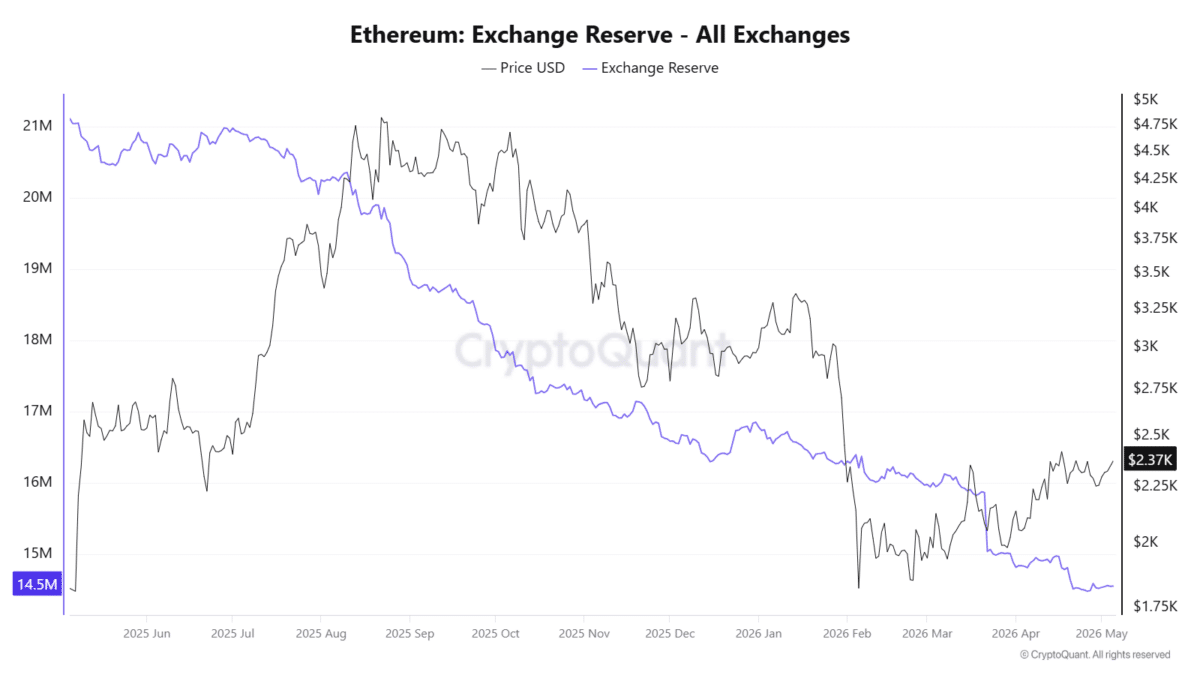
The chart shows that more ETH is moving into cold storage, self-custody wallets, or locked in staking contracts—which now hold more than 38 million tokens. The shift makes fewer coins available for immediate trading; leading to less potential sell pressure if prices rise.
In dollar terms, the aggregate reserve value has shrunk to roughly $31.8 billion—also a record low—primalry as ETH trades well below its previous high.
At the time of publishing, ETh price traded at $2,376—up 16% in the past 30 days but overall down 53% from its all-time high of $4,953, marked in August 2025—as per CoinMarketCap data.
What data reveals about market behavior
This trend is not unique to Ethereum but appears more pronounced here due to the network’s mature staking ecosystem. With over one-third of the total ETH supply now committed to staking, participants are earning yields while removing tokens from circulation.
On-chain analysts note that similar reserve drawdowns in previous cycles often preceded strong price recoveries once demand returned.
Binance, the largest exchange by volume, has seen its own ETH holdings drop to multi-year lows near 3.3 million tokens. Other major platforms including Coinbase and OKX have reported comparable outflows.
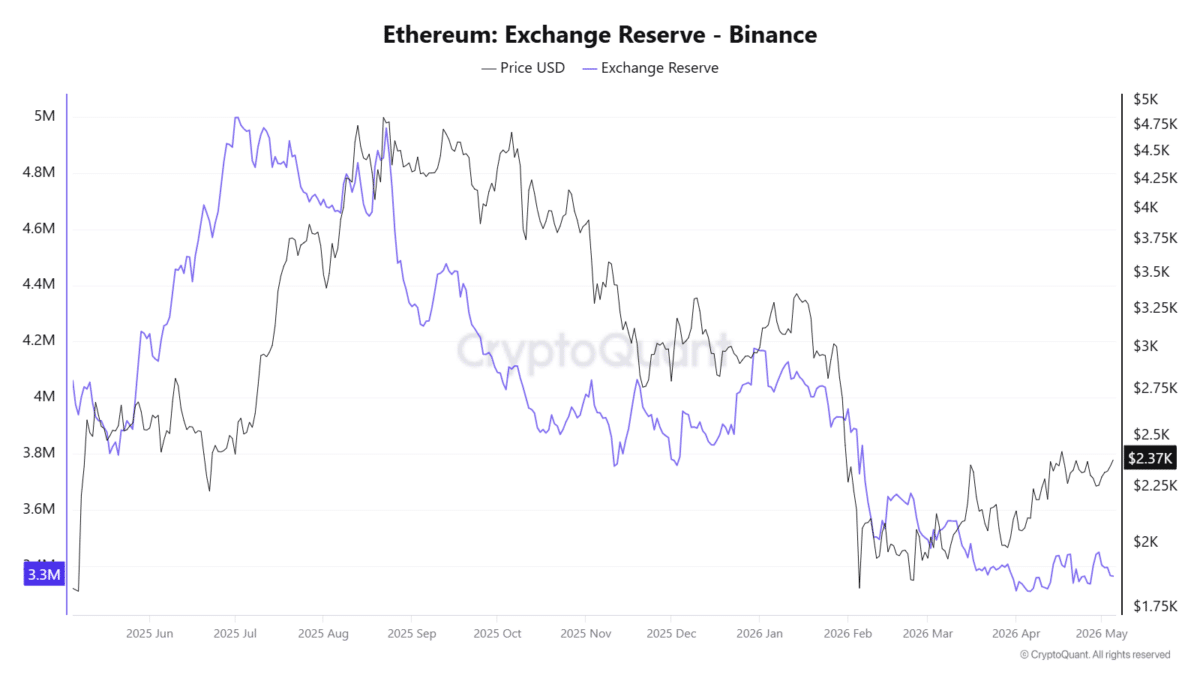
These movements suggest that sophisticated investors and institutions are increasingly favoring self-custody solutions and decentralized finance (DeFi) protocols over leaving assets on centralized platforms.
Market observers point to several drivers behind the exodus. Heightened awareness of custody risks following past exchange failures, improved wallet usability, and the appeal of staking rewards have all played a role.
Additionally, Ethereum’s transition to a proof-of-stake (PoS) consensus mechanism continues to incentivize holding rather than trading.
ETH ETF funds amplify supply narrative
The shrinking exchange reserves are occurring alongside renewed institutional interest through U.S. spot Ethereum ETFs. On May 4, 2026, ETH ETFs recorded $61.29 million in net inflows, with BlackRock’s offerings leading the charge. Just days earlier on May 1, the funds saw a strong $101 million inflow, breaking a brief outflow streak.
As per SoSoValue data, U.S. spot ETH ETFs currently hold $13.97 billion of assets—representing nearly 5% of ETH supply.
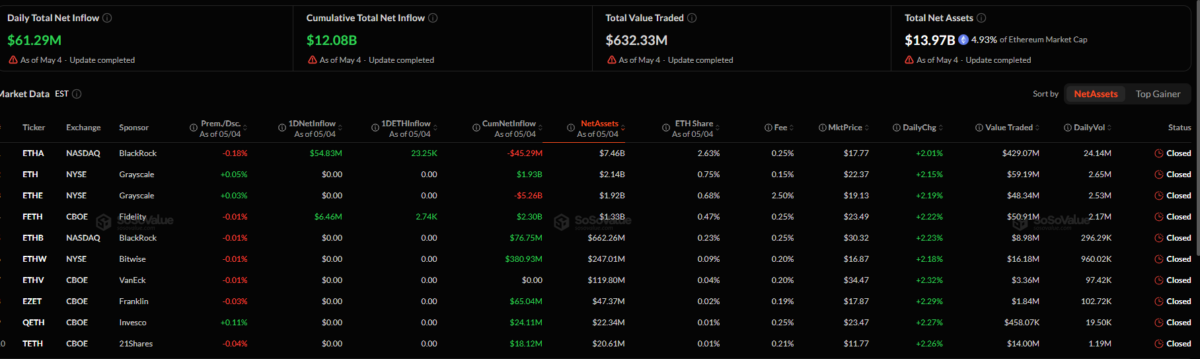
These consistent institutional purchases are mechanically absorbing available ETH supply and reinforcing the bullish on-chain setup. This combination of record-low exchange balances and steady ETF demand creates a powerful supply-demand imbalance.
BlackRock and Fidelity have been the most aggressive buyers, signaling growing confidence from traditional finance players even as retail sentiment remains cautious.
Implications for the broader Ethereum ecosystem
With broader market sentiment remaining choppy amid macroeconomic uncertainty, the onchain data nevertheless paints a picture of conviction. Long-term holders are betting on the network’s future rather than flipping tokens on exchanges.
Some analysts argue that ultra-low exchange reserves create conditions for a violent short squeeze if positive catalysts emerge—such as increased institutional adoption, successful layer-2 scaling upgrades, or renewed ETF inflows. Others caution that reduced liquidity on exchanges could also amplify downward volatility during risk-off periods.
Ethereum’s fundamentals remain robust despite the price correction from 2025 highs. The network continues to lead in decentralized application activity, total value locked in DeFi, and developer mindshare. Upcoming protocol improvements aimed at further enhancing scalability and reducing fees could attract fresh capital.
Whether the squeeze translates into higher prices remains to be seen. With the broader market sentiment being choppy, on-chain data paints a picture of conviction as long-term holders are betting on the network’s future rather than flipping tokens on exchanges.
Also read: Bitcoin ETFs See $532M Inflows as Institutional Demand Holds