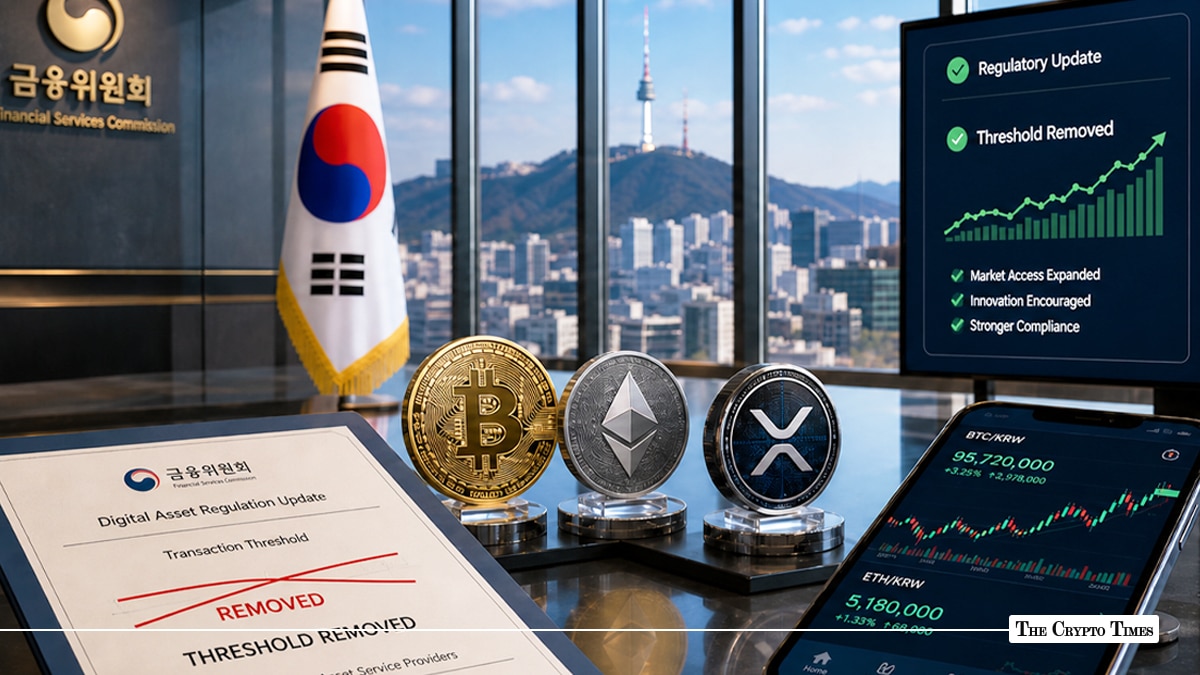
South Korea is moving to tighten rules on crypto transfers, and the industry is reacting with concern. Regulators plan to apply the Travel Rule to all transactions, removing the current 1 million won threshold. This means both sender and receiver will need full verification before any transfer goes through. As a result, companies warn that transactions could take longer and users may face losses if prices move during delays.
As per a local report, the proposal is an amendment to the enforcement decree of the Act on Reporting and Use of Specific Financial Transaction Information by the Financial Services Commission (FSC) and Financial Intelligence Unit (FIU), which says the goal is to improve oversight of virtual asset activity. However, 27 local firms, represented by the Digital Asset Exchange Association (DAXA), have pushed back. They argue the new rules could disrupt how exchanges operate and shift financial risks onto users. The discussion has now turned into a debate over how to tighten regulation without harming everyday users.
Industry flags transaction delays and user losses
Crypto firms warn that the new rules could significantly slow down deposits and withdrawals. Both sending and receiving platforms must verify user details before completing any transfer. Additionally, they must reject transactions that lack full information. However, blockchain systems do not easily support rejection once a transaction is initiated.
Exchanges may have to rely on return procedures instead of simply rejecting transactions. This process can take time, and in the meantime, prices can move sharply. As a result, users may end up losing money while their funds are still being processed.
Industry players also say responsibility becomes unclear when disputes arise between exchanges and users. In such cases, it is not always clear who should cover any losses, which could lead to disagreements and delays in resolving issues.
Moreover, firms point to added risks in cross-border transactions. Overseas exchanges may refuse to comply due to different regulatory standards. An industry official said cooperation remains unlikely because of data privacy concerns. Hence, international transfers could face longer delays or even fail entirely.
Regulatory push meets market weakness
Regulators continue to defend the proposal as part of broader anti-money laundering efforts. The Financial Intelligence Unit plans to meet with local exchanges after May 11 to address concerns. An official said, “We will meet directly with exchanges to resolve misunderstandings.” The agency added that it aims to introduce rules the industry can realistically follow.
However, the timing raises concerns as South Korea’s crypto market shows signs of weakening. Data from the Bank of Korea shows total holdings fell sharply to 60.6 trillion won. Trading volumes and exchange deposits have also dropped in recent months, pointing to softer investor activity.
At the same time, demand for stablecoins has continued to rise. This trend suggests investors are shifting toward safer digital assets during uncertainty. As a result, stricter rules could add pressure to a market that is already losing momentum.
Global standards and policy tensions
Industry players say South Korea’s approach goes beyond global standards. The Financial Action Task Force recommends a $1,000 threshold for Travel Rule compliance. Meanwhile, other regions apply higher limits or more flexible rules. However, South Korea now plans to remove the threshold entirely, widening the scope of oversight.
Critics say the rules treat all crypto transactions as risky by default. They warn that this could make it harder for users to access services and limit how they use their assets. As a result, the discussion has shifted to a broader issue, balancing stricter regulation with the need to keep the crypto sector open to innovation.
Also Read: Circle Secures MiCA Approval to Expand Crypto Services Across Europe