Crypto venture capital (VC) is going through a recalibration. The numbers from Q1 2026 show a market that is shrinking in volume but concentrating in conviction.
According to data from crypto-fundraising.info, venture capital deal count in the crypto space fell 48.9% year-on-year, from 358 rounds in Q1 2025 to just 183 in Q1 2026. Total disclosed capital came in at $4.77 billion, an 11.1% decline. But here is the part that matters: the average disclosed deal size jumped 76.4%, from $20.3 million to $35.9 million.
In simple terms, investors are writing fewer checks, but the checks they are writing are significantly bigger. The market has moved from a spray-and-pray approach to a flight-to-quality model.
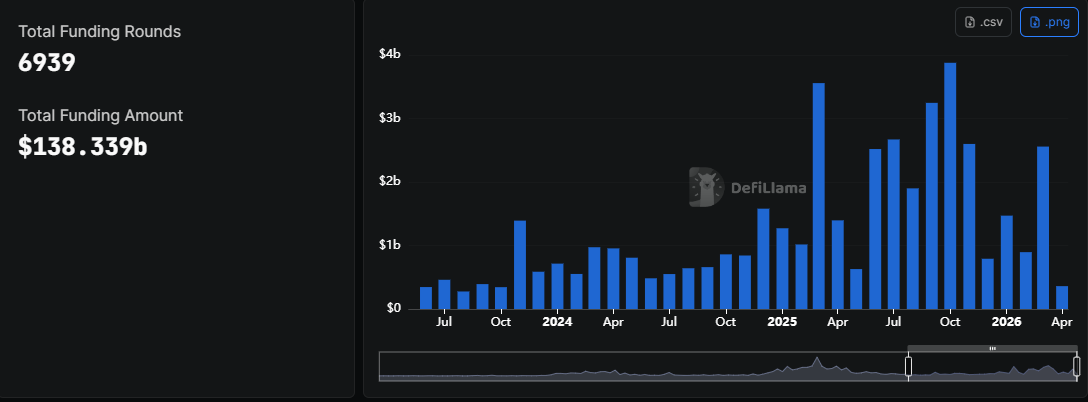
This pattern is visible across every major data source. DefiLlama data shows that 53 projects secured funding exceeding $10 million each during Q1. The prediction market sector alone attracted $1.67 billion across three transactions, followed by payments at $679 million across nine deals, and trading applications at $417 million across six deals.
And the investors showing up are not just crypto-native firms. Sequoia Capital, Founders Fund, Bain Capital, and Alibaba Group all participated in Q1 rounds, signaling that traditional finance and tech investors see this downturn as a buying opportunity rather than a reason to pull back.
Coinbase Ventures was the most active investor in Q1 2026, participating in 12 deals, more than double the next most active firm (Tether at 8 deals). Andreessen Horowitz (a16z), Castle Island Ventures, Big Brain Holdings, and Galaxy Digital each participated in five deals.
Where the money is going: Four themes dominating 2026
The Q1 data reveals clear concentrations of capital. When you look at where the biggest checks are being deployed and where the most active investors are placing their bets, four themes stand out: tokenization, specialized trading infrastructure, next-generation DeFi, and AI agents.
These are the same themes that Coinbase Ventures had outlined in its investment priorities blog late last year, and they are now playing out in real time across the funding landscape.
Tokenization: Real-world assets moving on-chain
The tokenization of real-world assets has moved from a theoretical concept to an active investment category. Perpetual exchanges like Hyperliquid have seen their volumes grow into the billions, and the broader market for bringing stocks, commodities, and macro instruments on-chain is expanding rapidly.
BlackRock CEO Larry Fink, in his 2026 annual shareholders’ letter, projected that the tokenization market could grow to $20 trillion by 2030, covering stocks, ETFs, indices, and commodities. That figure represents roughly a 754x jump from current levels. Major platforms like RobinHood, Grayscale, and Kraken have already launched tokenized stock products.
Coinbase Ventures described this trend as the “perpification of everything” in its November 2025 blog, noting that perpetual contracts can create synthetic exposure to virtually any asset without requiring custody of the underlying. The firm sees two directions here: on-chain macro exposure (allowing traders to position around energy prices, inflation breakevens, credit spreads, and volatility) and entirely new market categories that are difficult to tokenize traditionally but easy to replicate synthetically.
Specialized exchanges and trading infrastructure
Institutional market infrastructure is the second area where capital is concentrating. This includes proprietary automated market makers (Prop-AMMs), verticalized trading applications, and prediction market aggregators.
Bernstein has forecasted that the institutional crypto trading market could more than triple from $5 billion in 2024 to $18 billion by 2030, with the U.S. market share surging from 7% to 20%.
This theme found its most significant validation this week.
On April 14, Deutsche Borse, the operator of the Frankfurt Stock Exchange, announced a $200 million investment in Kraken’s parent company Payward through a secondary share transaction. The deal gives Deutsche Borse a 1.5% fully diluted stake and values Kraken at approximately $13.3 billion, a notable markdown from the $20 billion valuation the exchange achieved during its November 2025 funding round, when Citadel Securities participated in an $800 million raise.
The investment deepens a strategic partnership first announced in December 2025. According to Deutsche Borse’s official statement, the partnership now encompasses regulated crypto trading, tokenized markets, derivatives, and enhanced liquidity for institutional clients across geographies. The transaction is expected to close in Q2 2026, subject to regulatory approval.
There is more. Kraken co-CEO Arjun Sethi confirmed at the Semafor World Economy Summit on the same day that the company has filed a confidential IPO application with the SEC. No pricing or timeline was disclosed, but the filing is reported to be active and moving forward.
It is worth noting that this is not an isolated move. The parent company of the New York Stock Exchange invested in crypto exchange OKX in March, and Nasdaq announced a collaboration with Kraken’s parent company in the same month. Traditional exchanges are clearly staking their positions in the crypto trading infrastructure layer.
Next-generation DeFi: Yield, Privacy, and Composability
The third area of concentration is advanced DeFi protocols. Perpetual platforms are beginning to integrate with lending markets, allowing collateral to simultaneously generate yield while backing leveraged positions. Monthly on-chain derivatives volume has already reached $1.4 trillion, and the expectation is that more protocols will allow users to hedge, earn, and leverage within a single system rather than fragmenting capital across multiple platforms.
Unsecured lending represents another major opportunity. The U.S. alone has $1.3 trillion in revolving unsecured credit lines. Coinbase Ventures noted in its blog that crypto-native models blending on-chain reputation with off-chain data could unlock this segment at scale.
This week brought fresh confirmation that institutional appetite for DeFi is growing. On April 16, Japanese financial giant Nomura published its 2026 Digital Asset Institutional Investor Survey, conducted with its digital asset subsidiary Laser Digital. The survey covered 518 investment professionals across institutional investors, family offices, and public-interest organizations in Japan.
The findings are significant. Nearly 80% of institutional investors plan to allocate between 2% and 5% of their total assets under management to cryptocurrencies. More importantly, the survey found that institutions are pursuing yield strategies rather than simple token price appreciation. Over two-thirds of respondents want exposure to DeFi mechanics like staking, 65% are targeting lending and tokenized assets, and 63% are exploring derivatives and stablecoins. Another 63% identified real use cases for stablecoins in treasury management, cross-border payments, and investing in tokenized assets.
Privacy remains a key unlock for institutional DeFi adoption. The Ethereum Foundation launched a dedicated “Privacy Cluster” team of 47 engineers, researchers, and cryptographers in October 2025 to embed privacy into the Ethereum ecosystem. Ethereum co-founder Vitalik Buterin has publicly endorsed privacy tools like Railgun and argued that privacy should be a default option for blockchain users. The industry sees momentum behind technologies like zero-knowledge proofs, fully homomorphic encryption, and multiparty computation.
AI Agents and On-Chain Payments
The fourth theme is the intersection of AI and crypto. AI agents are increasingly being viewed as economic actors that will need to transact autonomously, and blockchain-based payments are positioned as the natural infrastructure for this.
Coinbase CEO Brian Armstrong, former Binance CEO Changpeng Zhao, and Circle CEO Jeremy Allaire have all pointed to this intersection as a defining trend for the industry.
The most significant development on this front came in April 2026 when Coinbase’s x402 protocol moved to the Linux Foundation as an open, community-governed standard. The protocol is designed as a universal standard for embedding stablecoin payments directly into web interactions using the HTTP 402 “Payment Required” status code. It allows AI agents, APIs, and applications to make machine-to-machine payments without human intervention.
The x402 Foundation’s initial governing body includes Cloudflare and Stripe, with founding members including Amazon Web Services, American Express, Circle, Google, KakaoPay, Mastercard, Microsoft, Polygon Labs, Shopify, Solana Foundation, and Visa.
McKinsey has projected that the agentic payments market could reach as high as $5 trillion by 2030. The Solana Foundation has reported that 65% of x402 transaction volume is already running on its network.
Other notable capital raises this week
Beyond the Deutsche Borse/Kraken deal, two other funding rounds this week illustrate the broader trend.
Spektr: $20 million Series A
Copenhagen-based Spektr raised $20 million in a Series A round on April 16, led by NEA, with participation from Northzone, Seedcamp, and PSV Tech. The round brings Spektr’s total funding to just under $26 million.
Spektr uses AI agents to automate compliance tasks like know-your-customer (KYC) and know-your-business (KYB) checks. Its platform handles document reviews, ownership mapping, and risk analysis, replacing manual processes that still dominate compliance operations at financial institutions.
The company was founded by the team behind HelloFlow, which was acquired by identity verification firm Trulioo for more than $50 million. Spektr currently has about 45 employees and is live with clients including Pleo, Santander Leasing, Mercuryo, Phantom, and Monta. The funding will be used to expand its engineering team and open offices in London and New York.
Paxos Labs: $12 million strategic round
Blockchain infrastructure firm Paxos Labs raised $12 million in a strategic funding round on April 14, led by Blockchain Capital, with participation from Robot Ventures, Arthur Hayes’ family office Maelstrom, and Uniswap Labs Ventures.
Paxos Labs was incubated within stablecoin infrastructure company Paxos, which has processed over $180 billion in tokenization activity, and spun off to focus on the product layer for digital assets. The funding supports its Amplify platform, a software toolkit with three modules, Earn, Borrow, and Mint, that allows businesses to add crypto services like yield products, lending, and branded stablecoin issuance through a single integration.
Partners Aleo, Hyperbeat, and Toku are already live on the platform. The Hyperbeat integration crossed $510,000 in assets under management within its first week of going live on April 9.
The bottom line
The Q1 2026 data and this week’s funding activity paint a consistent picture. Capital has not left the crypto market. It has reorganized.
The number of deals has collapsed, but the capital per deal has grown. Traditional financial institutions like Deutsche Borse are making strategic bets on crypto infrastructure. Institutional investors, as the Nomura survey shows, are moving beyond speculation toward yield-generating DeFi strategies. And the infrastructure for AI-driven payments is being built out with backing from the biggest names in tech and finance.
The market is quieter. The trading volumes are lower. But for builders and investors with long time horizons, that is exactly the point.
Also Read: Flow Capital to Tokenize $150M Credit Fund via DigiFT Platform