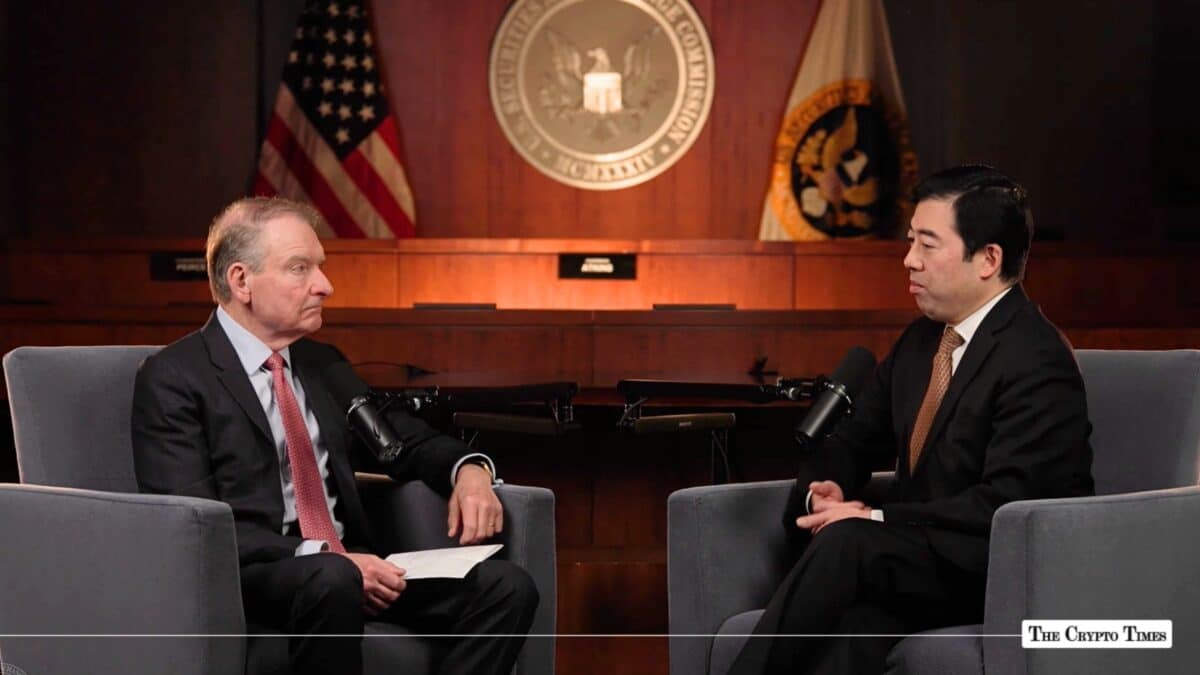
For 90 years, the U.S. Securities and Exchange Commission never had a podcast. That changed on April 16 when Chairman Paul Atkins launched the first episode of “Material Matters,” and what was supposed to be an introductory episode quickly turned into one of the most unfiltered public conversations the agency has ever had.
Atkins interviewed the only two other sitting Commissioners, Mark Uyeda and Hester Peirce, in back-to-back segments. Over nearly 28 minutes, the three of them tore into the Biden-era SEC, made the case for crypto as a pillar of American financial innovation, and outlined a regulatory reset that touches everything from IPOs to smart contracts to investor education.
Uyeda on the Gensler years: “A complete outlier”
Commissioner Uyeda has spent close to 20 years at the SEC. Before that, over a decade as a corporate securities lawyer and a state securities regulator in California. He also served as Acting Chairman from January to April 2025, stepping into an agency he says had drifted far from what it was supposed to do.
His take on the previous four years left no room for interpretation. “The last four years were a complete outlier to anything I’ve seen in that over three decades of time as a corporate securities lawyer,” he said. He described how the SEC under former Chairman Gary Gensler went from being a disclosure-focused regulator to what he called “a business conduct regulator.”
The list he rattled off was long. The agency had started weighing in on whether companies issued dividends or did share repurchases, what their cybersecurity looked like, their supply chain management, human capital resources, the makeup of their workforce, DEI at the board level, greenhouse gas emissions, mine safety records, and executive compensation. All without any legislative mandate from Congress.
“We’re supposed to be a disclosure agency and that is something that we have hewed to regardless of whether this was during the Clinton administration in the 90s, George W. Bush, President Obama. But in the last four years, it was a complete deviation,” he said.
Then came the football analogy. Normal policy disagreements, Uyeda said, are about whether the ball sits closer to the left hash mark or the right. “Unfortunately the last four years I think we weren’t even in the stadium. We were outside. We were so far out of our lane.”
Uyeda also raised a number that often gets buried in policy conversations. The U.S. has roughly half the number of public companies it had 30 years ago. His concern is that IPOs are no longer about companies raising capital from the public. They have turned into liquidity events for employees and early venture capital investors, and that locks ordinary retail investors out of wealth creation entirely.
Peirce breaks down why crypto actually matters
The second half of the podcast belonged to Commissioner Peirce, who has been leading the SEC’s Crypto Task Force, now rebranded as Project Crypto. She did not just talk policy. She went back to basics.
“Crypto solves the double spending problem,” she said. “You used to be able to send data over the internet but you couldn’t send value because I could send you value and then I could send the same value to someone else and say oh look I paid you both. Cryptography solves that problem.”
From there, she explained how blockchain technology allows people to transact directly without relying on middlemen. Those intermediaries, she said, have “sometimes been the source of problems” by either walking away with customer money or being careless with it. She pointed to smart contracts as a way to program compliance directly into assets, automate collateral payouts, and build restrictions into code instead of paperwork.
“Through the power of smart contracts, you can program assets which is very powerful. You can build regulatory requirements right in or other kinds of restrictions you want to build in,” she said.
When Atkins asked whether there is urgency to all of this, Peirce did not hedge. “We do want to make this the place where people want to innovate whether it’s in crypto or something else,” she said. She added that a proper regulatory framework would actually help the SEC go after fraud more effectively, rather than “spending our enforcement resources where our regulatory resources could have done the job.”
SEC and CFTC: From turf war to joint mission
One of the bigger revelations from the podcast was just how closely the SEC and CFTC are now working together.
Atkins pointed out that Michael Selig, who was originally brought in by Peirce as lead legal counsel for the Crypto Task Force, has since become Chairman of the CFTC. Atkins called this something that “portends really close working relationship between the two agencies for the first time in decades and decades.”
For years, the two agencies were locked in what the industry openly called a turf war over crypto jurisdiction. That era appears to be over. The agencies signed a Memorandum of Understanding on March 11 and followed it with ajoint interpretive release on March 17 that created a formal token taxonomy, splitting digital assets into clear categories and assigning regulatory responsibility.
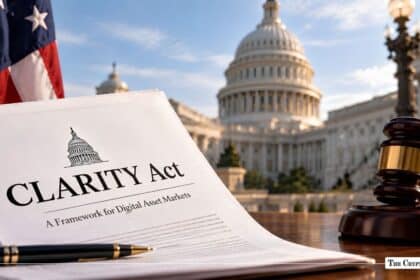
Peirce said the CFTC will now take the lead on spot crypto trading, an area that has never had a regulatory framework. “We want to make sure that we’re not spending resources to address the same problem,” she said. She also noted that Congress has a role to play here, pointing to the CLARITY Act still working its way through the Senate.
Free enterprise, investor education, and what comes next
Uyeda wrapped his segment with an unexpected turn. With the U.S. approaching its 250th anniversary, he tied the SEC’s mission back to the country’s founding values of opportunity, free enterprise, and the freedom to pursue a trade with minimal government interference.
But he also warned that success breeds complacency. “All the success America has had in terms of economic growth, innovation, new technology, that can breed complacency,” he said. “Well there’s always a competitor willing to try to knock you off.”
Peirce closed her segment by turning to investor education. She warned that fraudsters are reaching people through increasingly informal channels, and the SEC needs to meet investors “where they’re meeting scammers.” She pushed hard for financial literacy starting in elementary school, saying she wants kids to be “immersed in it so that by the time they’re managing their own money they’re very comfortable and they’re not scared to find the help they need.”
For an agency that spent the Gensler years communicating mostly through enforcement actions, the fact that all three sitting Commissioners are now explaining their thinking publicly, in their own words, says a lot about where this SEC is heading. Whether the rulemaking keeps pace with the rhetoric is the question that matters now.
Also Read: CFTC Chair Selig Urges Congress to Send CLARITY Act to President