Key Highlights
- An unidentified trader built a massive 145.24 million FARTCOIN long across four wallets, sparking a quick 27% surge before a sharp reversal triggered full liquidation and a $3.02 million loss.
- Hyperliquid’s Auto-Deleveraging rewarded short traders with $849,000 in profits (including $512K and $337K hauls), while the platform’s HLP pool absorbed roughly $1.5 million in bad debt from the unwind.
- Just days prior, seven coordinated wallets pumped XPL perps with $1.85M, withdrew $4.63M for a $2.78M profit (150% return), and left Hyperliquid’s HLP down $600K—showing how the same thin-liquidity playbook can deliver wins or wipeouts.
In the latest twist for one of crypto’s most volatile meme coins, Fartcoin tumbled more than 13% in 24 hours after a bold attempt to push its price higher on the decentralized perpetuals exchange Hyperliquid backfired spectacularly.
On-chain sleuths at Lookonchain spotted the move, sharing that an unidentified trader opened a massive long position of 145.24 million FARTCOIN tokens spread across four wallets.
The bet, worth roughly $15 million at prevailing prices, briefly ignited a 27% surge during late Wednesday as the coordinated longs squeezed thin order books on the low-liquidity market.
But the rally proved short-lived as the market reversed hard within hours, with Fartcoin price dropping 30% and triggering full liquidation of the position and a $3.02 million loss for the aggressor.
Hyperliquid’s Auto-Deleveraging (ADL) mechanism then kicked in, automatically matching the underwater longs against profitable short positions. Short traders walked away with $849,000 in total gains, including standout hauls of $512,000 and $337,000 for two wallets.
The exchange’s market-making pool, known as HLP, reportedly absorbed around $1.5 million in bad debt from the chaotic unwind, highlighting risks in thinly traded perpetuals.
Fartcoin price trajectory
Fartcoin’s spot price reflected the turmoil. It spiked from roughly $0.2 to over $0.2478 intraday before collapsing back toward $0.175, where it was changing hands Thursday morning with 24-hour volume exceeding $150 million—as per CoinMarketCap data.
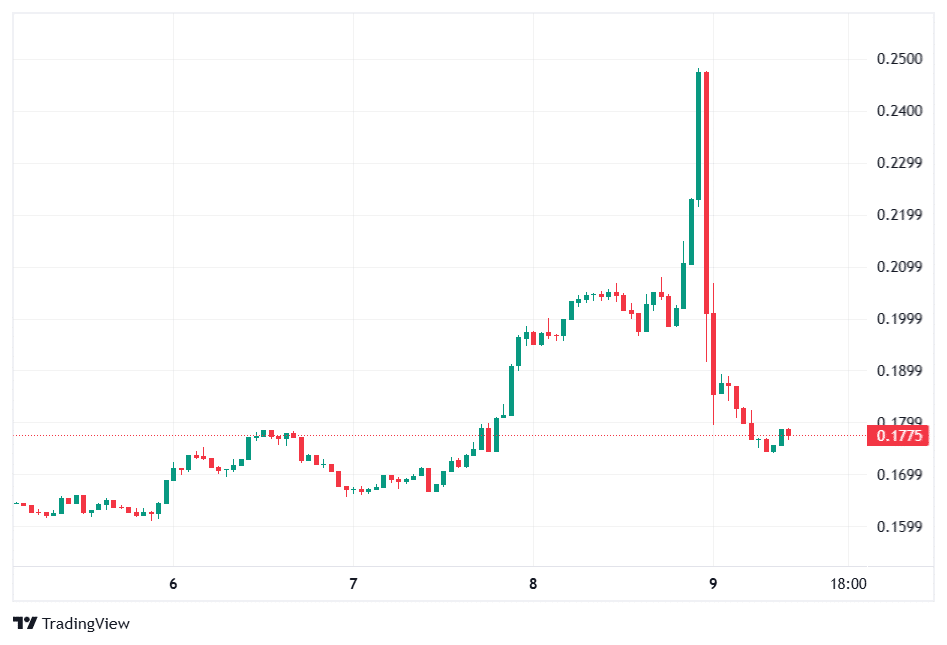
That put the token’s market cap near $176 million against a fully diluted valuation of roughly the same size, given its near-1 billion circulating supply. The 13-14% daily drop erased much of the previous week’s modest gains and left the asset trading more than 90% below its all-time high of $2.48 set in January 2025.
The episode can be described as classic “whale versus whale” theater in the meme-coin arena. Low liquidity on Hyperliquid perps allowed the initial pump, but once momentum stalled, cascading liquidations amplified the downside.
The similar attack pattern in XPL trade
A similar high-stakes manipulation unfolded on Hyperliquid just days earlier with XPL, the native token of the Plasma Layer 1 network. In this drama, seven coordinated wallets deposited roughly $1.85 million in USDC and opened highly leveraged long positions in the thinly traded XPL perpetuals.
The aggressive buying ignited a near-vertical price surge that squeezed short sellers, triggering a cascade of liquidations and amplifying the rally in the low-liquidity market.
As reported by The Crypto Times, the group then executed synchronized withdrawals totaling $4.63 million from their collateral, pocketing an estimated $2.78 million profit—a blistering 150% return on capital in a trade that lasted mere minutes.
Hyperliquid’s Hyperliquidity Provider (HLP) pool absorbed around $600,000 in bad debt from the backstop liquidations, socializing part of the risk across the platform.
Like the subsequent Fartcoin incident, the XPL event highlighted the double-edged nature of leverage on Hyperliquid: thin order books allow rapid pumps from coordinated longs, but any reversal can unleash violent unwinds—rewarding the aggressors in one case while punishing them in the other.
Both trades underscore how meme-adjacent and pre-market tokens remain vulnerable to whale-versus-whale dynamics where liquidity gaps turn modest capital into outsized moves and platform-level losses.
Also read: The 620,000 Bitcoin Blunder: Bithumb Turns to Courts to Claw Back Remaining BTC