Key Highlights
- VDOR fell 93% in early April 2026, dropping from $0.04 to around $0.0027 amid heavy selling and low liquidity.
- The crash has raised rug pull concerns, with supply reportedly controlled by an anonymous team.
- The token also reacted to falling oil prices following ceasefire developments in the Middle East.
Vanguard Digital Oil Reserve (VDOR), a Solana-based memecoin that rides on the frenzy of the oil crisis, has crashed 93% during early trading hours, raising concerns that the token creators may have executed a rug pull.
Just hours before the drop, the token reportedly had about 70,000 holders and a $49 million market cap. But at the time of writing, its market value has fallen to around $2.9 million.
The token is now trading at about $0.0037. It previously rose to around $0.04 before dropping sharply to $0.004 and then stabilizing. At the same time, trading activity surged by roughly 259% over 24 hours, reaching about $7.2 million.
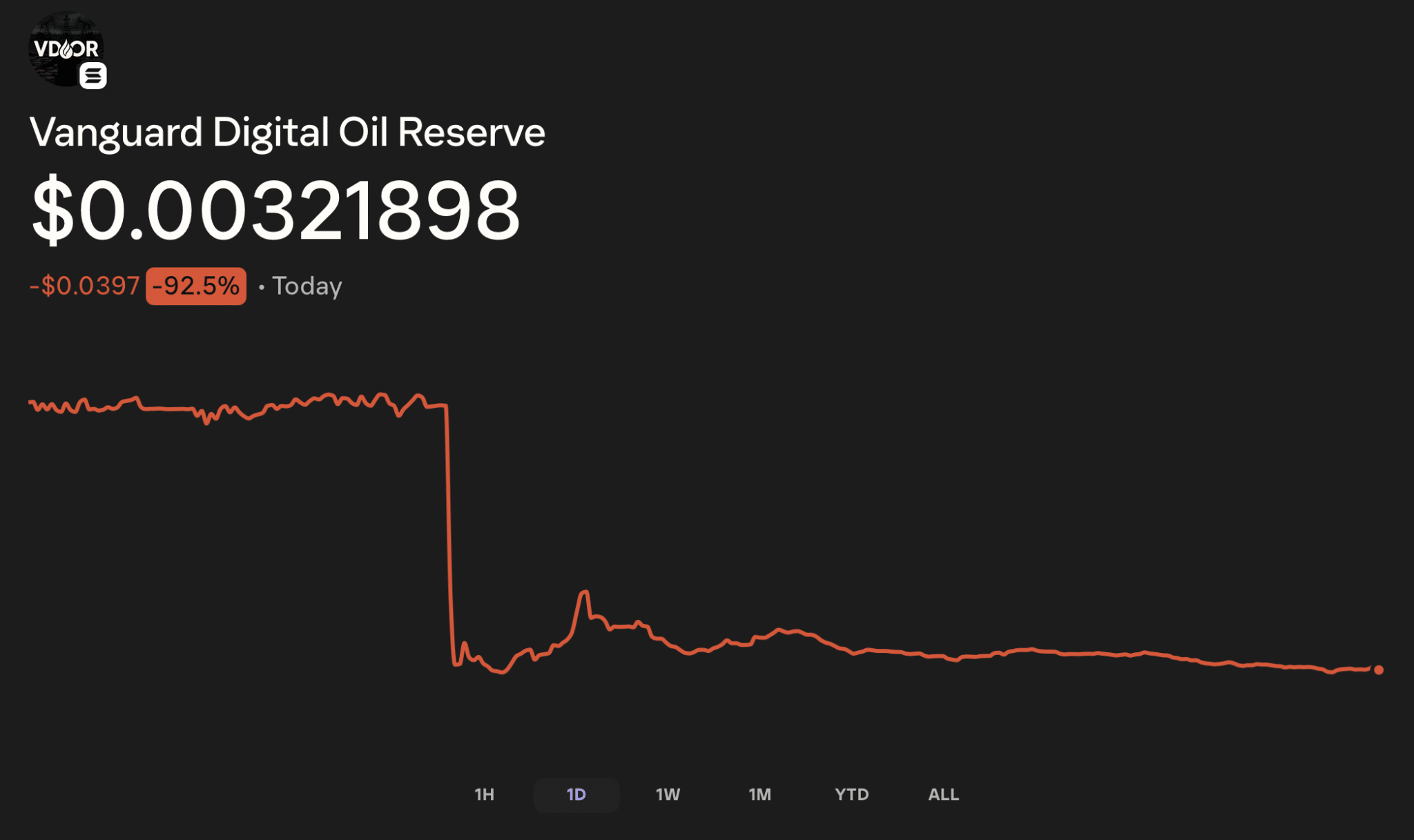
However, the current price action suggests that much of this activity is driven by selling pressure.
In a post on X, crypto influencer Mr. Beefman claimed that the token’s support was fully controlled by the anonymous team, allowing them to dump the coins and crash the price at any time.
What is Vanguard Digital Oil Reserve (VDOR)?
VDOR is a Solana-based SPL token launched in late 2025. It recently gained attention by marketing itself as an “on-chain energy reserve,” claiming to offer exposure to the oil sector through blockchain rails.
However, the token is not backed by physical oil reserves, and its price does not track real-world oil markets. The team behind the project remains anonymous, with no verified partnerships with institutional players, audits, or official mechanisms linking the token to real-world oil prices.
Previous price action
Before the crash, VDOR saw strong gains as traders speculated on its narrative, with some assuming a connection to Vanguard Group, which has no affiliation with the token.
At one point, the token surged over 130% in a week, from $0.0067 on March 24 to $0.0169 on March 31. This pushed its market cap from $7 million to $17 million, while daily trading volume increased from $276,000 to $2.6 million.
The number of token holders also increased from about 6,570 to 28,864 in one week, driven by the conflict over the Strait of Hormuz. However, that number has since dropped to around 11,234.
Triggers and market reaction
The decline appears to coincide with ceasefire developments in the Middle East following negotiations between the United States and Iran, which led to a drop in global oil prices.
WTI crude (CL00) dropped by 17.26% to $93.45, down $19.50 in a single downtrend move, while Brent crude (BZC00) dropped 15.30% to $92.55, shedding $16.72. Natural gas (NG00) also declined 4.70% to $2.73.
The easing of tensions allowed some shipping activity to resume in the Strait of Hormuz, reducing immediate supply concerns and weighing on oil prices.
VDOR, positioned as an “oil-linked” token, reacted to this broader market sentiment. The sharp decline may have also created conditions for large sell-offs, with the broader narrative potentially masking underlying token dynamics.
Also Read: XRP ETFs See Massive Weekly Inflow, Leaving BTC and ETH Behind