Key Highlights
- A solo Bitcoin miner on CKPool earned about $210,000 by mining block 943,411.
- Solo mining is rare, with only 20 blocks mined by solo miners in the past 12 months.
- Rising network difficulty and high costs make mining harder, favoring large industrial miners over individuals.
A solo Bitcoin miner connected to CKPool, a Bitcoin mining pool, earned approximately $210,000 on Thursday by mining block 943,411.
According to data from block explorer mempool.space, the reward included 3.139 BTC, which came from both the standard block reward and transaction fees.
How solo mining works
Solo mining is when a single miner attempts to find a block without joining a large pool. In the current competitive market of high hashrate, it is rare for a solo miner to beat others to add a new block to the chain and earn a full block reward. According to data from Bennet’s tracker, solo mining pools have mined only 20 Bitcoin blocks in the past 12 months.
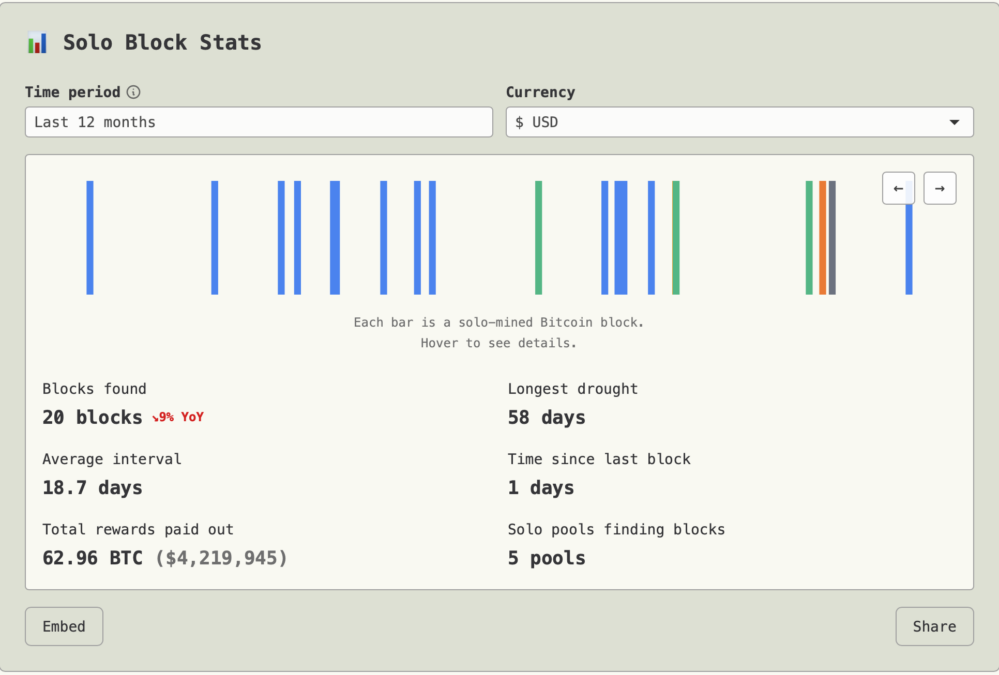
These blocks paid a total of 62.96 BTC, which averages to about one win every 18.7 days. The longest period without a solo win was 58 days, and the previous solo success occurred on February 28.
Bitcoin mining has become increasingly competitive due to rising network difficulty. Difficulty measures how hard it is to find a new block on the Bitcoin blockchain. Higher difficulty means miners must perform more calculations, requiring more computing power and electricity.
Recently, the network difficulty fell by about 7.7% before rising again 3.87% in a single day. This brief drop gave miners a slightly better chance to find a block, but current levels remain close to all-time high levels, so solo miners have very low odds of success.
At the same time, data from CoinWarz show that Bitcoin difficulty has increased dramatically over the last decade. Sometimes it drops a little when miners turn off unprofitable machines or use them for other tasks, like running artificial intelligence programs. Rising difficulty, along with higher costs for electricity and machines, gives an advantage to large, well-funded mining companies rather than individual miners.
Big miners adjust strategies
Many big mining companies have responded by selling some of their Bitcoin instead of depending on chance. Riot Platforms, for example, sold 3,778 BTC during the first quarter of 2026. Other firms, including MARA Holdings, Genius Group, and Nakamoto Holdings, have also sold portions of their Bitcoin holdings.
Despite these challenges, this solo miner shows that individual miners can still succeed, even though large industrial mining operations now dominate the network. At the time of writing, Bitcoin itself is trading for $66,978, up 0.04% in the last 24 hours, according to data from CoinMarketCap.
Also Read: Bitcoin Supply in Profit Revisits 2022 ‘Bottom Discovery’ Zone