Key Highlights
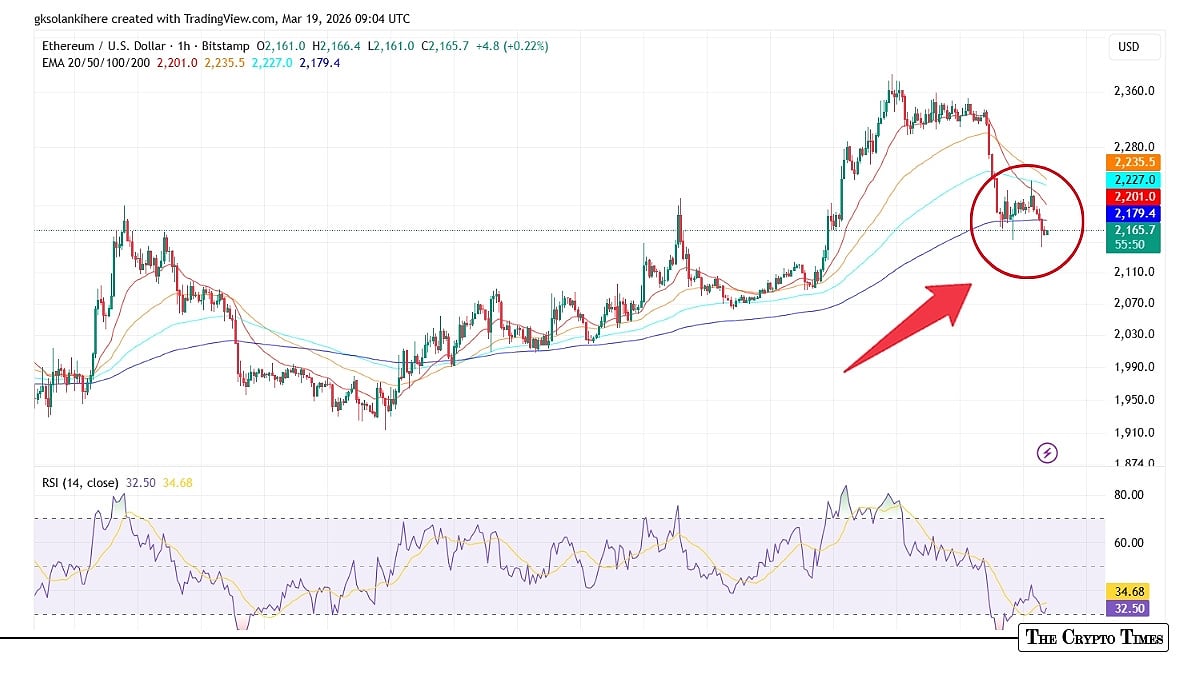
- ETH trades around $2,180 after a 6% 24h drop, down >56% from 2025 ATH ($4,953). It remains in a descending channel with support at $2,100–$2,150 and resistance at $2,200–$2,360, pressured by macro uncertainty.
- Whale accumulation intensifies (e.g., one wallet added >$152M ETH recently via Kraken withdrawals), accumulation addresses up 32% (6.5M ETH added since Jan), staking hits record >37M ETH (31% supply), and spot ETFs show positive inflows for three weeks; signaling long-term demand despite price weakness.
- Vitalik emphasizes “sanctuary technology” upgrades (Hegotá for account abstraction, Glamsterdam/Lean Ethereum for decentralization). Institutional targets remain high: Tom Lee $7K–$9K (up to $20K+), Hayes $10K–$20K, Standard Chartered ~$7,500 by year-end; positioning current dip as potential setup for rebound if catalysts hit.
Ethereum finds itself at a pivotal juncture as of March 19 2026, trading in a narrow range around $2,200–$2,150 after a sharp 6% drop over the past 24 hours. According to real-time data from CoinMarketCap, the asset opened the day near $2,203, reached a high of $2,322, and fell to a low of $2,144 before stabilizing, with trading volume surging past $26 billion.
This decline caps a turbulent month: ETH rallied from February lows near $1,473 to brief highs above $2,350 earlier in March, yet it lingers more than 56% below its 2025 all-time high near $4,953—as per market data.
Currently, ETH sits in a corrective phase, trapped in a descending channel on daily charts. Support holds tentatively around $2,100–$2,150, a zone tested multiple times this month. Meanwhile, resistance clusters at $2,200–$2,360; a decisive break higher could spark recovery toward prior highs, while a breach below $2,000 opens the door to $1,900 or deeper retracements.
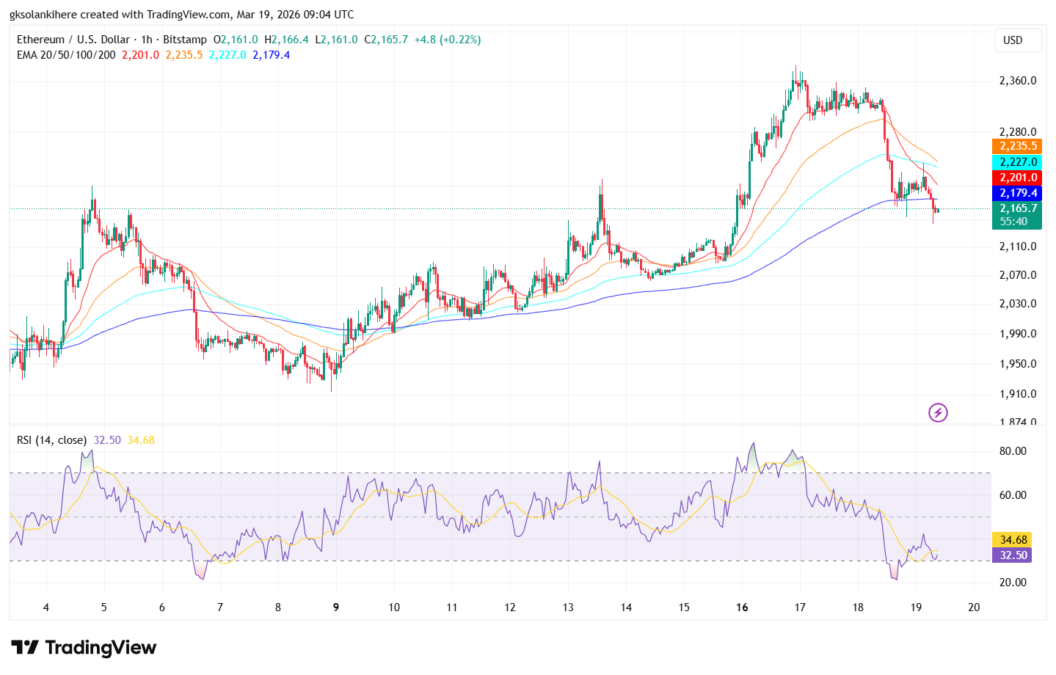
Oversold RSI readings, sitting at 32.5 on 1-hour timeframe hint at potential exhaustion selling, yet broader moving averages stay bearish, underscoring downward pressure from macro headwinds like interest rate uncertainty and risk aversion.
Contrary, on-chain signals provide a counterbalance. Whale accumulation has intensified, with large holders withdrawing millions in ETH from exchanges recently, with staking hitting record levels—over 37 million ETH locked, representing roughly 31.08% of circulating supply, as per Validator Queue data.
Spot Ethereum ETFs inflows, on the other hand, have been positive since the past three weeks, drawing fresh institutional capital. These metrics suggest underlying demand persists despite price weakness, as long-term participants double down on Ethereum’s infrastructure role.
ETH onchain signals: quiet strength beneath the surface
Ethereum’s on-chain data reveals a clear divergence between price action and underlying network conviction. Accumulation addresses, wallets with minimal or no selling history, have absorbed substantial ETH since the start of the year.
CryptoQuant metrics show these addresses added roughly 6.5 million ETH from January levels, pushing their total holdings from around 20.1 million to 26.55 million ETH, a 32% increase.
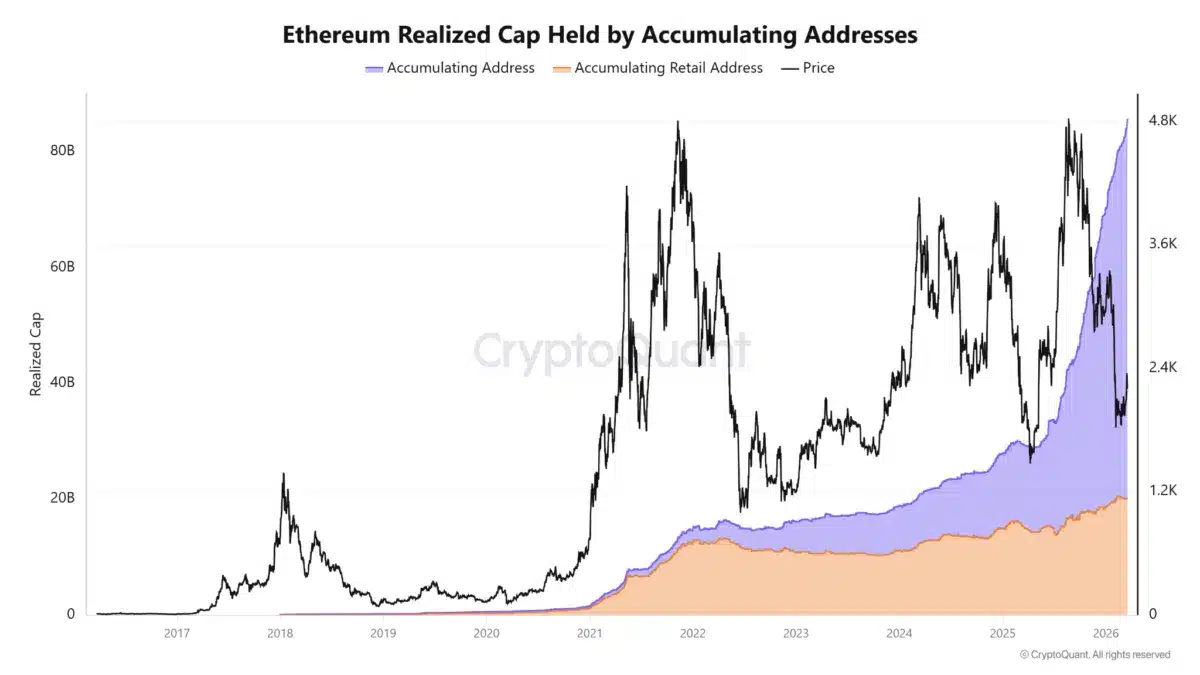
This steady inflow, often described as near-vertical on longer-term charts, reflects deliberate buying during periods of market fear rather than speculative chasing.
Whale activity reinforces the pattern, with individual large holders executing multi-million-dollar purchases, including one anonymous wallet accumulating over $152 million worth of ETH in a three-day window, with portions withdrawn from exchanges like Kraken.
Such moves reduce exchange balances and tighten available supply, creating conditions where any renewed demand could face limited sellers.
Core Ethereum figures: Focus on fundamentals over price
Vitalik Buterin, Ethereum’s Co-Founder, continues steering clear of direct price commentary, instead emphasizing technical and philosophical advancements. In recent March posts and articles, he outlined the Ethereum Foundation’s renewed mandate: transforming Ethereum into “sanctuary technology”—a decentralized, resilient layer for privacy, coordination, and self-sovereignty in an era of centralized threats.
Upgrades like the Hegotá fork (slated for later 2026) aim to enable native account abstraction (via EIP-8141) for smarter, more user-friendly wallets, while Glamsterdam and “Lean Ethereum” initiatives target better decentralization, reduced node demands, and censorship resistance. Buterin frames these as essential for Ethereum to serve as global shared memory, particularly for cryptographic tools and AI agents, rather than chasing financial hype.
Institutional bulls map out recovery path
While core developers build quietly, institutional analysts project significant upside for 2026. Tom Lee of Fundstrat, also Chairman of Bitmine, forecasts ETH at $7,000–$9,000 early in the year, with longer-term potential toward $20,000–$22,000 if Ethereum captures tokenized asset flows and becomes Wall Street’s preferred blockchain infrastructure. His ETH treasury firm Bitmine has kept adding ETH to its treasury, now nearing a valuation of $10 billion.
Arthur Hayes, BitMEX Co-Founder, holds firm on $10,000 (with aggressive scenarios reaching $20,000), viewing current levels as consolidation before renewed discovery. Standard Chartered calls 2026 potentially “the year of Ethereum,” targeting around $7,500 by year-end on L2 scaling, real-world assets (RWAs), stablecoin expansion, and ETF momentum, with even higher figures into 2028.
In a revised move, Citigroup recently trimmed nearer-term targets amid legislative delays—but the weight of opinion tilts bullish. Analysts from the bank believes that a new trend on ETH will be driven by staking yields, AI agent economies, and Ethereum’s maturation as a productive asset.
Outlook: Catalysts vs. Risks
Ethereum’s trajectory hinges on execution. Short-term downside risks linger if macro pressures intensify or support fails, but oversold conditions, whale buying, record staking, and protocol upgrades build a solid base.
The narrative has now shifted: Ethereum is less about cyclical speculation and more about foundational infrastructure for AI, privacy, and decentralized finance (DeFi). If upgrades deliver and institutional adoption accelerates, 2026 could mark a meaningful rebound.
However, as volatility remains constant in this industry, it makes the second largest cryptocurrency’s movements heavily uncertain while macro events overriding fundamentals overnight.
Also read: Bhutan Moves 973 Bitcoin to Exchanges Amid Strategic Mining Pivot