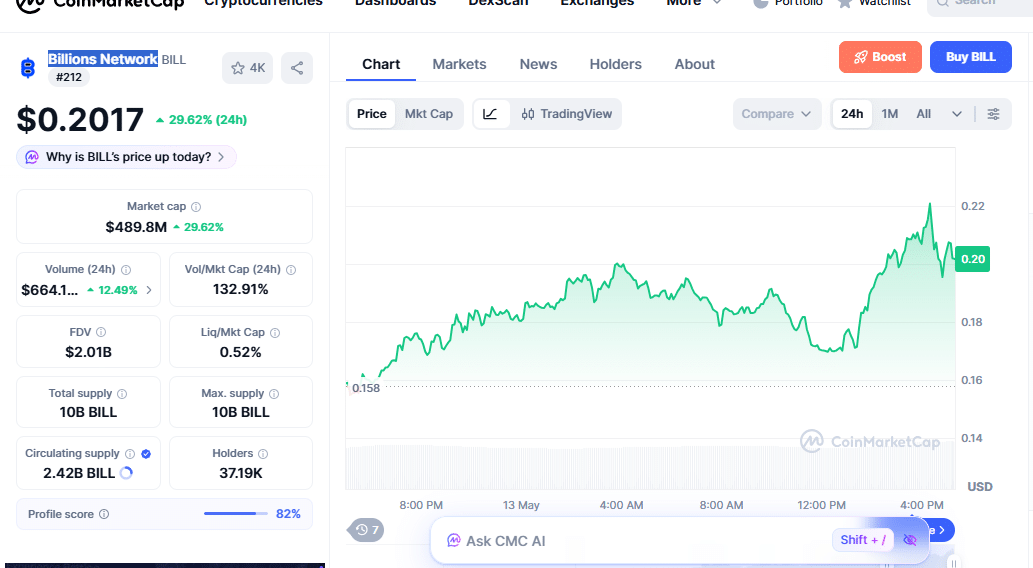
Billions Network (BILL) surged nearly 30% to a new all-time high of $0.2017 on Tuesday, driven by a confluence of exchange-level catalysts and a rapidly building “AI identity” narrative that has positioned the token as one of the hottest altcoin plays of May 2026.
According to CoinMarketCap, the token’s market capitalization stood at roughly $489.8 million, with 24-hour trading volume reaching $664 million. BILL has now gained over 870% since its token generation event on May 4, when it debuted at approximately $0.0208.
Binance Perps and the $200K Competition
The primary catalyst behind the latest leg up is Binance’s infrastructure support. The exchange launched BILLUSDT perpetual futures with up to 20x leverage on May 7, providing professional traders with a high-leverage instrument for speculation and hedging. Bybit had added its own BILL perps just one day earlier on May 6, following its spot listing on May 3.
Binance subsequently launched a $200,000 trading competition for BILL, directly incentivizing high-volume participation and creating a feedback loop: competition attracts volume, volume drives price discovery, price movement generates social media attention, and attention brings new buyers.
The exchange support has been unusually rapid and broad for a newly launched token. Within days of its May 4 TGE, BILL was listed across Binance Alpha, Bybit, KuCoin, Kraken, OKX, MEXC, Bitmart, and Coinbase — one of the most synchronized multi-platform launches in recent memory.
The “Mobile-First Worldcoin” Narrative
Beyond exchange mechanics, BILL is riding a powerful narrative wave. The token is being framed across crypto social media as a mobile-first, privacy-preserving alternative to Worldcoin (now World) in the AI identity verification space.
The core pitch: Billions Network lets users prove they are unique humans online without biometric hardware (no iris-scanning orbs), without centralized data storage, and through a smartphone-only workflow using zero-knowledge proofs. Users verify their identity using a government-issued ID on their phone, receive a credential, and can then prove attributes — such as “I am human” or “I am over 18” — without revealing underlying personal data.
The project also extends to AI agents, allowing machines to verify themselves as non-malicious bots — a dual human-plus-agent identity layer that distinguishes it from Worldcoin’s human-only approach.
The digital identity verification market is projected to reach $20 billion by 2028, and BILL sits at the intersection of two dominant 2026 narratives: AI agents and privacy-preserving infrastructure.
Venture Backing Adds Credibility
BILL’s investor roster has been a key talking point in the social media hype cycle. The project is backed by Coinbase Ventures and Polychain Capital — both tier-one crypto venture firms whose involvement signals institutional conviction in the AI identity thesis.
Social media influencers have been actively highlighting the combination of venture backing and price performance, with some pointing to BILL’s 326% gain over recent days and framing it as the standout AI narrative play of the current cycle. The feedback loop between influencer attention and buying activity has been a defining feature of BILL’s post-TGE price action.
Thin Liquidity and Supply Risks
The CoinMarketCap data reveals important structural caveats beneath the headline numbers. BILL’s liquidity-to-market-cap ratio sits at just 0.52% — meaning that for a token approaching a $500 million market cap, actual on-chain liquidity is minimal. This structural thinness amplifies price movements in both directions.
Only 2.42 billion of BILL’s 10 billion total supply is currently circulating—approximately 24%. The remaining 76% is locked, with staking locked until October 2026 according to the latest project updates. Launchpad refund processing for participants opting for a refund plus a 5% bonus is scheduled to begin on May 19.
The low circulating supply has been a double-edged catalyst: it concentrates buying pressure into a thin float, driving outsized price gains, but also creates the conditions for sharp reversals when locked tokens eventually enter circulation. Earlier in the week, the BILL team transferred 50 million tokens to Bitget, which preceded a 40% price drop — a reminder of how sensitive the token is to supply-side events.
The project has also faced controversy around a vesting shift: presale investors from August 2025 were originally promised a 75% unlock at TGE, but this was changed days before launch to a choice between a refund or a 6–12 month lockup, leading to accusations of unfair treatment from early backers.
The Broader AI Identity Rotation
BILL’s breakout fits within a wider capital rotation into AI-adjacent tokens that has defined the past two weeks. As Bitcoin consolidates above $80,000 and institutional flows remain focused on BTC ETFs and the CLARITY Act markup, speculative capital is cycling into high-beta altcoin narratives — with AI identity, AI agents, and privacy infrastructure emerging as the preferred categories.
Also Read: Telcoin (TEL) Surges 27% in 24 Hours Amid Broader Altcoin Rally