Key Highlights
- Bhutan sold over $22M in BTC during a market dip, showing cautious management amid falling prices and uncertainty.
- Most of Bhutan’s crypto is Bitcoin, mined cheaply with hydro power, while smaller altcoins barely impact the portfolio.
- Unlike El Salvador, Bhutan favors sustainable mining and cautious selling, sparking speculation about potential market dips.
The Government of Bhutan has moved $22.4 million in Bitcoin (BTC) to crypto exchanges during the recent market dip, signaling an adjustment in its digital asset strategy.
According to blockchain analytics platform Arkham, the Royal Government of Bhutan transferred 184.028 BTC, worth around $14.09 million, from its wallets in a single transaction. As per Arkharm’s series of posts on X, 100.818 BTC worth $8.31 million was transferred to the QCP-managed WBTC merchant account five days prior.
The supposed selling comes amid a notable decline in Bitcoin price, which has shrunken by nearly 458% from it’s all-time high of $126,198—marked in October last year—to below $70,000 currently. At the time of publishing, according to data from CoinMarketCap, Bitcoin was trading at $69,450, down 8.5% in the past 24 hours.
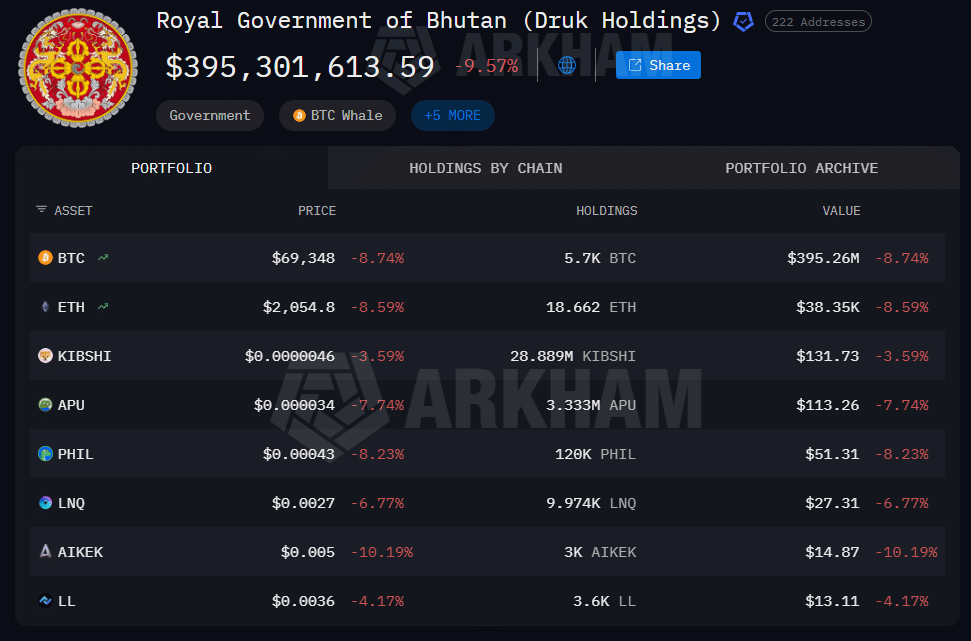
Conversely, Bhutan’s crypto holdings have dropped about 6%, now totaling around $395.3 million. Bitcoin makes a large part of it, while Ethereum holds up a tiny part of just 18.662 ETH valued under $40,000.
Bhutan’s mining and portfolio strategy
Bhutan has been mining Bitcoin since 2019, with an estimated profit reaching $765 million. Due to its low hydroelectric power costs, its costs were kept low at $120 million. The Himalayan country mined the most in 2023, with a production of approximately 8,200 BTC.
However, most of Bhutan’s Bitcoin was mined before the halving in 2024, which boosted its mining costs significantly. It then took almost twice as much to mine a single BTC, given the increase in the network’s hashrate, which slowed down Bhutan’s mining activity.
As of now, Bhutan is selling Bitcoin at a time when both the economy and crypto markets feel uncertain. In the U.S., investors have been worrying about various macro-economic factors and frequent shutdowns.
Also Read: Bitnomial Brings Tezos (XTZ) Futures to U.S. Market