Key Highlights
- Many WLFI holders remain locked out of their tokens, preventing them from participating in votes that affect the project’s direction.
- A small number of large wallets, linked to the team or strategic partners, appear to have dominated the USD1 proposal vote.
- WLFI’s revenue structure benefits insiders entirely, leaving ordinary holders without any financial gain or real influence.
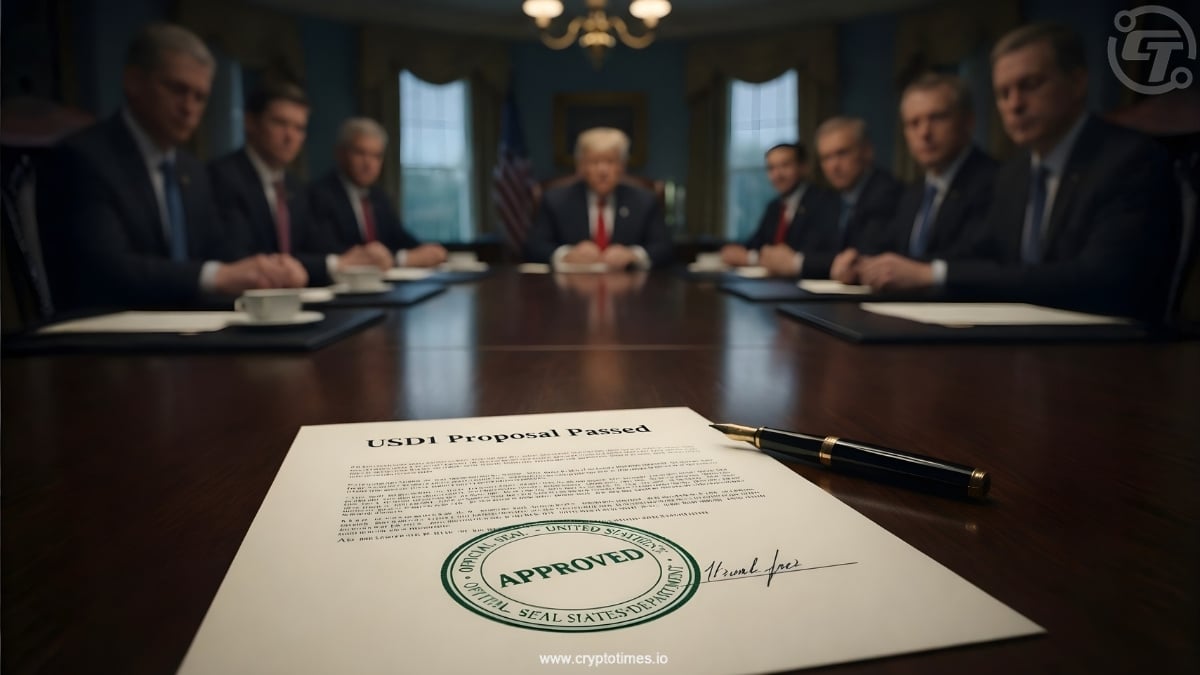
A recent governance vote at World Liberty Financial (WLFI) has made some investors uneasy, not so much because of what was being voted on, but because of how the decision was made. The proposal focused on using treasury-held WLFI tokens to support the growth of USD1.
However, what stood out, according to observers and some traders on X, was the influence of large, team-linked wallets and the fact that many regular holders were unable to take part in the vote.
A popular trader and DeFi analyst on X, going by the username DefiSquared, suggested in a post that the vote may have been coordinated in a way that benefited the protocol.
On-chain data and voting records shows a small number of wallets holding very large amounts of WLFI were responsible for pushing the proposal through. These wallets voted in favor, while a large section of ordinary investors were unable to participate at all because their tokens have remained locked since the token generation event.
Token holders locked out of governance
One of the biggest issues around this vote is that many WLFI holders still cannot access or move their tokens. Since the launch, investors have repeatedly asked for clarity on when their tokens will be unlocked, but so far there has been no clear answer from the team. Because of this, a large number of holders have effectively been excluded from governance, even though decisions are being made that directly affect the project.
During the voting period, several participants openly expressed their frustration. Some asked for the remaining tokens to be unlocked before any new proposals were passed, while others said they would oppose all future votes until the issue was addressed. Despite this, the proposal went ahead and passed, largely due to votes cast by high-balance wallets.
This has led many to question whether WLFI’s governance system reflects the wider community at all, or whether it mainly serves those who already hold large allocations.
Questions around the USD1 proposal
The proposal itself focused on using unlocked WLFI treasury tokens to support the expansion of USD1. While it was presented as a growth-focused move, critics have questioned the timing, especially given that basic concerns around token access and governance remain unresolved.
At one point, the proposal appeared unlikely to pass, with a noticeable number of votes against it. That changed only after large wallets entered the vote and tipped the balance. For some investors, this raised doubts about whether the outcome was ever really in question.
Revenue structure adds to concerns
The vote has also brought renewed attention to WLFI’s revenue structure. According to the project’s own documentation, WLFI token holders do not receive any share of protocol revenue. Instead, 75% of the net revenue goes to DT Marks DEFI LLC, with the remaining 25% going to AMG and WC Digital Fi LLC, which is linked to the Witkoff family.
In practice, this means that even though there are governance votes, the financial upside stays almost entirely with entities connected to the project’s leadership.
For many holders, that leads to a simple but important question: if there’s no share in revenue and very little say in how things are run, what’s the real long-term reason to hold WLFI?
Token distribution and market reaction
The token distribution only adds to these concerns. Around 33.5% of the total supply is held by the team, with another 5.85% held by strategic partners. Public investors, by comparison, received roughly 20% of the supply.
After the vote, blockchain data showed large transfers taking place, including a movement of 500 million WLFI to Jump Trading. At the same time, retail investors still can’t access or move their tokens. That has added to concerns that control and liquidity remain concentrated at the top, while ordinary holders are effectively stuck on the sidelines with no way to react or participate.
Market response so far has been cautious. Some traders have said they are taking short positions on WLFI, mainly because of dilution concerns, centralized control, and the fact that the token does not offer any form of revenue sharing.
Broader implications for governance
This situation has again brought attention to how WLFI’s governance actually works. While the project claims to be decentralized, the voting power clearly sits with a small group. Most token holders still don’t have any real say, simply because they can’t access or use their tokens.
For many people watching this closely, this vote isn’t just about USD1 anymore. It has started to look like a pattern, where decisions are pushed through by a few large wallets while everyone else is left on the sidelines.
So far, there has been no public response from the WLFI team on these concerns. And until there is some clarity on token unlocks, voting rights, and how revenue is handled, doubts around fairness and transparency are likely to continue.
Disclaimer: This article does not make any claims or allegations against WLFI or its team. The information presented reflects observations from publicly available on-chain data and commentary from traders, including posts on X. Nothing in this report is intended as a personal claim or accusation.
Also Read: Optimism Proposes 50% Superchain Revenue for OP Token Buybacks