Key Highlights
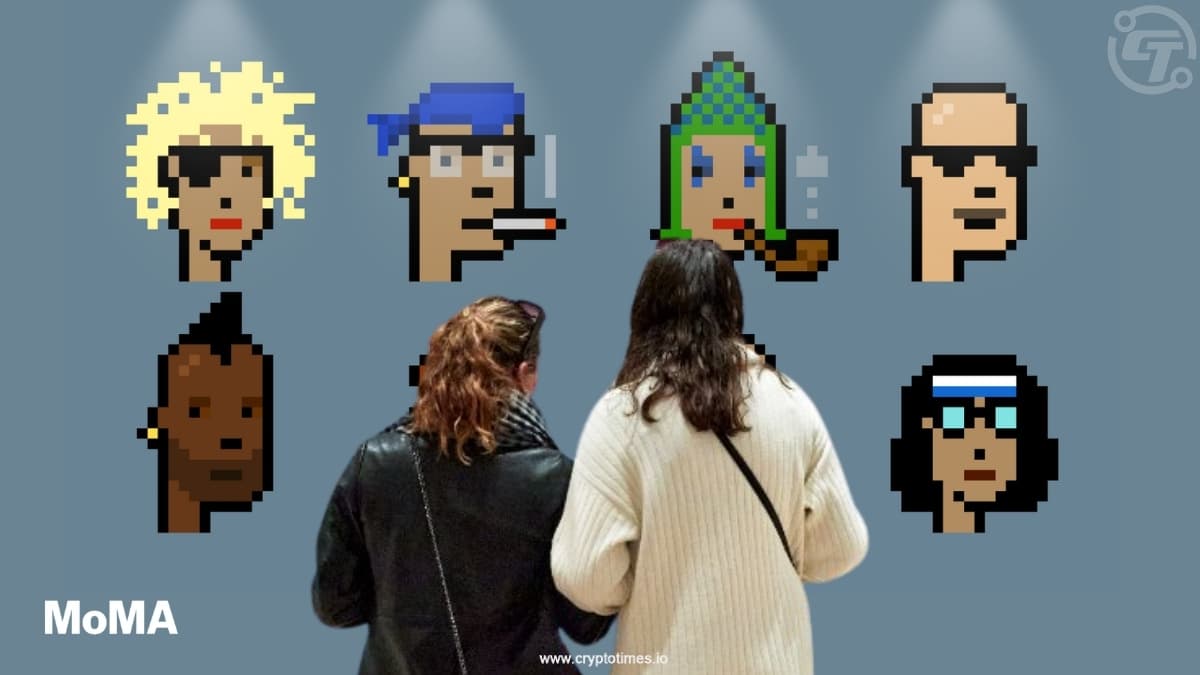
- The Museum of Modern Art (MoMA) has added eight CryptoPunks to its permanent collection under the Media and Performance department.
- The works were donated through a coordinated effort involving Larva Labs and leading blockchain art collectors.
- The acquisition reflects a broader shift in how major museums are approaching on-chain and digital art.
CryptoPunks, the early blockchain art project that helped define what non-fungible tokens (NFTs) eventually became, are now part of the permanent collection at the Museum of Modern Art (MoMA) in New York.
MoMA has accepted eight CryptoPunks into its collection, marking one of the clearest signs yet that on-chain art is being treated as a serious cultural medium rather than a short-lived digital trend.
The Punks added to the collection are #4018, #2786, #5616, #5160, #3407, #7178, #74, and #7899. All eight will be preserved by MoMA under its Media and Performance department, the same area that houses works dealing with video, technology, and experimental formats.
From an internet experiment to a museum artifact
CryptoPunks were created in 2017 by Larva Labs, the digital studio founded by Matt Hall and John Watkinson. At the time, the project was closer to an experiment than a finished art product. The idea was simple: generate 10,000 small pixel characters using code, make each one unique, and put them on the blockchain.
Each Punk is just 24 by 24 pixels, but what matters is how they exist. CryptoPunks aren’t just image files that can be copied around. They exist on-chain as NFTs, with their ownership history logged on the blockchain, locking in their authenticity from the moment they were created. That technical structure later became the blueprint for much of the NFT market that followed.
A donation led by the community
MoMA’s acquisition was not the result of a single donor but a coordinated effort involving multiple collectors and supporters of blockchain art. The donation came together with support from Art on Blockchain and contributions from collectors including Mara Calderon, Cozomo de’ Medici, judithESSS, NTmoney, kukulabanze, and Rhyd0n.
Larva Labs also contributed CryptoPunks from their own holdings, a move that reinforces the creators’ long-standing involvement with the project. Assistance in navigating the acquisition process was provided by 1OF1_art. Together, the group helped move the works from private wallets into a public institution.

The eight CryptoPunks added to the collection
- CryptoPunk #74, created in 2017, was donated by Larva Labs founders Matt Hall and John Watkinson and has been accessioned by MoMA as object number 423.2025.
- CryptoPunk #2786 entered the collection through a gift from Mara and Erick Calderon and is recorded as object number 424.2025.
- CryptoPunk #3407 was donated by Rhydon and Caroline Lee and has been catalogued as object number 425.2025.
- CryptoPunk #4018 was gifted by Ryan Zurrer of 1OF1 AG and accessioned as object number 426.2025.
- CryptoPunk #5160, also from 2017, was donated by Matt Hall and John Watkinson and recorded as object number 427.2025.
- CryptoPunk #5616 entered MoMA’s collection as a gift from judithESSS and is catalogued as object number 428.2025.
- CryptoPunk #7178 was donated by the Tomaino Family and accessioned as object number 429.2025.
- CryptoPunk #7899 was gifted by The Cozomo de’ Medici Collection and recorded as object number 430.2025.
All eight works will sit within MoMA’s Media and Performance department, the section of the museum that focuses on art shaped by technology, new media, and unconventional formats.
Why this moment matters
MoMA’s choice to add CryptoPunks to its permanent collection reflects a quiet but important change in how major institutions are starting to treat blockchain-based art. Rather than viewing these works through price charts or market speculation, the museum has placed them in a wider context of artists working with code, systems, and digital tools.
For the CryptoPunks community, the decision feels like an overdue acknowledgment. A project that began as a small experiment on the blockchain has now been formally recognized by one of the world’s most influential modern art museums.
A project that began in 2017 as a simple on-chain experiment has now found a place inside one of the world’s most influential modern art museums. For institutions more broadly, it marks a clear signal that on-chain art is no longer on the margins, but part of the permanent cultural record.
Also Read: TON-Based NFT Marketplace Fragment Flips Hyperliquid in 24h Revenue