


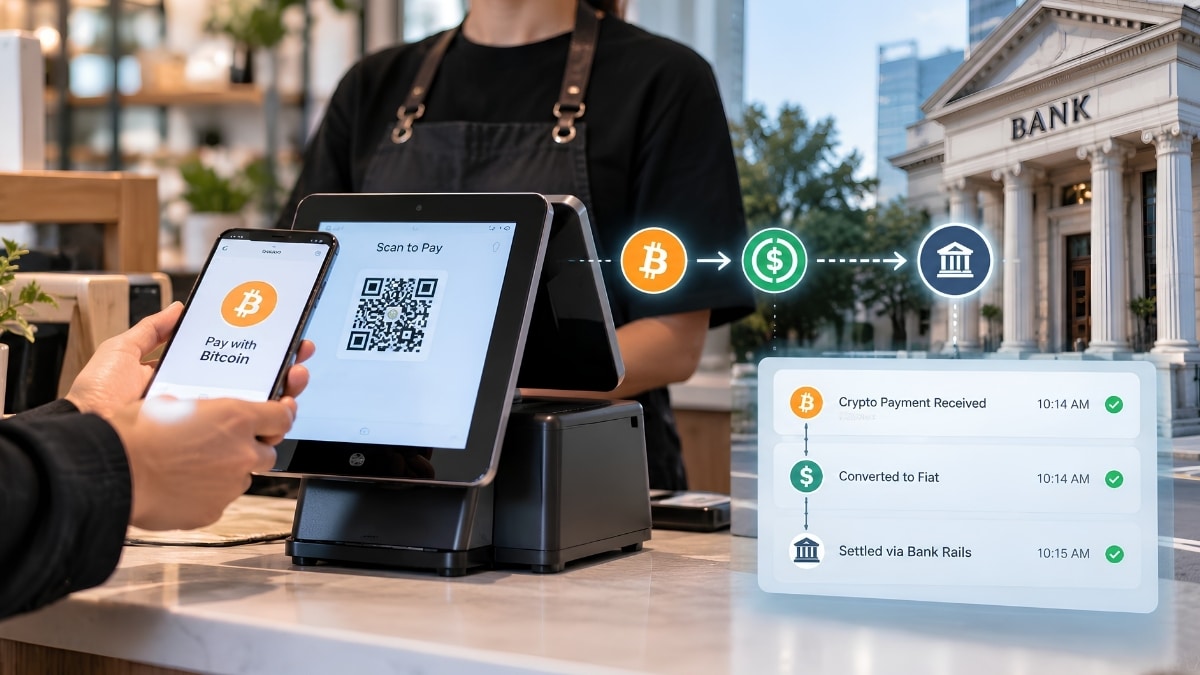
A coffee chain in Lisbon puts a “We accept Bitcoin” sticker on the register, and a customer taps a QR code to pay for a espresso. Nothing about that moment looks like a bank. Yet within seconds the transaction is quietly handed off to the same clearing infrastructure that has moved money since the 1970s – card networks, correspondent accounts, national clearing houses. The crypto layer is the front door. Everything behind it still smells like a branch office.
That handoff exists because merchants need cash flow they can actually spend, not a wallet balance that swings 8% before lunch. A payment platform built for this gap takes the incoming coin, converts it at the moment of sale, and deposits fiat into the merchant’s business account the next business day – the coffee shop owner never touches a blockchain explorer, and the payroll still clears through the same bank it always did.
The Conversion Moment: From Coin to Cash
The conversion itself happens in a window measured in seconds, not because blockchains are fast but because the processor locks a rate before broadcasting anything. Bitcoin’s own settlement can take ten minutes for one confirmation; a merchant selling sandwiches cannot wait that long to know if a sale went through. So the platform fronts the fiat immediately, using its own treasury, and settles the actual crypto position afterward on its own timeline. The customer sees instant confirmation. The bank sees a normal deposit arriving from a payment processor’s account, no different from a card settlement batch.
Bank Rails Merchants Never See
Underneath that deposit sits a stack most shoppers never think about. A licensed acquiring bank holds the merchant’s settlement account. A correspondent bank moves funds across borders when the merchant and the processor sit in different countries. A card scheme’s clearing cycle still runs in parallel for the portion of sales that came in through cards rather than coins. None of this touches a public ledger.
Regulators built this stack around specific legal entities – banks with deposit insurance, licensed money transmitters, registered payment institutions – and crypto rails have no equivalent yet that carries the same guarantees. A merchant who wants their revenue protected by the same rules that cover a grocery store’s bank account needs a route back into that system, every single time. Here is what actually happens to a coin, step by step, before it becomes usable cash:
- Customer broadcasts a transaction from a wallet to the merchant’s designated address.
- The processing platform detects the transaction and locks a fiat conversion rate.
- The platform’s treasury desk executes the equivalent trade on a liquidity venue.
- Fiat proceeds route through an acquiring bank into the merchant’s settlement account.
- The bank reports the deposit through standard clearing, identical to a card batch.
Compliance the Old-Fashioned Way
Banks will not open a settlement account for a business they cannot screen, and that screening runs on decades-old rules – proof of incorporation, beneficial ownership disclosure, sanctions list checks, transaction monitoring thresholds. A crypto-accepting merchant does not get a pass on any of it. If anything, the bank’s compliance desk slows down at the sight of it – a note reading “source: Bitcoin sale” still triggers a manual review queue at most institutions rather than an automatic pass.
That is the quiet reason full crypto-native settlement is rarer than the marketing suggests: someone still has to satisfy a bank that the money entering its ledger is clean, sourced from a real sale, and traceable to a real business. The blockchain records the transaction hash. The bank still wants the invoice.
| Layer | What runs on it | Who operates it |
|---|---|---|
| Customer payment | Crypto network (e.g. Bitcoin, USDT) | Wallet providers, exchanges |
| Rate lock and conversion | Processor’s internal treasury | Payment platform |
| Settlement to merchant | ACH, SEPA, card clearing | Acquiring bank |
| Compliance and reporting | KYC/AML monitoring systems | Licensed financial institution |
Every row in that table answers to a different regulator, which is exactly why no single company can currently own the whole chain end to end.
Why Full Crypto-Native Rails Aren’t Here Yet
Two structural gaps keep merchants tethered to the old system, and neither is about technology moving too slowly.
Liquidity Fragmentation
Crypto liquidity sits scattered across dozens of exchanges and market makers, each with its own depth and spread. A processor converting a €50 coffee purchase barely notices the spread; a processor converting a €500,000 wholesale invoice can lose real margin to slippage if it routes through a thin venue. Fiat rails solved this problem generations ago with central bank settlement finality – crypto markets are still assembling an equivalent, venue by venue.
Regulatory Patchwork
A merchant selling to customers in twelve countries faces twelve different stances on crypto settlement, from outright licensing regimes to outright bans on merchant acceptance. Routing everything back into fiat through regulated banking rails sidesteps that patchwork entirely – the merchant’s obligations become the same wherever the buyer happens to be. Until crypto settlement itself carries uniform legal status across major markets, bank rails remain the only leg of the journey every jurisdiction already recognizes, and that is why the sticker on the register and the bank statement in the back office still describe the same transaction in two completely different languages.


