I stepped into the digital asset trenches in mid-2020. The timing could hardly have been stranger.
The pandemic had unsettled the global economy in ways few people were prepared for. Businesses paused overnight. Hiring froze across industries. Governments and central banks were scrambling to stabilise markets with policies that, only months earlier, might have seemed extraordinary.
It was a period where many assumptions about “stable” financial systems suddenly looked less certain.
Around that time I found myself entering the digital asset industry. The sector didn’t resemble a mature market yet. It felt closer to a parallel experiment unfolding alongside the traditional financial system rather than inside it.
Two networks dominated most discussions: Bitcoin and Ethereum.
Bitcoin had already spent more than a decade surviving cycles of enthusiasm and skepticism since its original whitepaper appeared in 2008.
Ethereum, introduced several years later, was gradually being discussed as something broader than digital money. Developers increasingly described it as programmable infrastructure and a software capable of hosting financial applications.
In 2020 these networks still sat on the fringe. Banks watched from a cautious distance and regulators were still trying to determine how digital assets fit within existing legal frameworks.
Yet while institutions hesitated, the developer communities behind these networks continued building.
Liquidity, stimulus and the search for alternatives
The macroeconomic backdrop of 2020 and 2021 created unusual conditions across financial markets.
Central banks lowered interest rates rapidly and expanded asset-purchase programmes at a scale rarely seen before. The balance sheet of the U.S. Federal Reserve alone grew from roughly $4 trillion before the pandemic to nearly $9 trillion by 2022, according to data from the Federal Reserve Bank of St. Louis.
At roughly the same time, global money supply indicators such as M2 expanded sharply.
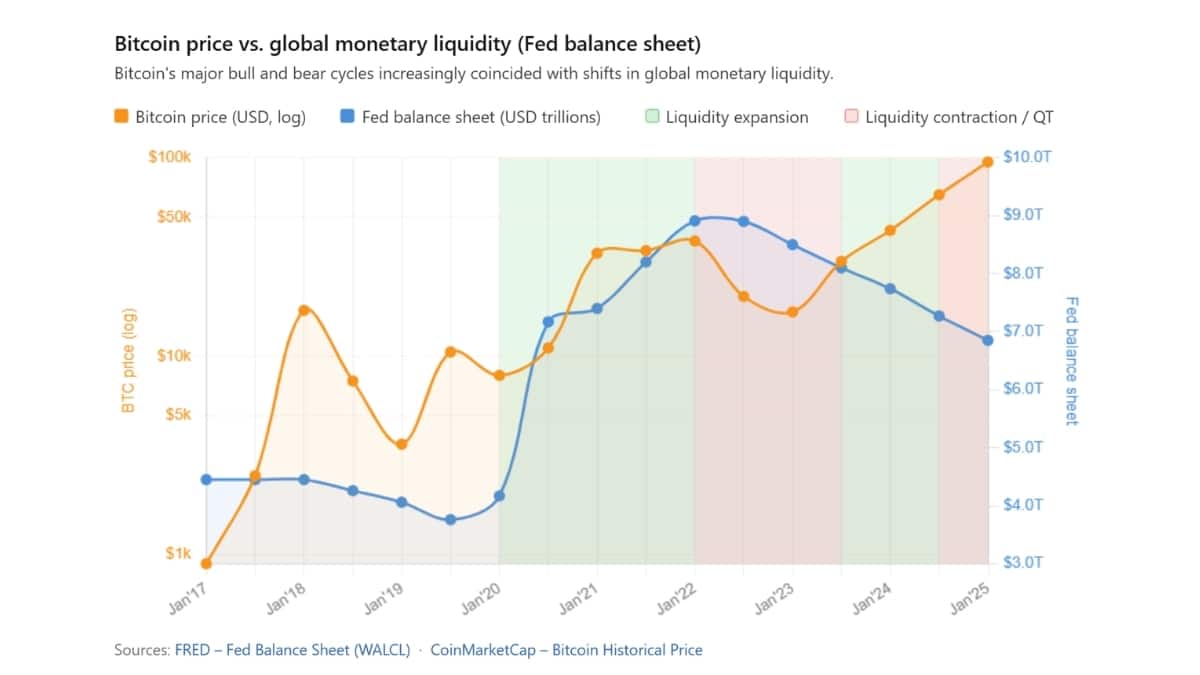
Economists writing in the IMF’s Global Financial Stability Report later noted that periods of abundant liquidity often encourage investors to look beyond traditional assets.
During those years Bitcoin began appearing more frequently in institutional research discussions. Some investors compared it with digital gold, largely because its supply schedule—fixed at 21 million coins—stood in contrast to the rapid expansion of fiat currencies.
Within a relatively short time institutional curiosity began appearing around the edges of the market. Hedge funds commissioned exploratory research. Asset managers debated small allocations.
Reports tracking fund flows from digital asset manager CoinShares began documenting increasing participation in crypto investment products.
At the same time the infrastructure supporting the market was improving. Regulated custodians, derivatives exchanges and institutional trading platforms gradually emerged.
These developments didn’t eliminate skepticism, but they made participation easier for investors accustomed to traditional financial systems.
Bitcoin and the pull of macro cycles
Another pattern slowly became visible as the market matured.
For years Bitcoin had often been described as a non-correlated asset, something that would behave independently of traditional financial markets. That narrative became harder to sustain after 2022.
When interest rates began rising and global liquidity tightened, risk assets across markets adjusted. Technology equities fell sharply and venture funding slowed. Bitcoin’s market corrected at roughly the same time.
Research from the Bank for International Settlements later suggested that crypto markets had become increasingly sensitive to broader financial conditions as institutional investors entered the space.
Two indicators illustrate the scale of the asset’s growth over the past decade.
First, Bitcoin’s market capitalization briefly exceeded $1 trillion during the 2021 bull market, placing it among the world’s largest traded assets.
Second, the computing power securing the network—the hash rate—has continued rising over time. Data tracked by the Cambridge Bitcoin Electricity Consumption Index shows the scale of infrastructure supporting the network globally.
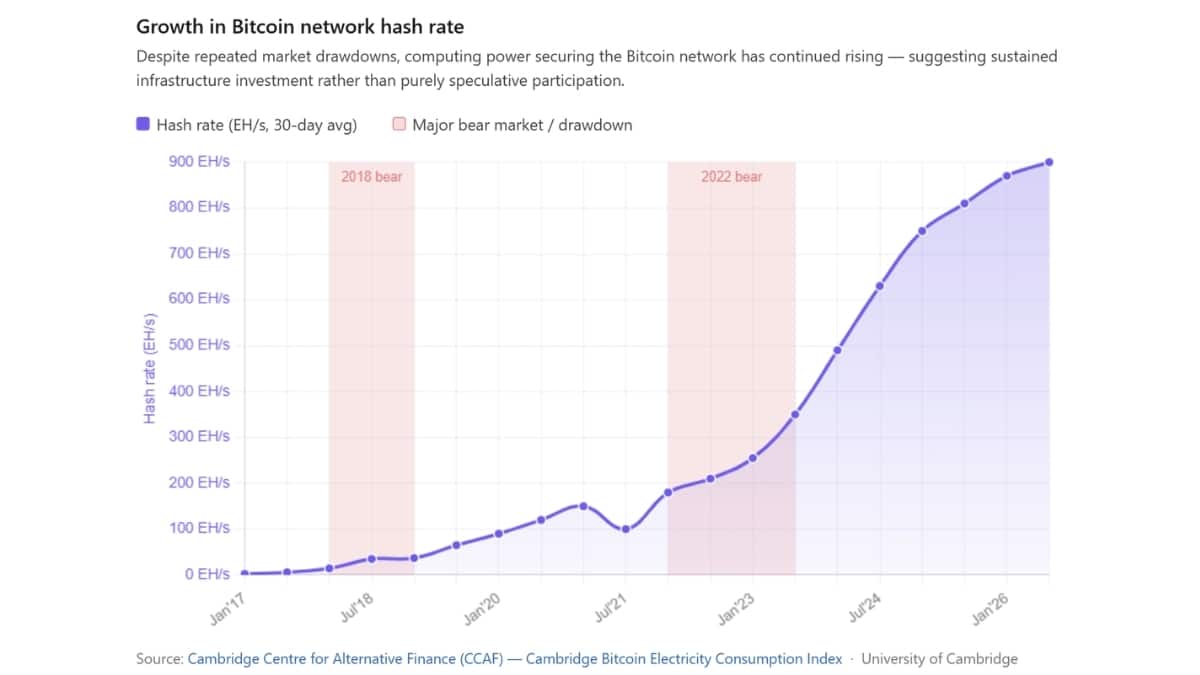
Whatever one’s opinion of the asset itself, that persistent growth suggests long-term investment by participants who expect the system to continue operating.
Price cycles come and go. The underlying infrastructure tends to move more slowly.
Ethereum and the rise of decentralized finance
While Bitcoin increasingly intersected with macroeconomic cycles, Ethereum’s evolution followed a different path.
Developers began using the network to build decentralised financial applications—lending markets, exchanges and liquidity pools operating through automated smart contracts.
The ecosystem that emerged from this activity became known as decentralized finance, or DeFi.
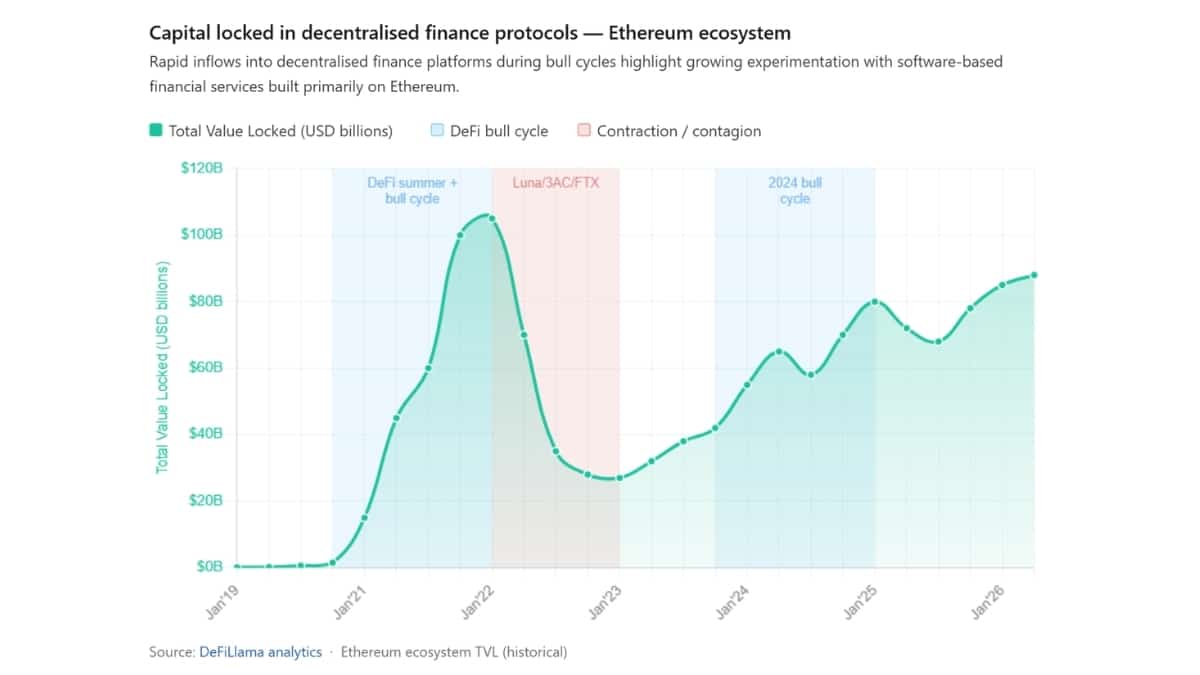
By 2021 the total value locked in DeFi protocols had briefly exceeded $100 billion according to data compiled by DeFillama.
Research from ARK Invest further described Ethereum less as a cryptocurrency and more as a foundational infrastructure layer for digital financial services.
The network itself also continued evolving. In September 2022 Ethereum completed its transition from proof-of-work (PoW) mining to proof-of-stake (PoS) validation, an upgrade widely known as “The Merge.
The shift significantly reduced the network’s energy consumption while changing the economics of how transactions are validated.
Technically speaking, it was one of the largest infrastructure upgrades attempted on a live blockchain network.
A national experiment: El Salvador
Fast forward to recent years, digital assets eventually moved beyond private markets and into national policy discussions.
In 2021 El Salvador introduced legislation recognising Bitcoin as legal tender alongside the U.S. dollar. The policy, promoted by President Nayib Bukele, quickly became one of the most closely watched economic experiments in the digital asset space.
International institutions responded cautiously. The World Bank raised concerns regarding financial transparency and regulatory oversight.
The International Monetary Fund later warned that the policy could introduce macroeconomic risks.
Supporters, however, argued that digital assets could expand financial access in regions where traditional banking infrastructure remains limited.
Whether El Salvador’s policy ultimately proves successful remains uncertain. What it demonstrated clearly was that digital assets had moved into the realm of national economic strategy.
Regulation and the next phase
As the sector matured, policymakers began developing regulatory frameworks intended to bring digital assets within existing financial systems.
The European Union’s Markets in Crypto-Assets (MiCA) regulation represents one of the most comprehensive attempts to create unified oversight across a major economic bloc.
At the same time economists have continued examining how digital assets interact with traditional macro indicators.
One such indicator is the yield on inflation-adjusted U.S. Treasury securities. Real interest rates—tracked by the Federal Reserve—often influence investor appetite for alternative assets.
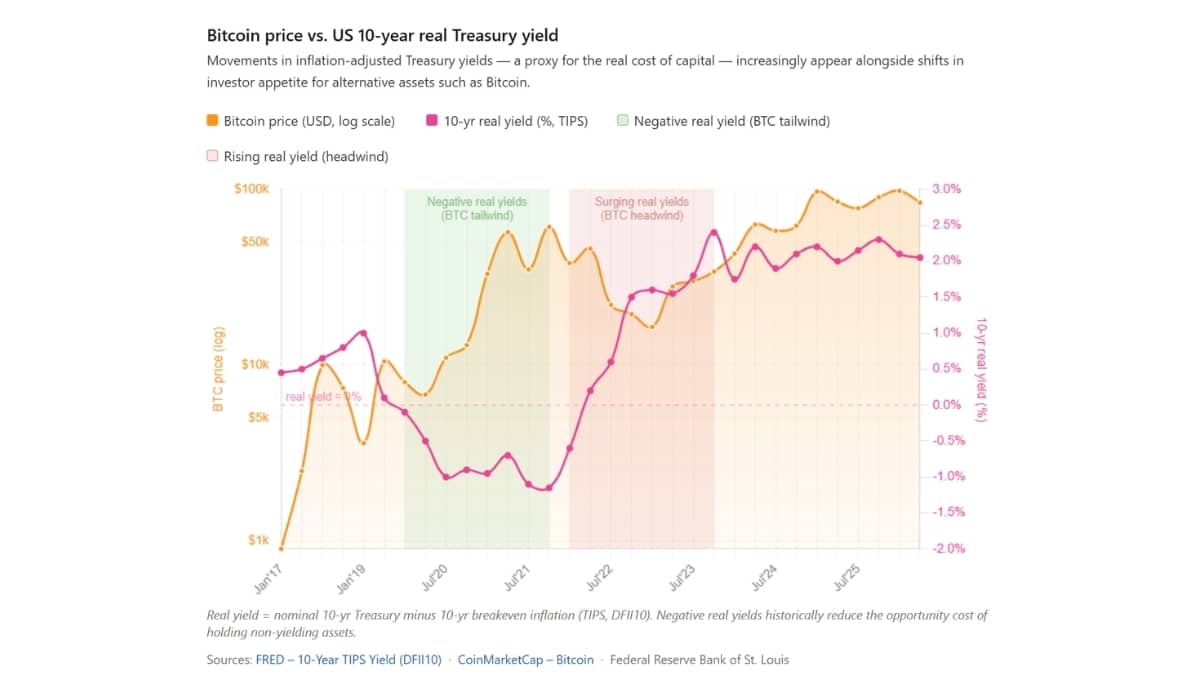
When real yields rise sharply, capital tends to move toward safer fixed-income instruments. When they fall, investors often begin searching for alternative stores of value.
Digital assets now appear to participate in these cycles more visibly than they once did.
Looking toward the next decade
From the vantage point of someone who entered the industry during the economic uncertainty of 2020, the transformation since then has been difficult to ignore.
Bitcoin increasingly resembles a macro-sensitive digital commodity—an asset influenced by liquidity conditions yet defined by a predetermined supply structure.
Ethereum continues evolving as a technological platform supporting applications that resemble parts of traditional financial infrastructure.
The next decade will likely determine whether these networks remain parallel experiments or become integrated components of global finance.
That outcome probably won’t arrive through a single breakthrough or policy decision.
More likely it will emerge gradually—through regulation, institutional participation and the continued work of developers building systems that operate quietly in the background.
Financial systems rarely change overnight. More often they evolve layer by layer.
Digital assets may simply represent the newest layer being added to a structure that has been under construction for centuries.