
Bitcoin and Ethereum prices fell on Wednesday after US inflation rose more than economists expected in September, raising concerns that the Federal Reserve could keep interest rates high or consider another increase.
According to data from CoinMarketCap (on October 14 at 17:33 UTC), Bitcoin is down 1.98% and currently trades for $81,776 and Ethereum has also lost about 5.05% to $2,437.
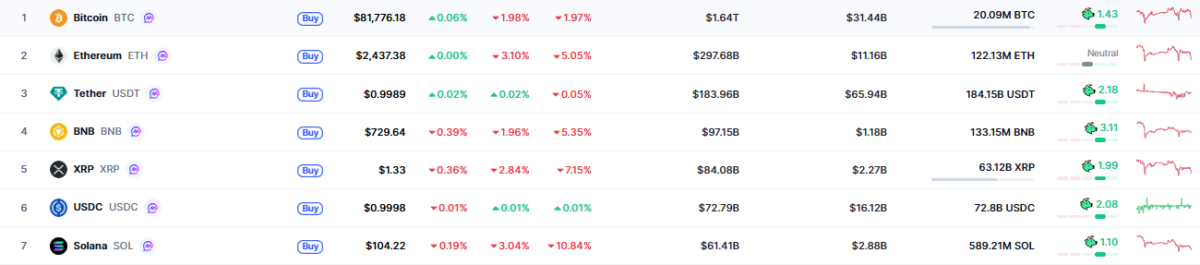
According to data from the US Bureau of Labor Statistics, the Consumer Price Index (CPI), which measures changes in the prices of goods and services, increased by 0.6% in September.
Annual inflation reached 3.7%, up from 3.4% in August and above economists’ forecast of 3.6%. The total crypto market value also fell 0.7% to $2.8 trillion, while Solana dropped 1.9% and XRP declined 1.3%.
Rising fuel prices keep inflation elevated
Higher gasoline prices were a major contributor to the monthly increase in inflation. Fuel prices jumped 9.1% in September and accounted for more than half of the monthly increase in consumer prices. When fuel becomes more expensive, businesses often pay more to transport goods and run their operations. These extra costs can spread to other products and services, making it harder for inflation to cool.
Core CPI, which excludes food and energy because their prices tend to be volatile, rose 2.6% over the past year, which is above the expected 2.5%. This reading matters because it helps show whether price increases are spreading beyond fuel and other items that often experience sharp price changes.
Higher oil prices may add to inflationary pressure by increasing transportation and production costs. Data from TradingView shows that oil is trading above $90 a barrel for much of the previous two months amid the war between the US and Iran. Higher oil prices can increase the cost of producing and moving goods, keeping prices elevated across the economy.
Fed rate hike fears put pressure on crypto
The higher inflation reading has also changed expectations for the Federal Reserve’s next move. The central bank raised interest rates in September to a range of 3.75% to 4.00%. According to CME FedWatch, the chance of another rate increase at the October 27–28 meeting rose from 22% before the inflation report to between 62.9% and 37.1% afterward.
Higher interest rates can make borrowing more expensive and reduce the money available for risky investments. They can also make government bonds more attractive to investors compared with cryptocurrencies, which do not pay fixed interest.
Crypto liquidations increase as traders face losses
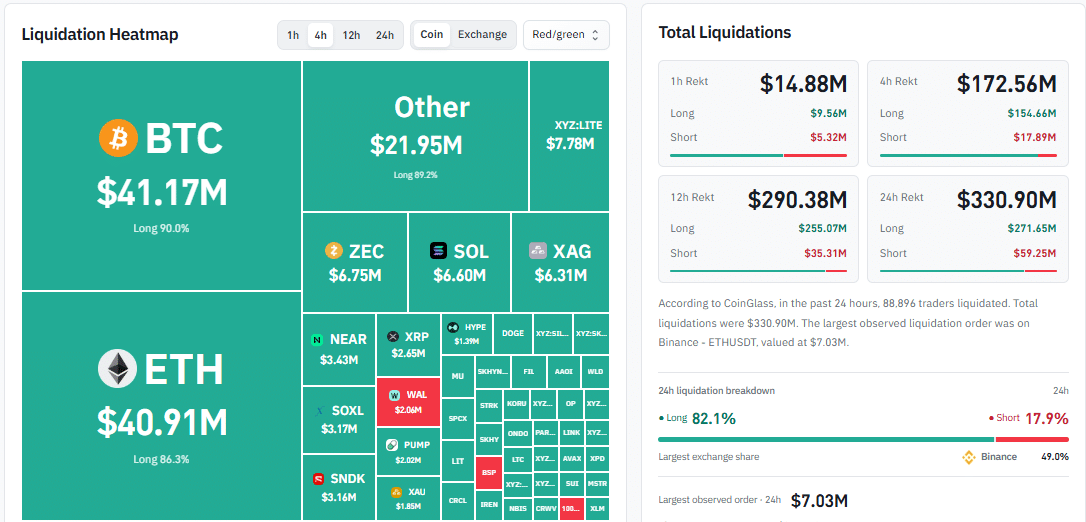
Market volatility also triggered liquidations of leveraged crypto positions, forcing traders to close positions when they failed to meet margin requirements.
According to data from Coinglass (on October 14 at 17:33 UTC), about $172.56 million has been liquidated from the market within the last 4 hours. Bitcoin long positions accounted for around $41.17 million with Ethereum accounting for $40.9 million. This added to around $330.90 million in total liquidation in the last 24 hours.
Bitcoin watches key support levels
Despite the decline, Bitcoin remained near a support level traders were monitoring. According to the TradingView chart, the asset is currently at a support level near $81,603.
A daily close below that price could expose Bitcoin to further declines toward $80,365 and then $78,003. On the other hand, if price respects the support level, it could push the token up to the nearest resistance level at $86,000.
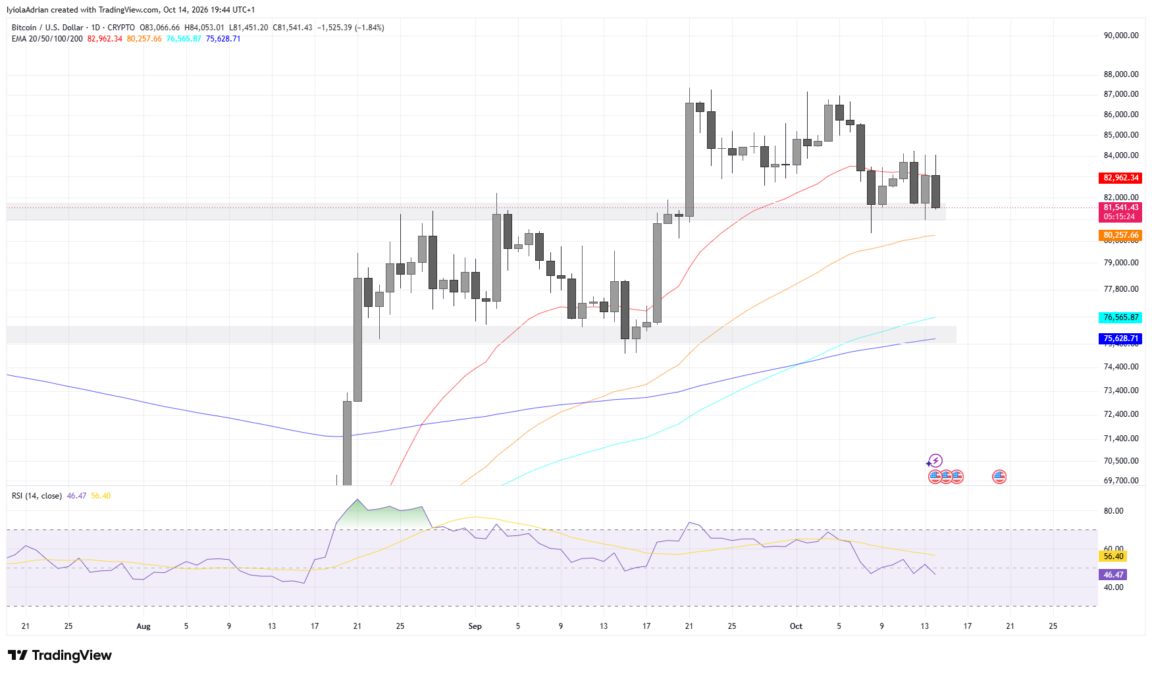
However, Bitcoin is trading below its 20-day, 50-day, 100-day and 200-day moving averages, while its Relative Strength Index (RSI) stands at 47.05. This suggests that the market has broken below the average level and is approaching the oversold level.
Bitcoin ETF inflows recover as markets await the Fed’s next move
Nicolai Sondergaard, senior research analyst at Nansen, also pointed to a gap between investment fund demand and direct buying activity. Bitcoin exchange-traded funds (ETFs) recorded $175.7 million in inflows on October 13, following $678.9 million in outflows between October 5 and 9 and another $65.4 million in outflows on October 12.
“The ETF demand is recovering faster than on-chain conviction,” Sondergaard said in a statement shared with The Crypto Times.
The next test for financial markets is the US Producer Price Index, which measures changes in prices received by producers. Investors will also watch the Federal Reserve’s October 28 rate decision for clues about what comes next for interest rates and the crypto market.
Also Read: BitMEX Sued Over $26.5M in Bitcoin Trading Losses Linked to UK Derivatives