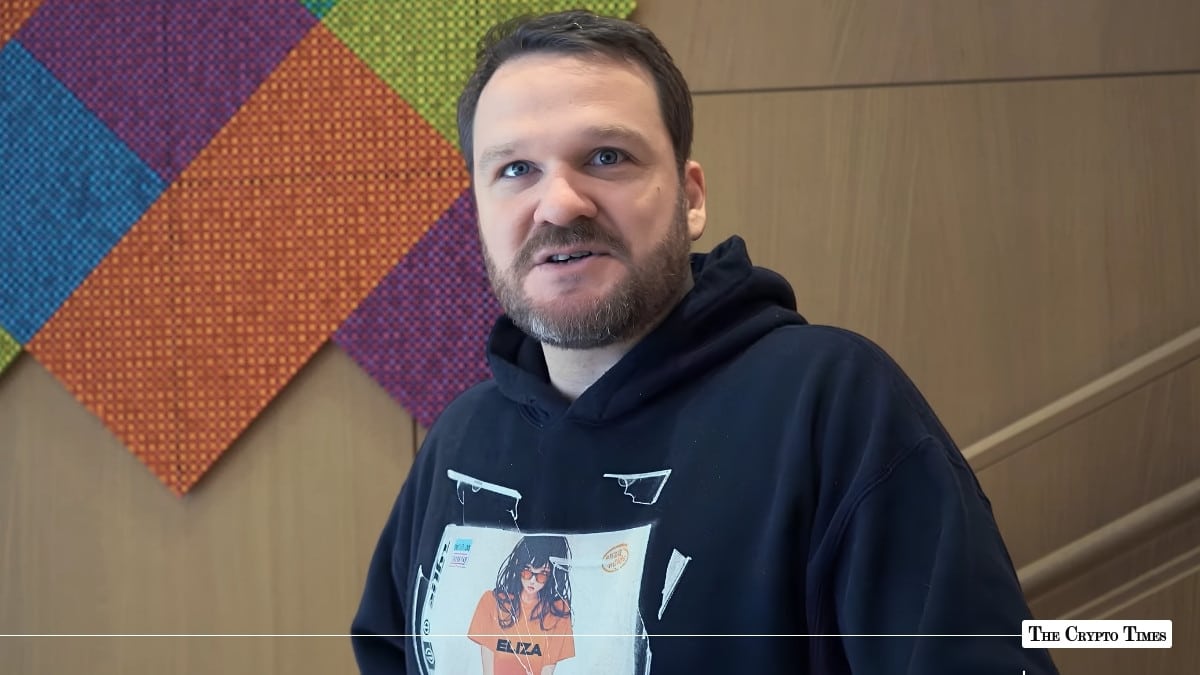
Shaw Walters, the Founder of Eliza Labs and the public face of the project that began life as ai16z before rebranding to ElizaOS, said on Tuesday that the associated token is “completely dead” and that the ElizaOS Foundation is winding down after settling a federal class-action lawsuit brought by Burwick Law.
Writing on his personal account on X, Walters said the team handed over the remainder of its treasury and cash reserves to plaintiffs represented by Burwick, framing the outcome as a forced capitulation rather than an admission of wrongdoing.
“Their claim was ridiculous, but we didn’t have the capital to legally fight it so we settled on giving them the rest of what we had,” Walters wrote. “The token is dead. Completely. The foundation is winding down.”
He added that he never sold any of his personal holdings, that he was paid a salary comparable to other engineers on the team, and that he is now living on savings while continuing to develop the underlying open-source software. Walters said he retains the intellectual property behind the Eliza framework, but will not allow any future token to be attached to it. “I am starting over,” he wrote, “and I am never letting a token come close to Eliza again.”
From a $2.6 Billion Peak to a Wind-Down
The project launched on Solana on October 24, 2024 under the ticker $AI16Z, and was marketed as the first venture-capital-style DAO run by autonomous AI agents. It became one of the defining trades of the late-2024 AI-agent narrative, driven in part by a viral November 18, 2024 exchange in which a16z Crypto CTO Eddy Lazzarin replied “Check your DMs” to a Walters post on X. Burwick would later cite that single moment in its complaint as adding more than $170 million in market value within 24 hours.
$AI16Z peaked at roughly $2.47 on January 2, 2025, according to CoinMarketCap data, implying a fully diluted valuation of more than $2.5 billion at the time. The rally faded almost as fast as it began. Andreessen Horowitz demanded that the project drop the “ai16z” name shortly after, and Walters announced the rebrand to ElizaOS in late January 2025.
The original $AI16Z ticker still trades as a legacy contract, and the numbers tell the story of the collapse on their own. At the time of writing, $AI16Z changes hands at roughly $0.00029 with a market capitalization of just $316,000, a drawdown of more than 99.99% from its January 2025 high.
Daily trading volume has fallen to around $6,600. Its all-time low of $0.000176 was set on February 13, 2026, less than three months before the class action landed. Circulating supply remains capped at 1.09 billion tokens.
The migration to $ELIZAOS, executed between October and November 2025, expanded the total supply from roughly 1.1 billion to 11 billion tokens through a 1:10 redenomination, with existing holders offered a 1:6 swap. That new token now trades at around $0.00037, giving it a market capitalization of roughly $2.8 million and a fully diluted valuation of about $4.1 million as per CoinGecko data.
Its own all-time high (ATH) of $0.03946, set on November 7, 2025 shortly after migration, is already down more than 99%. Trading volume, at just over $1 million a day, sits almost entirely on the new contract, an indicator that most of the remaining speculative interest crossed over during the swap window and the legacy $AI16Z pool has effectively been abandoned.
Inside the Burwick Class Action
The settlement resolves Doe v. Walters (Case No. 1:26-cv-3238), the federal class-action complaint that Burwick Law filed on April 16, 2026 in the U.S. District Court for the Southern District of New York (SDNY) on behalf of purchasers of both $AI16Z and its successor token $ELIZAOS.
The complaint named Eliza Labs Inc., Walters, Sebastian Quinn-Watson, and AI16Z DAO as defendants, alongside 50 unnamed parties. It asserted claims under New York General Business Law §§ 349 and 350, together with negligent misrepresentation and unjust enrichment, and sought actual damages, treble damages, disgorgement, and a constructive trust over traceable treasury assets.
Burwick’s central allegation was that the project was marketed as being governed by an autonomous AI agent when it was in fact operated manually, echoing an October 30, 2024 Protos report that first raised doubts about the autonomy of the “Marc AIndreessen” persona.
The firm further alleged that the project leveraged the a16z brand association to inflate demand, and that the migration to ELIZAOS diluted existing holders by allocating roughly 40% of new supply to insiders, private investors and team-linked entities, leaving 60% for legacy holders.
The complaint also revisited the controversial launch of a separate $ELIZA token on November 19, 2024, rolled out nine days after Walters had publicly stated that the project would “not create a coin.”
The original community token crashed by around 87% within 15 minutes of the new launch, while the new token briefly surged past a $100 million market capitalization. Blockchain analytics firm Lookonchain later flagged wallets that appeared to have pre-positioned ahead of the announcement.
Walters has consistently disputed the substance of those allegations, and his Tuesday statement framed the litigation and the broader community reaction as symptoms of speculative excess rather than evidence of project failure. Settlement terms beyond his own description have not been independently confirmed in public court filings as of Wednesday morning, and Burwick Law had not issued a public response at the time of publication.
An Unusually Heavy Overhang, Even for the Cycle
Even by the standards of the AI-agent sector, ElizaOS was carrying more weight than most projects by the time Burwick filed. Walters and Eliza Labs were already in litigation against Elon Musk’s X Corp, a suit filed in August 2025 in federal court in San Francisco that accused X of extracting technical information from the company under a cease-and-desist order and then launching a competing agent product, Ani, immediately after.
Both the personal and official Eliza accounts were suspended from X for around six months before being reinstated in December 2025, a period during which the token’s liquidity thinned dramatically.
Market analysts noted that these overlapping pressures, including the corporate rebrand, the token migration that expanded supply tenfold, and ongoing legal disputes with major platforms, coincided with a prolonged contraction in trading volume. According to Walters’ statement, the settlement terms with Burwick subsequently exhausted the foundation’s remaining liquid reserves, bringing operations to a halt.
Analysis: The End of a Defining AI-Agent Trade
The wind-down closes one of the most closely tracked experiments of the 2024 to 2025 AI-agent cycle, and reads as a case study in the structural tension between open-source technical development and freely tradable governance tokens.
At its January 2025 peak, ai16z sat near the center of a narrative that briefly turned autonomous agents into one of crypto’s hottest categories, sharing the stage with the Virtuals Protocol on Base and a wave of Solana-based agent tokens.
The economics of that trade depended, more than most participants acknowledged at the time, on the solvency of a small number of project treasuries. Once the settlement pulled the ElizaOS treasury out of the picture, the last institutional support for the token disappeared, which lines up neatly with the on-chain price action.
Walters’ decision to separate the intellectual property from the token, and to explicitly reject any future token attachment, is arguably more consequential than the wind-down itself. It fits a quiet but growing pattern among founders who have concluded that a continuously priced token introduces more governance friction than it does capital efficiency, particularly for infrastructure projects where the actual users are developers rather than traders.
Whether the Eliza framework retains relevance in that mode will depend on adoption by builders working on local, private, or crypto-enabled agents, an audience Walters himself has repeatedly argued sits well outside the current crypto social media cycle.
The wind-down is unlikely to be an isolated event. Several of the tokens that rode the same 2024 to 2025 wave are now trading at similar drawdowns from peak, and Burwick alone maintains active class actions against a long list of Solana-native launches, including $ZEREBRO, $M3M3, $LIBRA, $HAWK, $BELIEVE, and the Pump.fun and Solana RICO complaint. The legal cycle for the AI-agent cohort is only beginning to clear.
For holders of $ELIZAOS and the legacy $AI16Z, Walters’ statement is effectively a formal notice that no operating entity remains behind either token. For Walters personally, it appears to mark a reset, back to open-source software development, and away from a token model he now describes in his own words as something he will never repeat.
“We’re still building Eliza and the underlying OS,” he wrote in the closing line of his post. “Eliza is dead. Long live Eliza.”
Also Read: Binance Founder Warns Crypto Users After Coldcard Hack Tops $70M