
Key Highlights
- Hyperscale Data stock surged 5.5% after the company sold about 100 Bitcoin to help fund its Michigan AI campus.
- The company said it used part of its Bitcoin treasury and a Bitcoin-backed credit facility to finance AI expansion while keeping its long-term Bitcoin strategy.
- Hyperscale Data joins other major Bitcoin firms like MARA, Bitdeer, Strategy, and Core Scientific in using Bitcoin holdings to support business growth.
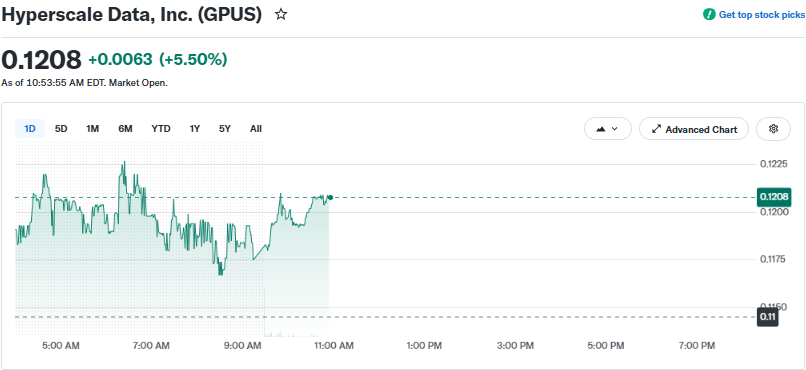
Hyperscale Data (NYSE American: GPUS), a Bitcoin treasury and digital infrastructure company, saw its stock rally about 5.50% during Thursday’s trading session after it announced that it sold about 100 Bitcoin and secured a Bitcoin-backed credit facility to help fund the development of its Michigan AI campus.
The company disclosed the transaction but did not mention when the Bitcoin was sold or how much it sold it for. Following the announcement, GPUS shares rebounded from below $0.1150 to around $0.1209, lifting the company’s market capitalization to approximately $42 million. Trading volume also remained elevated compared with recent sessions.
Bitcoin treasury helps fund AI expansion
According to the company, proceeds from the Bitcoin sale will be used to fund construction, purchase critical infrastructure, and acquire long-lead equipment required for the Michigan AI campus.
Moreover, Hyperscale established a Bitcoin-backed credit facility that allows it to borrow money while using its remaining Bitcoin holdings as collateral. The company said the loans are expected to carry variable interest rates between 4.5% and 5.0%. The company described the move as “monetizing” part of its Bitcoin treasury to support the Michigan project.
Chief Executive Officer William Horne said the company still believes in Bitcoin despite selling part of its holdings. “This decision does not constitute a change in our long-term conviction regarding Bitcoin,” Horne said. “By selectively monetizing and financing against a portion of our Bitcoin holdings, we are shifting one balance sheet asset for another.”
AI deal could bring billions in revenue
Hyperscale Data said it has built a Bitcoin treasury worth about $71 million through its mining operations and treasury management. Rather than raising more money by selling new shares or taking on costly debt, the company believes using part of its Bitcoin holdings and borrowing against the rest gives it access to lower-cost funding while keeping meaningful exposure to Bitcoin.
The money will help support the company’s previously announced master services agreement with a neo-cloud AI infrastructure provider. Under the agreement, Hyperscale Data will provide about 20 megawatts of AI computing capacity over an initial 10-year period. The contract also includes two optional five-year extensions. If the agreement runs for the full term, the company expects it to generate more than $1.2 billion in revenue.
The customer also has the right to request another 32 megawatts of AI computing capacity during the first two years of the agreement. If that option is used and continues through the full contract period, Hyperscale Data said total revenue from the deal could exceed $3 billion.
Following the partial sale, the company ranks as the world’s 44th-largest publicly disclosed corporate Bitcoin holder, according to BitcoinTreasuries.net.
More Bitcoin firms are selling their holdings
Hyperscale joins a growing number of Bitcoin-focused companies using their crypto holdings to fund expansion rather than treating them solely as long-term treasury assets.
Earlier this year, MARA Holdings sold 15,133 Bitcoin to repurchase convertible senior notes and support its expansion into digital energy and AI infrastructure. Bitdeer Technologies even went all in and sold all its remaining Bitcoin reserve as it expanded its data center and AI business.
Moreover, Strategy sold 3,588 Bitcoin in July to strengthen dollar liquidity, while Core Scientific has indicated it expects to sell more than 2,500 Bitcoin to fund its AI compute expansion.
The trend reflects how Bitcoin treasury strategies are evolving as companies increasingly view their holdings as a source of capital for infrastructure investment. Even so, firms adopting this approach remain exposed to Bitcoin price volatility, meaning future financing flexibility will continue to depend on broader cryptocurrency market conditions.
Also Read: Samson Mow Warns Bitcoin Against Rushing Post-Quantum Upgrade