
The cryptocurrency market continues to exhibit notable resilience in mid-July 2026, holding firm despite broader economic uncertainties and seasonal thin liquidity. After a challenging June marked by sharp drawdowns and heavy outflows from investment products, digital assets have stabilized in a narrow trading range.
Bitcoin, the market leader, has maintained levels above key psychological supports, while the total crypto market capitalization hovers steadily around $2.2–$2.3 trillion. This period of calm follows an initial July rebound, reflecting a market that is absorbing pressure without capitulation. Investors appear cautiously optimistic, supported by improving institutional flows even as retail sentiment remains subdued.
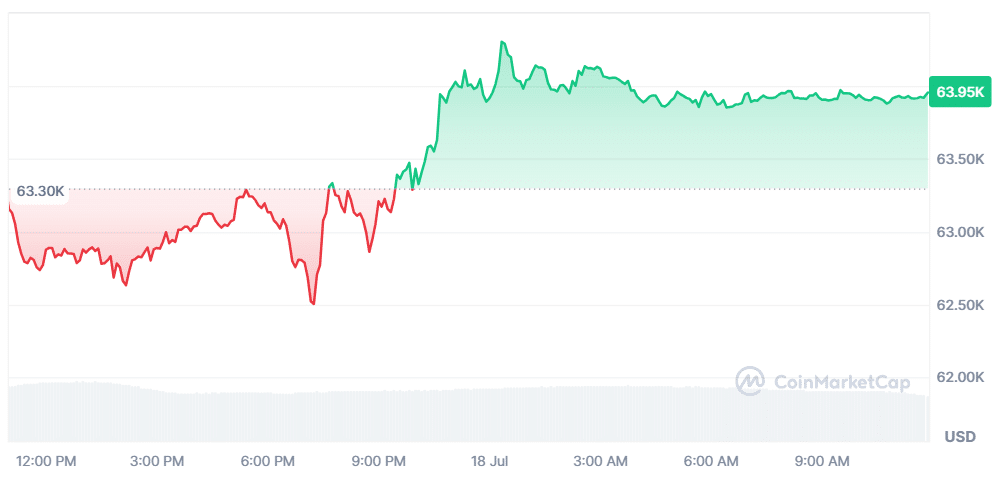
Over the past two days (July 16–17), price action has been characterized by low-volatility consolidation rather than sharp moves. Bitcoin traded between approximately $62,489 and $64,942, closing at roughly $63,796 on July 16 and $63,902 on July 17—a modest net gain of about 0.17% across the period.
At the time of publishing, BTC was trading at $63,957—up 2% in the past 24 hours, as per CoinMarketCap data.
Ethereum and major altcoins mirrored this pattern, showing limited directional conviction. Trading volumes remained moderate, with Bitcoin seeing roughly $5.35 billion to $5.90 billion daily, consistent with summer market conditions.
This sideways movement underscores a market in digestion mode, building a base after earlier gains while awaiting clearer macroeconomic or regulatory signals.
Recent Price Action: Consolidation Takes Center Stage
The past two days highlighted a textbook consolidation phase for the broader crypto market. On July 16, Bitcoin tested highs near $64,942 but faced selling pressure that prevented a sustained breakout, ultimately closing near $63,796. The following day saw an intraday dip toward $62,489—a level that found buying interest quickly—before recovering to close slightly higher at around $63,902.
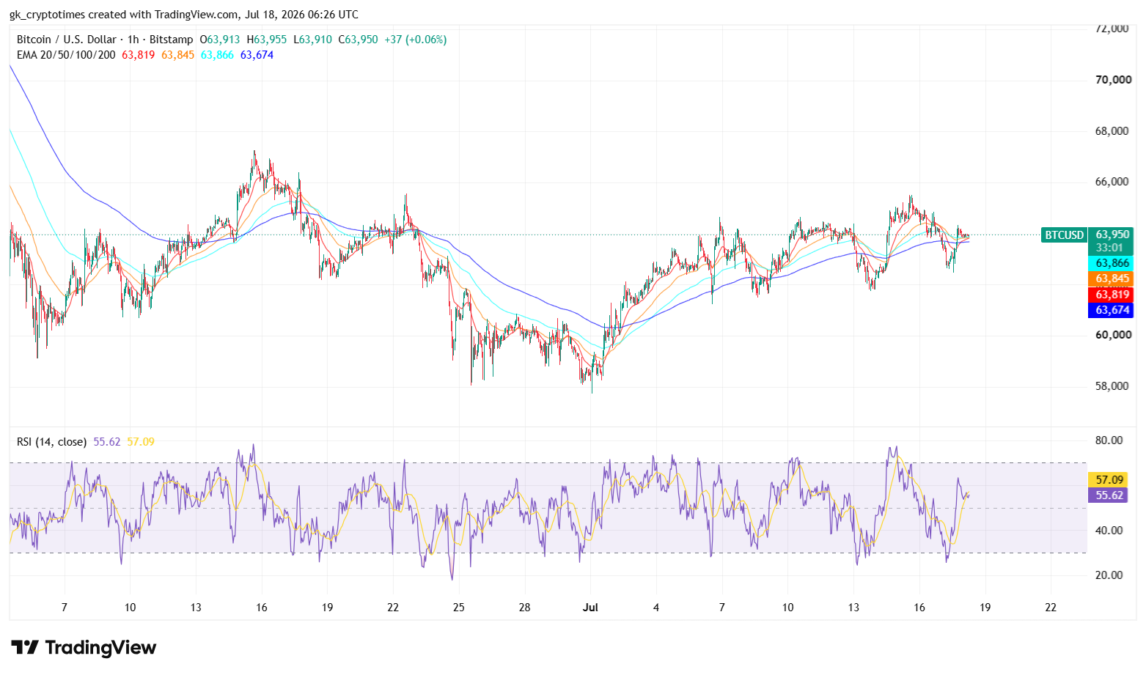
This pattern of defending supports while failing to clear overhead resistance illustrates a market lacking strong momentum but demonstrating underlying bid strength.
Ethereum traded in a comparable range around $1,800–$1,850, posting minor relative outperformance at times. Altcoins broadly remained range-bound, with Bitcoin dominance holding steady near 56.4%. This concentration of capital in large-cap assets suggests investors are favoring safety amid uncertainty rather than chasing higher-risk opportunities.
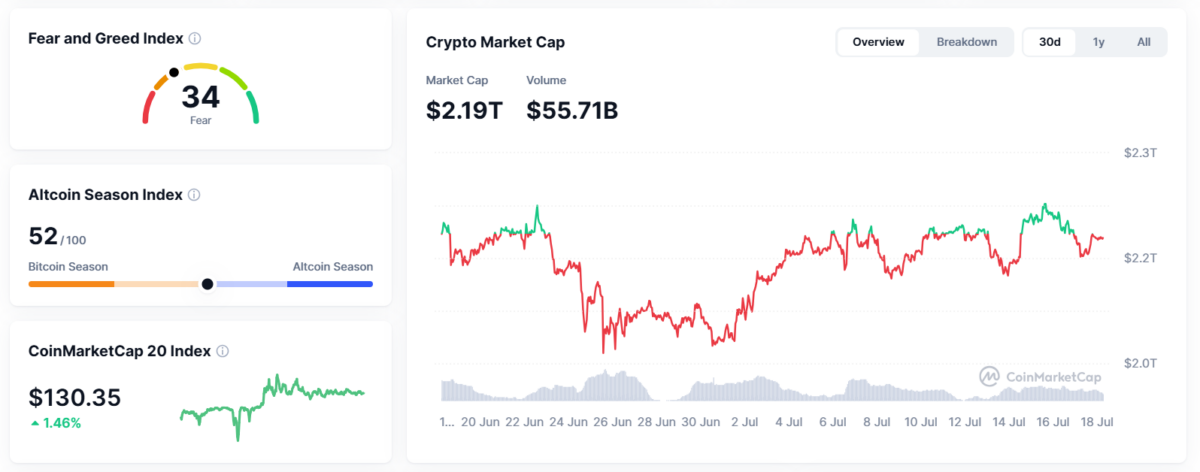
The total crypto market capitalization—currently sitting at $2.19 trillion—showed minimal fluctuation, up just 0.3–0.4% in aggregate snapshots, while the Fear & Greed Index lingered in the Extreme Fear zone around 25 to 35. Such readings often precede relief rallies when positive catalysts emerge, as overly pessimistic positioning can fuel short squeezes.
Notably, derivative data reinforced the cautious tone. Coinglass data shows that perpetual funding rates stayed mildly positive, indicating longs were paying a modest premium without excessive leverage buildup. Liquidations remained contained compared to earlier volatile periods, avoiding cascading effects. Spot trading volumes, while not booming, provided enough liquidity to absorb flows without extreme slippage.
This environment reflects a maturing market where participants are positioning defensively rather than speculating aggressively during the typical summer lull. Weekend trading often amplifies these dynamics due to lower participation from institutional players.
Institutional Flows and Macro Backdrop Fuel Resilience
A primary pillar of the recent resilience has been the turnaround in institutional demand, particularly through U.S. spot Bitcoin and Ethereum ETFs. After weeks of outflows that pressured prices in June, these products have seen constructive inflows in recent sessions, with Bitcoin ETFs recording notable positive days exceeding $100–$200 million.
This institutional buying has acted as a stabilizing force, offsetting retail caution and providing real demand for underlying assets.
Macroeconomic factors have played a dual role. Easing concerns around aggressive rate hikes, driven by softer U.S. jobs data and cooling inflation readings earlier in the month, have supported risk assets broadly. However, countervailing pressures such as rising oil prices, equity market volatility, and lingering geopolitical tensions in the Middle East have kept a lid on upside momentum.
Crypto’s ability to hold steady amid these crosscurrents—unlike more pronounced drawdowns in prior cycles—points to a stronger holder base, including long-term investors who accumulated near recent lows. On-chain metrics suggest whale accumulation in Bitcoin during dips, further anchoring prices.
Market Outlook: Range-Bound Stability or Imminent Breakout?
Looking ahead, the crypto market appears poised between continued consolidation and a potential breakout. Key resistance for Bitcoin lies in the $64,500–$65,000 zone; a decisive weekly close above this level could open the path toward $67,000 and retest recent highs. Conversely, a breakdown below $62,000–$62,500 would test deeper supports near $58,000–$60,000, though current buyer interest makes this scenario less probable in the near term without a major negative shock.
Several catalysts could influence the coming weeks. Continued ETF inflows would bolster confidence, while upcoming U.S. economic data releases and Federal Reserve commentary may sway risk appetite.
Seasonality favors July historically for Bitcoin, adding another layer of potential upside bias. However, thin liquidity means moves could be exaggerated in either direction once conviction returns. Altcoin rotation remains limited for now, but any sustained Bitcoin strength above $65,000 often precedes capital flowing into higher-beta assets.
Although risks still persist, including renewed macroeconomic surprises or regulatory delays. The Extreme Fear sentiment, while indicative of capitulation potential, also warns against complacency—markets can remain range-bound longer than expected. Investors should monitor on-chain flows, ETF reports, and funding rates closely for early signals of shifting dynamics.
Also read: FTX Creditors Set for $900M Windfall in Fifth Repayment