Key Highlights
- Glassnode measured Robinhood Chain submission latency at 3 milliseconds from Ohio, compared with 140 milliseconds from Tokyo and 200 milliseconds from Sydney.
- With Robinhood Chain producing blocks every 100 milliseconds, the Ohio-to-Sydney difference represents almost two blocks of potential ordering advantage.
- The measurements reveal a geographic latency advantage but do not prove that U.S. traders have actually front-run specific transactions.
Traders operating near Robinhood Chain’s sequencer in Ohio could gain an almost two-block advantage over users submitting transactions from Asia-Pacific markets, according to new latency data published by Glassnode.
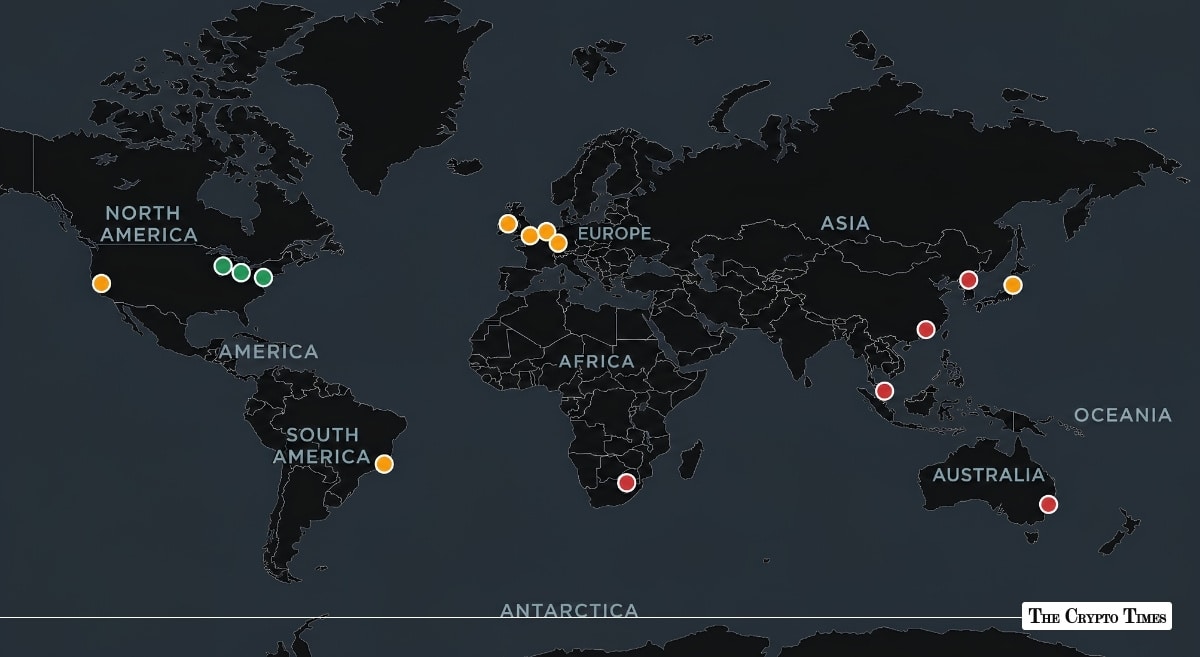
The analytics firm measured the time required to submit transactions to the network from probes located around the world. Its results showed latency of just 3 milliseconds from Ohio, where the sequencer is located.
Latency increased to 18 milliseconds from Virginia and 27 milliseconds from Chicago. Transactions submitted from London took 91 milliseconds, while Tokyo and Sydney recorded delays of 140 milliseconds and 200 milliseconds, respectively.
Robinhood Chain produces blocks approximately every 100 milliseconds. That means a trader in Ohio could potentially reach the sequencer around 197 milliseconds earlier than someone in Sydney, equivalent to nearly two Robinhood Chain blocks.
Robinhood’s first-come system creates a latency race
Robinhood Chain uses a first-come, first-served sequencing model. Transaction order depends on when each transaction reaches the sequencer rather than how much a user pays in priority fees.
Robinhood says this prevents users from jumping ahead by paying higher fees. However, it also means traders with faster network connections and infrastructure located closer to the sequencer may consistently reach the transaction queue first.
Glassnode identifies the Robinhood Chain sequencer as operating from Amazon Web Services’ Ohio region. Its latency monitor states that, under strict first-come ordering, physical distance from the sequencer can directly affect a trader’s position in the queue.
The geographic advantage becomes more significant because Robinhood Chain advertises 100-millisecond block times, considerably shorter than the latency difference between Ohio and several Asian and Australian locations.
A trading firm responding to a price movement from infrastructure in Ohio could therefore submit an arbitrage, swap or liquidation transaction before a competing firm operating from Tokyo or Sydney.
Does the data prove front-running?
The measurements do not show that a particular U.S. trader observed another user’s pending transaction and deliberately moved ahead of it.
Traditional front-running involves acting on advance knowledge of an incoming order. Glassnode’s data instead demonstrates the conditions for a latency race, where traders closest to the sequencer can react to market information and submit transactions faster than geographically distant competitors.
The advantage could still influence arbitrage opportunities, liquidations and trading around oracle price updates. However, evidence from individual transactions would be required to establish that systematic front-running is taking place.
The claim also does not necessarily involve Robinhood’s tokenized stocks. Robinhood states that its Stock Tokens are unavailable to U.S. persons, although the underlying blockchain is permissionless and supports other applications, including swaps, lending and perpetual futures.
Why it matters
Robinhood Chain is designed as infrastructure for tokenized financial markets, where fractions of a second can determine which trader captures an arbitrage opportunity or receives the most favorable execution.
Its 100-millisecond blocks improve transaction responsiveness, but the combination of rapid block production and a single first-come sequencer may make server location an important competitive factor.
The measurements suggest that equal fee treatment does not necessarily create equal transaction access. Traders able to place infrastructure close to the Ohio sequencer may retain an advantage over retail users and firms operating elsewhere.
What’s next
Developers and trading firms are likely to respond by moving transaction infrastructure closer to Ohio or using low-latency relay and RPC services.
Robinhood could also face questions about whether it plans to introduce geographic relays, encrypted transaction submission, transaction batching or other systems designed to reduce location-based ordering advantages.
Robinhood Chain transactions initially receive sub-second soft confirmation from the sequencer. Full Ethereum-backed finality arrives later, after transaction batches are posted to Ethereum and finalized.
Also Read: Fact Check: Was Robinhood Founder’s Seed Phrase Really Leaked?