As the 2026 FIFA World Cup unfolds across stadiums in the United States, Canada, and Mexico, a parallel drama is playing out in the digital realm.
Prediction market platform Polymarket has shattered records, with its flagship World Cup Winner contract alone surpassing $2.34 billion in trading volume since launching last year. Additionally, hundreds of additional markets—covering match outcomes, group advancements, player props, and novelty bets—have pushed total FIFA-related activity even higher, signaling a seismic shift in how fans and sharp money engage with the world’s biggest sporting event.
This isn’t fringe activity. With real USDC settlements, transparent order books, and 24/7 trading, Polymarket and rivals like Kalshi are carving out a sophisticated niche in a global betting landscape projected to exceed $50 billion.
Being one of the most-watched sports tournaments, the World Cup’s early group stage volatility, surprise results, and high-stakes matchups have fueled daily volumes in the tens of millions, drawing in everyone from retail enthusiasts to crypto whales hunting probabilistic edges.
The surge reflects broader trends: maturing crypto infrastructure, growing acceptance of event contracts, and a hunger for more nuanced ways to wager on football beyond traditional sportsbooks.
Surging Volumes Redefine Sports Prediction Markets
Polymarket’s World Cup Winner market stands as a behemoth, with cumulative trading now well over $2.34 billion and liquidity pools often exceeding $350 million.
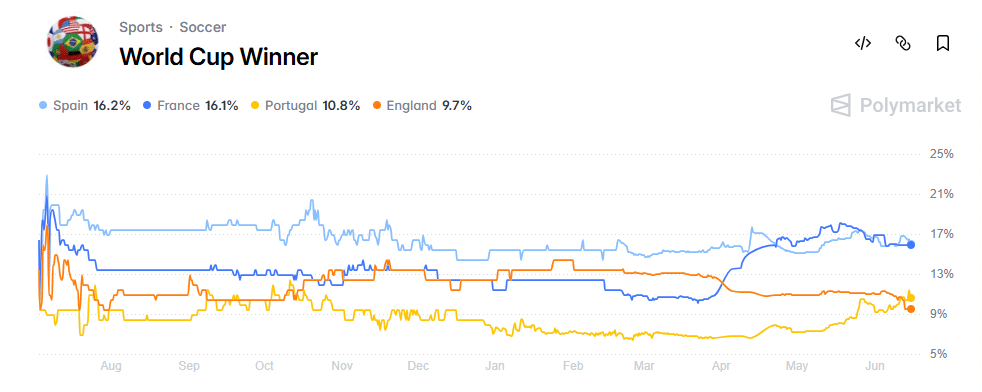
Individual nation contracts for frontrunners like France and Spain have each generated tens of millions in volume, while even long-shot teams command respectable flows. On peak days surrounding openers and key clashes, the daily trading volume for respective bets even surpasses $100 million.
Combined with Kalshi, FIFA-related contracts have easily cleared the $3 billion mark, with Polymarket dominating the space—often accounting for over 95% of certain high-profile volumes. This dwarfs previous sports events on the platform and positions the tournament as potentially its largest ever outside major elections.
Retail participation is evident in markets for co-host nations like the United States, which have seen over $50 million traded despite modest outright odds. Meanwhile, sharp traders focus on granular edges in group dynamics and player performance. The platform lists hundreds of active contracts, from straightforward moneyline bets to complex futures, creating a vibrant, interconnected web of probabilities that update in real time with lineups, injuries, and on-pitch developments.
This liquidity has professionalized sports forecasting. Prices often align closely with aggregated expert consensus but react faster to new information, offering a live gauge of collective wisdom.
Favorites and Market Dynamics Shape the Field
Current pricing paints Spain and France as narrow co-favorites, each hovering around 16% implied probability to lift the trophy at MetLife Stadium. Portugal, England, Argentina, and Brazil follow, with defending champions Argentina carrying the weight of history and star power. These percentages shift daily as group results cascade through advancement and knockout markets.
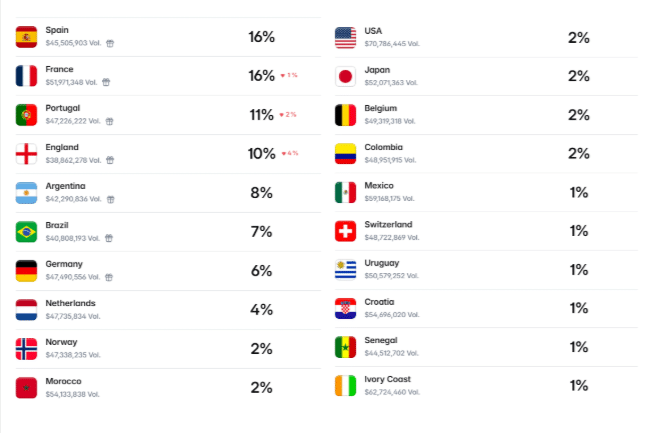
Beyond the outright winner, depth abounds. Golden Boot races feature heavy trading on names like Kylian Mbappé, while “Which Continent Will Win?” and team-to-advance contracts provide hedging opportunities. Match-specific markets—spreads, totals, and props—see concentrated action during live play, with volumes spiking when underdogs threaten upsets.
The multi-nation hosting format adds unique variables like travel fatigue, pitch conditions across time zones, and fan atmospheres that traditional oddsmakers model imperfectly. Prediction markets, by contrast, incorporate crowd-sourced insights instantly. An early goal or red card can swing contract prices within minutes, rewarding those glued to both the pitch and the order book.
Whale Activity and High-Stakes Plays Drive Headlines
With the frenzy meeting crypto’s anonymity, massive positions have become routine. One trader risked over $3 million on the Netherlands to defeat Japan in a Group F opener, injecting tension into an already compelling match and pushing that single game’s volume past $26 million. Such bets highlight the platform’s appeal for high-conviction plays where perceived mispricings—perhaps undervalued squad depth or tactical mismatches—create outsized payout potential.
Clusters of multi-million-dollar bets on correlated outcomes are common. Some participants build broad portfolios backing most major nations while shorting weaker sides, effectively creating synthetic parlays. Others pounce on sentiment dips, buying shares in undervalued teams after public overreactions to early draws. Daily profit-and-loss leaderboards frequently feature six- and seven-figure swings, underscoring the zero-sum intensity.
This whale presence amplifies liquidity but also raises questions about market influence. In thinner contracts, large orders can temporarily distort prices before broader participation corrects them. Yet for flagship markets, efficiency remains high, with arbitrage opportunities quickly erased between Polymarket and traditional books.
The Broader Impact on Sports Wagering and Regulation
The World Cup arrives amid evolving U.S. gambling rules and crypto adoption. Prediction markets operate in a regulatory gray zone in many jurisdictions, yet their transparency—every trade visible on-chain—contrasts with opaque sportsbook operations. This openness appeals to a tech-savvy demographic seeking more than point spreads.
Watching Polymarket at the frontline, traditional operators are taking notice. Some use Polymarket flows to calibrate their own lines, while others experiment with hybrid models. Global projections of $50 billion in total wagers suggest prediction platforms will capture a growing share, particularly among younger bettors drawn to player props, custom builders, and in-play trading.
Despite the scale of volume, challenges persist. Responsible gambling tools lag behind the ease of crypto deposits and leveraged positions. Critics worry about information asymmetries favoring well-resourced traders and the potential for manipulation in lower-volume markets. Regulators in the U.S. and elsewhere continue monitoring as volumes climb, balancing innovation against consumer protection.
Still, the democratization effect is undeniable. Anyone with internet access and stablecoins can participate alongside whales, turning passive fandom into active investment in football’s narratives.
Looking Ahead: Knockouts Promise Even Greater Intensity
With the group stage delivering surprises and tightening futures, attention now turns to knockout rounds. Elimination markets will see heightened drama as favorites confront do-or-die scenarios. The final in July could generate single-day volumes rivaling entire prior events, cementing prediction markets as fixtures in major tournaments.
For Polymarket, this World Cup validates a model built on collective intelligence and skin in the game. As more granular contracts launch—perhaps tactical props or referee decisions—the platform evolves from betting venue to comprehensive forecasting ecosystem.
Football has always thrived on uncertainty. Now, that uncertainty has a price, updated second by second, traded by thousands worldwide. Whether a late winner or a penalty shootout decides the champion, the markets will reflect it first—and reward those who read the probabilities best.
In this emerging arena, the beautiful game isn’t just played on grass. It’s priced, hedged, and celebrated in pixels, where a well-timed trade can feel as exhilarating as a stoppage-time goal.
Also read: 15 Days to MiCA: 75% of EU Crypto Firms Race Against July 1 Cutoff