
In a significant step for bridging traditional finance and digital assets, Bitwise Europe has launched the Bitwise Canton ETP (Ticker: BWCC), providing exchange-traded exposure to Canton Coin (CC), the native token of the Canton Network.
The product, listed today on May 26, 2026 on Deutsche Börse’s Xetra, targets growing institutional interest in privacy-focused blockchain infrastructure designed specifically for capital markets.
As shared in the official release, the ETP is physically backed by CC tokens held in cold storage, allowing investors to gain exposure through standard brokerage accounts without needing crypto wallets or direct token custody.
With a total expense ratio (TER) of 0.85% per annum, it tracks the Kaiko CANTO Reference Rate LDNLF index, net of fees. ISIN DE000A4ARTH9 and WKN A4ARTH complete its regulatory credentials in Germany.
This launch comes amid accelerating tokenization of real-world assets (RWAs) and reflects Bitwise’s strategy to expand its European crypto ETP suite with institutionally relevant projects.
Canton Network: Privacy-First Blockchain Built for Wall Street
The Canton Network claims to be a privacy-enabled public Layer-1 blockchain engineered for financial institutions. Unlike transparent public chains such as Bitcoin or Ethereum, a privacy blockchain ensures participants only see and validate transaction details relevant to them, a critical feature for banks handling sensitive data.
Developed with input from major players including Goldman Sachs, BNP Paribas, Deutsche Börse, Broadridge, and others, Canton Network supports issuance, trading, and settlement of digital assets while meeting stringent regulatory and compliance standards.
The project’s recent partnerships underscore its traction. DTCC is tokenizing U.S. Treasury securities on Canton, while institutions like HSBC and BNP Paribas have joined the Canton Foundation. Reports suggest the ecosystem already handles trillions in tokenized assets, positioning it as a frontrunner in bringing RWAs on-chain at scale.
“Canton Network stands apart as a blockchain platform built from the ground up for global financial markets, combining privacy, interoperability, and programmability in a way that is specifically designed to meet institutional compliance requirements,” said Bradley Duke, Managing Director and Head of Europe at Bitwise.
Bradley added that as tokenization momentum builds, Canton is well-placed to play a meaningful role in digital financial markets.
Strong Institutional Backbone, But Token Value Capture and Retail Interest Remain Unproven
While the Bitwise Canton ETP offers a regulated gateway to an institutionally tailored blockchain, skeptics question whether the underlying CC token—and by extension this new product—will deliver meaningful returns for investors amid broader challenges in the altcoin ETP space.
Despite Canton’s impressive roster of banking partners and reports of substantial tokenized volumes, the native token has faced price stagnation and limited upside, even as network activity grows.
In the wider European crypto ETP market, retail and even institutional traction for altcoin products has been notably weak compared to Bitcoin and Ethereum offerings. Major crypto ETP flows remain heavily concentrated in BTC products, which dominate assets under management and daily volumes.
Altcoin-focused ETPs, including those tracking Solana or XRP, have attracted far more modest inflows and often suffer from lower liquidity and wider spreads. This pattern raises doubts about genuine demand for a niche, privacy-first institutional token like CC.
Early indications for the BWCC ETP suggest it may appeal primarily to sophisticated or institutional allocators already familiar with Canton’s ecosystem, rather than broad retail audiences seeking high-beta exposure.
Critics highlight a persistent gap between on-chain institutional progress and token economics. CC’s burn-and-mint model aims to tie value to real usage, yet many observers note weaker price accrual mechanisms than more speculative Layer-1s.
Liquidity is moderate for its market cap, governance tilts heavily institutional, and Canton’s privacy-focused, permissioned design—while ideal for banks—may limit transparent verifiability and retail speculative appeal.
In a market where even established altcoin ETPs struggle for sustained investor interest, Canton risks being viewed as a “Wall Street infrastructure play” with strong compliance credentials but limited broader token holder upside.
For ETP investors, this creates a core tension: exposure to a project optimized for enterprise adoption rather than retail-driven price appreciation. While Bitwise’s product lowers barriers, it does not resolve high volatility, adoption risks, or uncertain value capture in early-stage institutional blockchain initiatives.
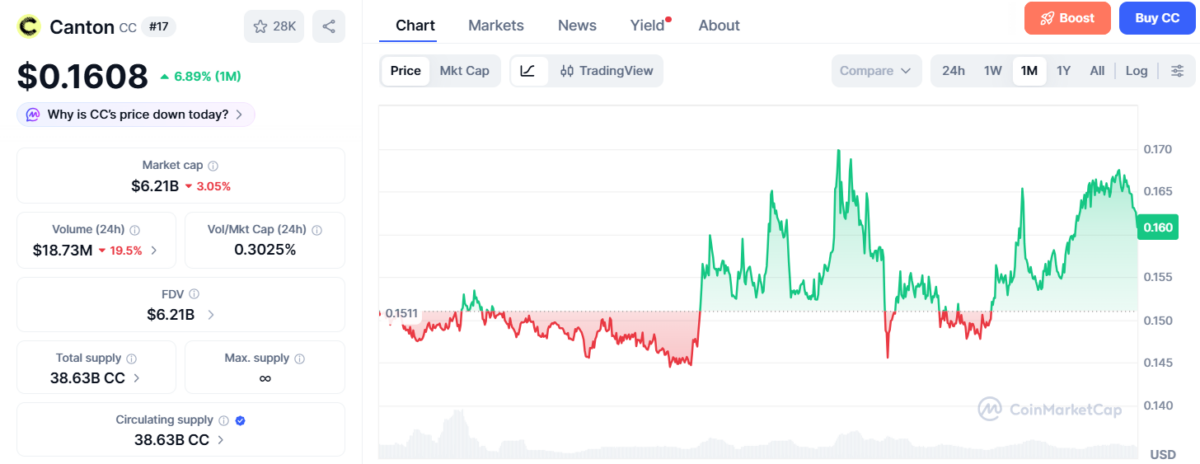
At the time of publishing, CC trades around $0.16, with a market capitalization near $6.21 billion and circulating supply exceeding 38.63 billion tokens. It has shown resilience, climbing from lows near $0.059 in late 2025, though it remains below its February 2026 all-time high near $0.194—as per CoinMarketCap data.
Growing ETP Landscape Signals Maturing Crypto-Finance Convergence
Bitwise’s latest offering adds to a broadening menu of regulated crypto investment products in Europe. The firm, with over $11 billion in assets under management globally, continues to push accessible, exchange-traded vehicles for sophisticated investors.
The Canton ETP arrives as tokenization gains mainstream traction. Major banks and infrastructure providers are actively experimenting with and deploying blockchain solutions for bonds, treasuries, repo, and more.
However, the much-cited “trillions” in tokenized assets on Canton require important context. While the network and partners like Broadridge and DTCC legitimately process over $4–9 trillion monthly in repo and financing transactions (largely U.S. Treasury-related), the actual value of fully tokenized, live on-chain RWAs across the broader market remains far smaller—approximately $46 billion excluding stablecoins as of early 2026.
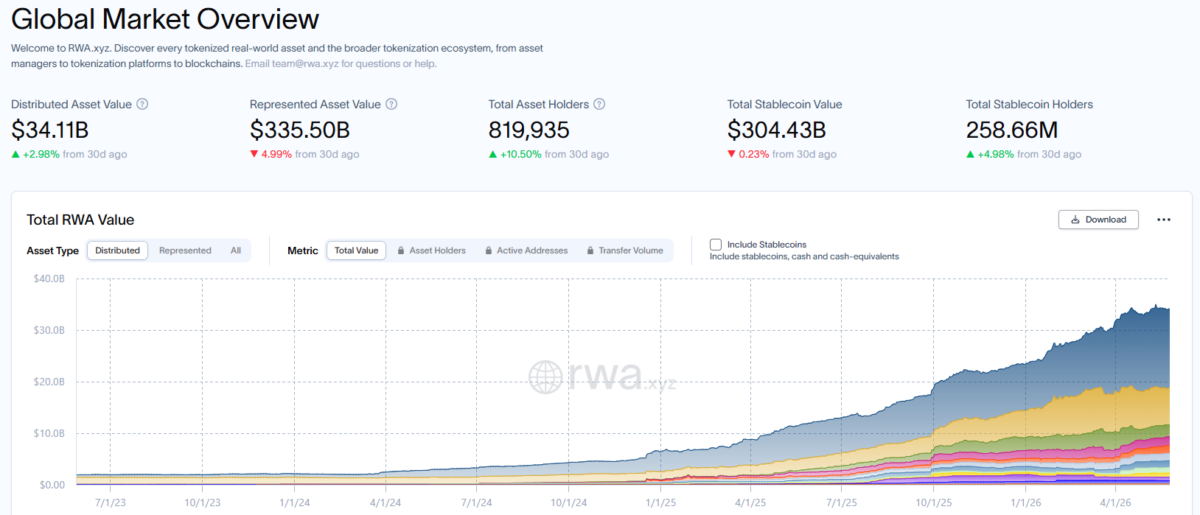
Canton’s headline figures largely reflect high-volume traditional institutional activity moving onto its infrastructure rather than pure on-chain tokenized asset value locked on the blockchain itself. While the blockchain network’s privacy features and institutional pedigree differentiate it in a crowded field, appealing to investors seeking exposure beyond retail-oriented Layer-1s, risks remain prominent.
The product carries standard crypto warnings: high volatility, liquidity concerns, custody risks, and evolving regulation. It is not suitable for all investors, and capital is at risk. Notably, the ETP is unavailable to retail clients in the UK and France.
As traditional finance increasingly embraces programmable, interoperable rails, products like BWCC may become standard components in diversified allocations.
Bitwise’s move underscores confidence that regulated, physically backed access to institutional-grade blockchain tokens will attract meaningful capital flows.
Also read: Virtus InfraCap Boosts Exposure to Strategy’s Bitcoin Treasury Play