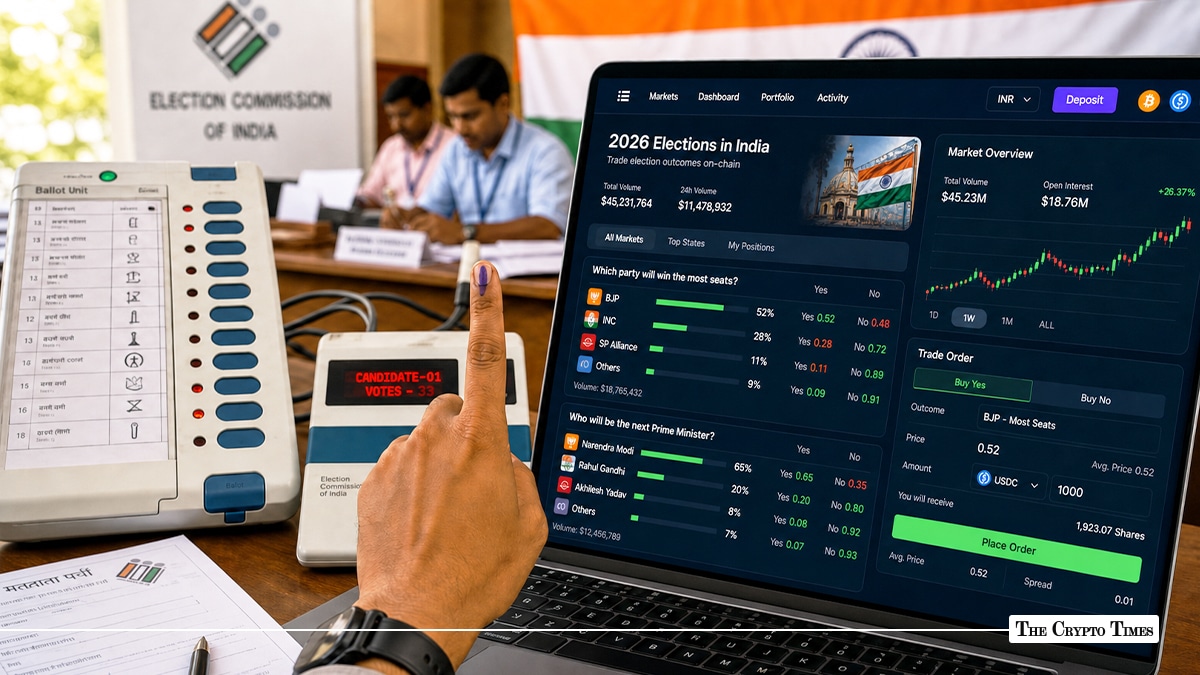
As the first sets of EVM numbers began trickling in for the 2026 Indian State Elections, a new financial heavyweight emerged in the political arena: decentralized prediction markets. According to on-chain data, total wagering volume for the current election cycle has surpassed $30 million (approximately ₹285 crore) across major platforms—marking a 400% increase from the 2024 general election and cementing India’s state election cycle as one of the most-traded political events in decentralized finance history.
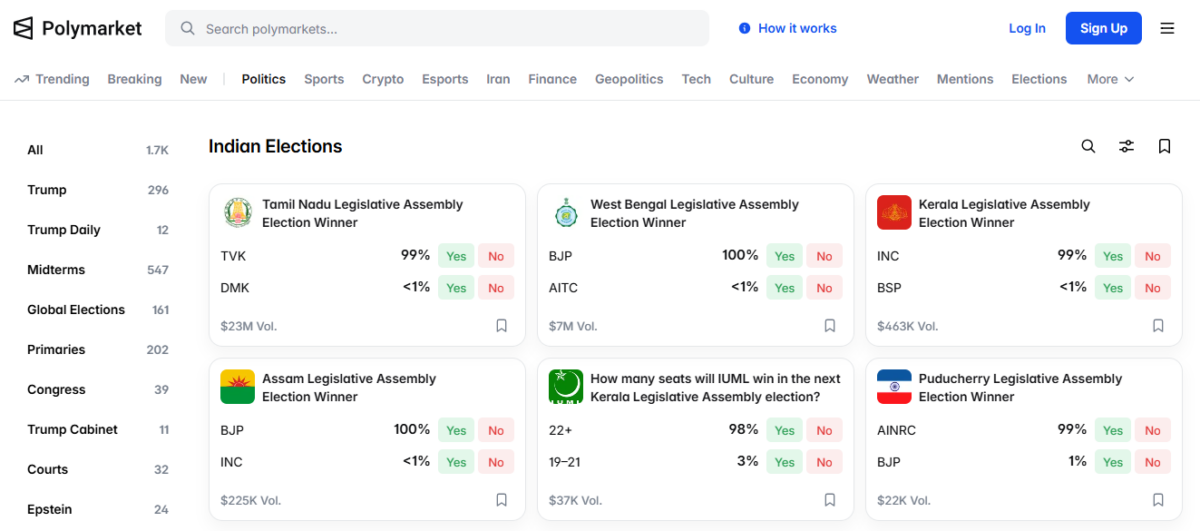
The numbers come from five simultaneously active markets on Polymarket—the world’s largest decentralized prediction platform—covering West Bengal, Tamil Nadu, Kerala, Assam, and Puducherry. What traders priced across those markets in the hours before and during counting proved, in several instances, to be ahead of what traditional exit polls, newsroom tickers, and political analysts were saying.
The “Vijay Factor” and Bengal Upsets
While traditional exit polls predicted a tight race across the board, crypto traders on Polymarket were early to spot the two defining “black swan” events of counting day.
According to government election results, Tamil Nadu delivered the most dramatic voter vindication. In a stunning political debut, actor Vijay’s Tamilaga Vettri Kazhagam (TVK) is currently leading in nearly 100 seats — defying a political landscape that has alternated between the DMK and ADMK for nearly six decades.
Traders who identified this possibility early and bought “Yes” shares for a TVK are now looking at massive returns—one of the largest single-event returns recorded on an Indian political market. The Tamil Nadu market attracted $22 Million in volume on Polymarket despite the party’s odds remaining deeply discounted for most of the campaign period.
West Bengal also produced a huge market in Indian election history on Polymarket, with $7 million in total trading volume. The market correctly anticipated the end of the TMC’s 15-year rule, with odds for a BJP majority flipping to 85% early this morning as leads showed the party crossing the 187-seat mark.
The West Bengal market had begun April with TMC at 75–80% probability—reflecting Mamata Banerjee’s incumbency and ground network—before a dramatic reversal following Phase 1 voting on April 23, when BJP momentum began showing in booth-level data that traders priced before national media caught up. The assembly tenure is ending on May 7, with one seat—the Falta constituency—subject to a repoll on May 21 following confirmed EVM tampering.
Beyond the two headline states, Assam produced the clearest call of the cycle: BJP trading at 99.9% probability with $224,868 in volume, a near-certain outcome that the market held for weeks. Kerala—where INC leads at 99.1%—attracted just $460,770 in volume, a thin market reflecting the state’s historically predictable alternating-front pattern. Puducherry, newly listed and carrying minimal liquidity, prices AINRC at 98.9% but should be read with caution given near-zero trading depth.
Regulatory Shadows and VPN Volume
The surge comes despite a complex legal landscape. While domestic “opinion trading” apps like Probo have faced increased scrutiny from Indian regulators, the decentralized nature of the Polygon network — which powers Polymarket’s order book and settlement infrastructure — has allowed Indian users to participate via VPNs and non-custodial wallets, settling positions entirely in USDC without touching the Indian banking system.
The legal environment remains contested. India’s Promotion and Regulation of Online Gaming Act (PROGA) 2025 classifies platforms like Polymarket as illegal online gaming operations. However, PROGA had not been formally notified as enforceable law as of early 2026 and is currently facing a constitutional challenge before the Supreme Court of India—creating a grey zone that payment processors and enforcement agencies have navigated inconsistently. The practical result: Indian participation continues at scale, routed through infrastructure that sits outside domestic regulatory jurisdiction.
Polymarket itself moved last week to address the integrity question, announcing a partnership with blockchain analytics firm Chainalysis to deploy on-chain monitoring for market manipulation and insider activity. The move is widely seen as a pre-emptive step ahead of anticipated regulatory pressure—including potential CFTC scrutiny of foreign election markets accessible to US-based platform infrastructure.
Also Read: India’s MeitY Warns VPN Providers: Block Polymarket or Lose Legal Safe Harbor
The $30M Figure in Context
The $30 million figure is a drop in the bucket compared to the estimated $2 billion “Satta Bazar”—the underground betting market that operates during Indian elections through encrypted WhatsApp networks, Telegram groups, and traditional bookmakers.
However, the transparency of the blockchain offers a level of auditability that traditional bookies fundamentally cannot match. Every position, every wallet, every price movement is permanently recorded on-chain and publicly verifiable — a property that makes Polymarket simultaneously more accountable and more legally exposed than its unregulated underground competitors.
The 400% volume surge from 2024 is driven by three structural factors: Polymarket’s return to the US market as a CFTC-regulated entity in late 2025 boosted global credibility and liquidity; the Intercontinental Exchange’s $2 billion strategic investment gave the platform institutional legitimacy that attracted new classes of sophisticated traders; and India’s concentrated five-state political calendar created a natural multi-market event that drew attention the way a futures expiry week draws derivatives desks.
What’s Next for Prediction Markets in India?
As counting continues in Kerala and Assam, the “election whales” are already shifting their liquidity toward upcoming municipal polls, signaling that the intersection of Indian politics and Web3 is no longer a niche hobby but a permanent fixture of the digital economy.
The question now is regulatory, not financial. With ₹285 crore in on-chain volume documented — transparent, immutable, and traceable — Indian regulators have more data to act on than they have ever had from the Satta Bazar. Whether PROGA enforcement catches up with the technology, or whether the Supreme Court challenge reshapes the legal framework entirely, will determine whether the 2028 general elections see $30 million or $300 million in decentralized prediction market volume.
Decentralized prediction markets first entered India’s electoral consciousness during the 2024 general elections, when Polymarket hosted markets on the BJP’s Lok Sabha seat count and Narendra Modi’s return as Prime Minister. Those markets attracted a fraction of the current volume. The 2026 five-state cycle—coinciding with Polymarket’s CFTC legitimization, ICE’s investment, and the platform’s X partnership with Elon Musk’s social network—has transformed Indian state elections into a globally traded political asset class.
Also Read: Is Polymarket Legal Worldwide? What You Need to Know (2026 Update)