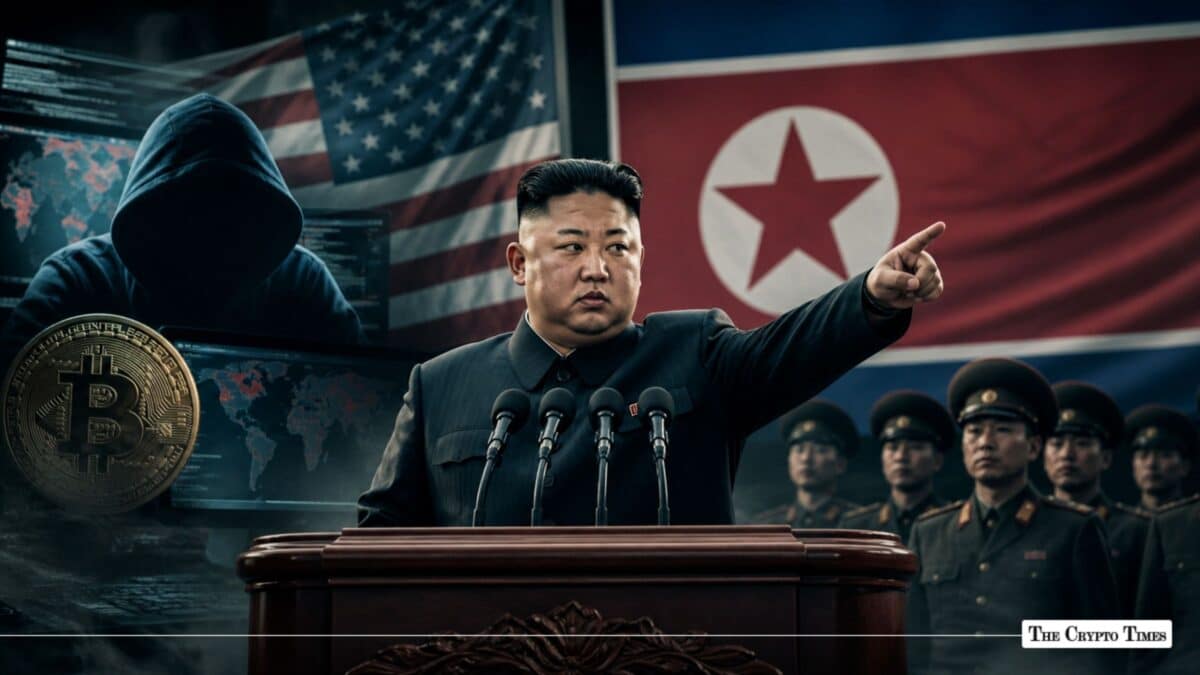
North Korea has issued a sharp rebuke to the United States after being accused of orchestrating a series of high-profile cryptocurrency hacks, including last month’s $290 million exploit tied to decentralized finance platform KelpDAO. The regime dismissed the allegations as politically motivated fabrications and warned it will not let the matter slide.
In a statement released via the state-run Korean Central News Agency (KCNA), a spokesperson for North Korea’s Foreign Ministry condemned the accusations, calling them “absurd slander intended to tarnish our nation’s image.”
Weaponizing cyber narratives
The ministry accused Washington of weaponizing cyber narratives to isolate Pyongyang internationally, stating that the U.S. is “attempting to spread a false perception of North Korea” through coordinated messaging involving government bodies and media.
“It is completely inappropriate for the United States, which holds actual control over global information technology infrastructure and habitually engages in indiscriminate cyber attacks, to portray itself as a victim,” the Ministry of Foreign Affairs stated.
North Korea signaled a highly aggressive stance in response to what it described as escalating hostility. “We will absolutely not tolerate the increasingly blatant attempts at confrontation by hostile forces,” the statement said, adding that the country will take “all necessary measures” to defend its sovereignty and national interests.
The ministry further emphasized that it “thoroughly opposes” any effort to use cyber issues as a political tool for interference in internal affairs.
The $290M KelpDAO hack and global suspicions
The diplomatic flare-up comes in the wake of a massive $290 million cryptocurrency theft from KelpDAO last month—currently the largest DeFi exploits of 2026. Attackers utilized a highly sophisticated “RPC poisoning” infrastructure attack on a cross-chain bridge to drain the funds.
While investigations remain ongoing, early suspicions from the international community have pointed toward the Lazarus Group, a notorious hacking collective widely believed to be linked to North Korea. The group has long been associated with sophisticated cyber operations, including the 2014 Sony Pictures breach, the 2016 Bangladesh central bank heist, and the global WannaCry ransomware attack in 2017.
A history of high-value heists
U.S. authorities have repeatedly tied North Korean actors to large-scale digital asset thefts to fund the Kim regime’s weapons programs. In February 2025, the FBI officially attributed the $1.5 billion hack of crypto exchange Bybit to North Korean-linked operatives known as “TraderTraitor,” reinforcing concerns over the regime’s use of cybercrime to bypass sanctions and generate revenue.
Despite these on-chain trails, Pyongyang continues to vehemently deny any involvement, framing the accusations as part of a broader geopolitical strategy aimed at undermining the country.
As cryptocurrency markets expand and decentralized platforms grow more complex, the intersection of geopolitics and cybercrime is becoming increasingly volatile. The latest exchange between Washington and Pyongyang highlights how digital asset theft is no longer just a financial issue—it is a live flashpoint in international relations.
Also Read: Mysterious Wallet Drains 326 ETH from Over 570 Ethereum Addresses