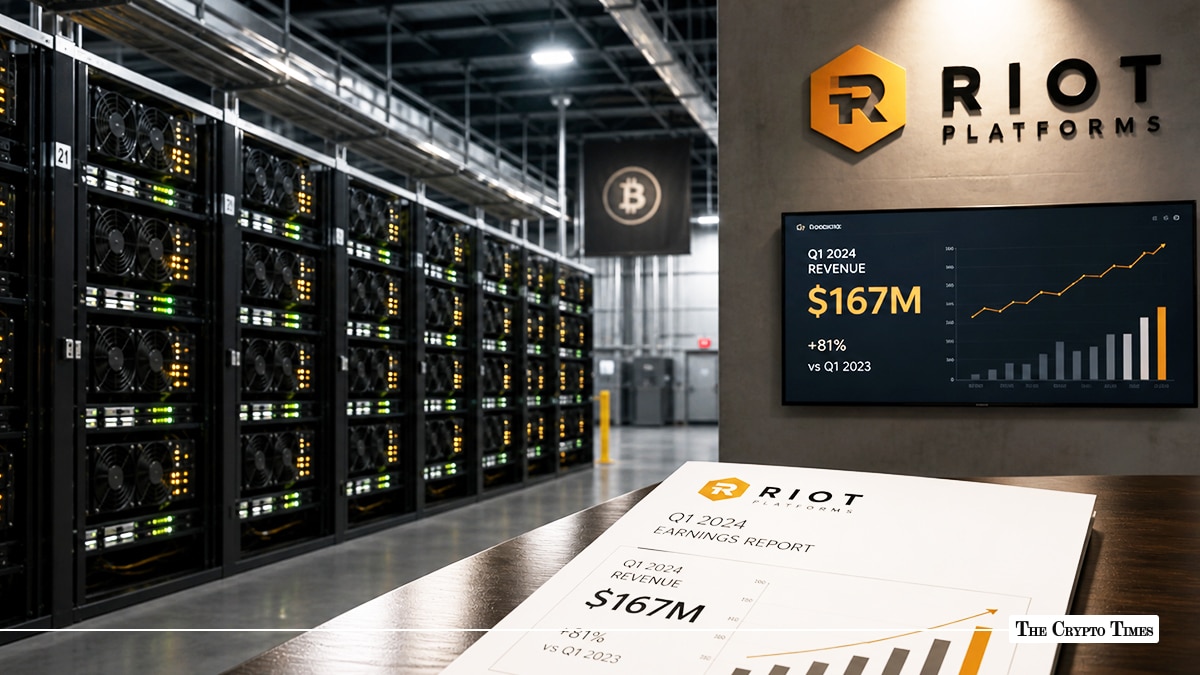
Riot Platforms (NASDAQ: RIOT) reported its first quarter 2026 financial results on April 30, and the numbers tell a story of transition. Total revenue came in at $167.2 million for the three months ended March 31, 2026, compared to $161.4 million in the same period last year. The modest top-line growth, however, masks a much bigger shift happening underneath.
For the first time, Riot’s data center segment showed up on the revenue line. The division pulled in $33.2 million in Q1, made up of $0.9 million in operating lease revenue and $32.2 million from tenant fit-out services. This is significant because it marks Riot’s official entry as an active data center operator, not just a Bitcoin miner with data center ambitions.
Bitcoin Mining revenue takes a hit
While the data center business is ramping up, the core Bitcoin mining segment is under pressure. Mining revenue dropped to $111.9 million in Q1 2026, down from $142.9 million in the same quarter a year ago.
The decline was driven by two factors. First, average Bitcoin prices were lower during the quarter. Second, the global network hash rate climbed 24% year-over-year, which means more competition for the same block rewards. Riot mined 1,473 BTC during the quarter, slightly below the 1,530 BTC produced in Q1 2025. The average cost to mine one Bitcoin, excluding depreciation, rose to $44,629 from $43,808 a year earlier.
On the bright side, Riot received significantly more power credits during the quarter. Power credits in Q1 2026 were 169% higher than in Q1 2025, partially offsetting the higher mining costs.
AMD doubles its footprint at Rockdale
The headline from the earnings call was AMD’s decision to exercise its expansion option. The chipmaker initially contracted 25 MW of critical IT capacity at Riot’s Rockdale facility in Texas. It has now doubled that commitment to 50 MW.
Riot CEO Jason Les called Q1 2026 a “definitive inflection point” for the company. He noted that Riot had delivered its first 5 MW of capacity to AMD on schedule in January, with the remaining 20 MW of the initial phase on track for delivery in May 2026. The additional 25 MW expansion is expected to begin coming online in November 2026.
The total capital expenditure for the expansion phase works out to roughly $3.3 million per megawatt, down from $3.6 million per megawatt during the initial buildout, according to the company’s earnings presentation.
CFO Jason Chung highlighted the shift in the company’s business model during the call. He noted that Riot is now an active data center operator for the first time, with contracted lease revenue from an investment-grade tenant on the books.
Engineering revenue climbs
Another bright spot was engineering revenue, which rose to $22.2 million from $13.9 million in the year-ago quarter. This segment covers infrastructure services and adds another layer of diversification to Riot’s revenue base beyond pure Bitcoin mining.
Balance sheet and Bitcoin holdings
Riot ended the quarter holding 15,679 BTC, valued at roughly $1.1 billion based on a March 31 price of $68,222 per coin. Of those, 5,802 BTC were held as collateral. The company also maintained $282.5 million in cash, with $76.9 million classified as restricted.
During the quarter, Riot sold more than $250 million worth of Bitcoin, continuing a trend seen across publicly listed miners who have been offloading holdings to fund operations and expansion. Riot had previously sold 3,778 BTC for $289.5 million in Q1, as reported earlier based on its operational update.
Stock reacts positively
RIOT shares surged on the earnings release. The stock closed up 7.31% at $18.50 on Friday, May 1, after jumping as much as 13.3% earlier in the session. It slipped marginally in after-hours trading.
The market reaction signals that investors are buying into Riot’s pivot toward AI and data center infrastructure. Wall Street is increasingly separating miners that are diversifying their revenue streams from those still fully dependent on Bitcoin mining margins.
The bigger picture
Riot is not the only miner making this transition. Across the industry, companies are repurposing mining infrastructure for AI and high-performance computing workloads. Core Scientific has been converting facilities for AI use, MARA Holdings acquired a stake in French AI infrastructure firm Exaion, and HIVE Digital Technologies has been scaling back mining at its Swedish site to redirect resources toward AI compute.
The post-halving economics have forced this rethink. Bitcoin mining margins are tighter, and the miners that can leverage their power infrastructure and cooling capabilities for AI tenants are the ones getting rewarded by the market. For Riot, the AMD deal is the clearest proof point yet that the strategy is working.
Also Read: 7 Crypto Stocks to Watch in May: RIOT, MSTR, COIN, MARA, HOOD, GLXY, CLSK