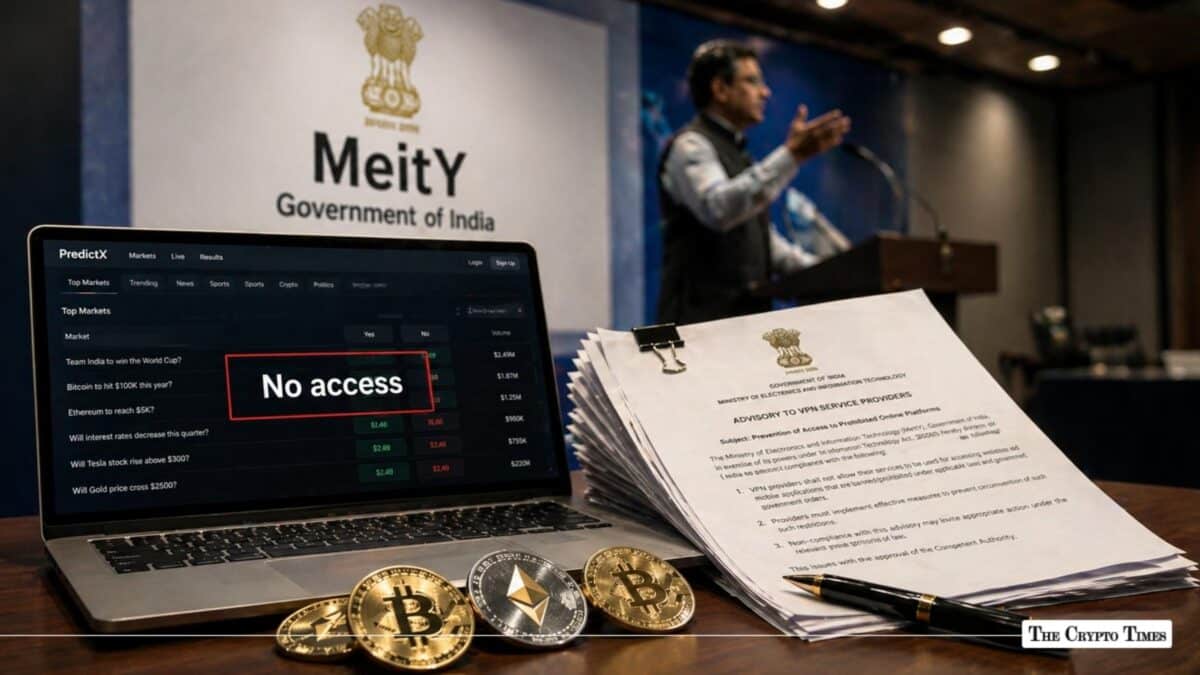
India’s Ministry of Electronics and Information Technology (MeitY) has intensified its crackdown on offshore betting by issuing a formal advisory to Virtual Private Network (VPN) service providers and internet intermediaries. The government is raising alarms over the systematic misuse of circumvention tools and stablecoins to access prohibited prediction markets.
According to an official advisory issued on April 25, 2026, the ministry warned that certain platforms, such as Polymarket, are being accessed despite being blocked under Section 69A of the Information Technology Act, 2000, with users increasingly relying on VPN services to bypass restrictions.
VPN misuse and crypto transactions
MeitY noted that users are circumventing legal safeguards by using VPNs to access restricted platforms. By masking their location and converting Indian Rupees (INR) into USD Coin (USDC), residents are participating in prediction markets that operate outside India’s regulatory perimeter.
The ministry said such activities raise “serious concerns relating to unlawful online betting, circumvention of regulatory frameworks, potential financial risks, and threats to public order and economic integrity.”
The advisory emphasizes that VPN service providers and intermediaries must comply with due diligence obligations under the Information Technology Act, 2000, and the IT (Intermediary Guidelines and Digital Media Ethics Code) Rules, 2021.
Under these provisions, intermediaries are required to ensure that their platforms are not used to host, transmit, or provide access to information that violates Indian laws, including content that could harm public order, sovereignty, or economic security.
MeitY stressed that intermediaries must take “immediate and effective action” to prevent access to unlawful platforms, including those involved in online betting and prediction market activities.
Online gaming law strengthens enforcement
The advisory gains its strength from the Promotion and Regulation of Online Gaming Act, 2025 (PROG Act), which prohibits all forms of real-money online gaming in India. This landmark legislation removed the previous judicial ambiguity surrounding “games of skill.” Under current law, any online platform where users stake money or digital assets in expectation of a reward is classified as an “online money game” and is strictly prohibited if not licensed by the National Online Gaming Commission.
It clarified that any platform facilitating or enabling access—directly or indirectly—to such activities, including through VPN-based circumvention mechanisms or financial transactions, would be in violation of the law, regardless of whether the games are based on skill or chance.
MeitY also warned that failure to comply with due diligence requirements could result in the loss of safe harbour protections under Section 79 of the IT Act, which shields intermediaries from liability for third-party content.
Intermediaries that fail to act or are found to be aiding or abetting unlawful activities may face legal consequences under applicable laws, including the IT Act and the Bharatiya Nyaya Sanhita, 2023. The advisory further highlighted that intermediaries are obligated to provide information or assistance to authorized government agencies for investigation, cybersecurity, or law enforcement purposes within prescribed timelines.
Broadening the surveillance net
The advisory reflects growing concerns among regulators over the misuse of VPN services and digital assets to bypass restrictions on online betting and gaming platforms.
As enforcement intensifies, intermediaries are expected to play a more proactive role in monitoring and preventing unlawful activities, ensuring compliance with India’s evolving digital and financial regulations.
In a recent development, India’s MHA has issued an advisory on Trust Wallet drainer scams, flagging fake “BNB Chain verification” sites that trick users into approving malicious smart contracts through Binance-to-Telegram social engineering tactics.
By targeting both the infrastructure of illegal betting (VPNs) and the tools of crypto-fraud (malicious smart contracts), India is signaling a zero-tolerance policy toward unregulated digital gateways.
Also Read: Global Crypto Scam Bust Nets 276 Arrests Across US, China, & Dubai