Bittensor’s TAO token closed Q1 2026 at roughly $251 after a quarter defined by two competing forces: aggressive institutional positioning and a governance crisis that briefly wiped $650 million from its market cap.
The April 9 exit of Covenant AI, one of the network’s largest subnet operators, triggered a 25% drop within hours and sparked public allegations of centralized control against co-founder Jacob Steeves.
Yet the same quarter also brought reported nine-figure capital deployments from Nvidia and Polychain Capital, dual spot ETF filings from Grayscale and Bitwise, and $43 million in claimed network revenue from AI usage.
The result is a protocol sitting at a crossroads. The directional thesis behind Bittensor’s institutional pitch is supported by multiple independent data points. The exact scale of several headline figures, however, remains unverified. Here is what the evidence actually shows.
Reported Institutional Allocations: Nvidia and Polychain
According to a Blockonomi report published on April 26, 2026, Nvidia deployed $420 million into TAO during Q1 2026, with approximately 77% locked in staking contracts. The same report attributed $200 million in TAO exposure to Polychain Capital over the same period, bringing combined reported institutional inflows to $620 million.
However, primary on-chain verification of the Nvidia position has not been published as of this writing. Neither Nvidia nor the OpenTensor Foundation has issued a direct on-the-record confirmation of the staking figures. Polychain Capital has not commented publicly.
The timing of the reported Nvidia allocation aligns with a period of heightened attention on Bittensor following comments by Nvidia CEO Jensen Huang on the All-In Podcast, recorded during GTC 2026.
During a conversation with Chamath Palihapitiya on March 20, Huang compared Bittensor’s decentralized training network to “a modern version of folding@home” after Palihapitiya described the Covenant-72B training run on Subnet 3.
TAO rallied approximately 17% on that day, crossing $300 for the first time since January 2026. The Opentensor Foundation subsequently corrected an inaccuracy from the podcast, clarifying that the model was a 72-billion-parameter LLM, not the 4-billion-parameter figure Palihapitiya cited on air.
If the reported Nvidia allocation is accurate, it would represent one of the largest single institutional positions in any altcoin outside of Bitcoin and Ethereum. But until on-chain attribution or corporate disclosure confirms the position, the figure should be treated as directional rather than definitive.
Real Revenue, Not Just Hype
Institutional allocators don’t move on whitepapers. They move on to functional economics, and Bittensor’s Q1 numbers gave them something concrete to underwrite.
The most widely cited Q1 2026 revenue figure for Bittensor is $43 million in AI usage revenue, a number that appeared in a Blockonomi report and was subsequently referenced by crypto analyst Dami-Defi on X.
If accurate, it would mark a significant milestone for a decentralized AI network generating real compute revenue rather than relying solely on token emissions.
However, this figure has drawn material pushback. A detailed economic analysis published in March 2026 estimated Bittensor’s total external revenue at $3 million to $15 million annually, far below the $43 million quarterly claim.
The analysis found that the Chutes subnet (SN64), often cited as the primary revenue driver, operates with TAO emission subsidies at a ratio of 22:1 to 40:1 relative to external revenue. Without those subsidies, Chutes’ inference costs were estimated at 1.6x to 3.5x higher than centralized competitors like DeepSeek and TogetherAI.
Separately, crypto analyst Justin Bons posted a thread on X on April 18, 2026, arguing that Bittensor generates only $15 million in annual revenue against $328 million in annualized token inflation, describing the model as economically dependent on subsidies rather than organic demand.
The discrepancy likely stems from how “revenue” is defined. If TAO emission rewards flowing to subnet operators are counted as revenue, the $43 million figure may be technically defensible.
If only external payments from users purchasing AI inference, compute, or training services are counted, the actual number appears substantially lower. No independently audited revenue dashboard exists for Bittensor’s subnet economics, and all AI service calls occur off-chain without blockchain-recorded verification.
Investors should watch for audited subnet revenue data from OpenTensor or third-party analytics providers like Taostats to resolve this ambiguity.
On the infrastructure side, Bittensor’s 2026 roadmap includes an upgrade (Robin) to double subnet capacity from 128 to 256. Each subnet operates as an independent marketplace for a specific type of machine intelligence, including inference, training, data scraping, and retrieval. The timeline for this expansion has not been confirmed.
Spot TAO ETF Filings: Grayscale and Bitwise
While Silicon Valley builds out the network’s infrastructure, Wall Street is racing to package it for traditional investors who legally can’t buy native tokens.
Grayscale Investments filed a Form S-1 registration statement with the SEC on December 30, 2025, to convert its existing Grayscale Bittensor Trust into a spot ETF trading on NYSE Arca under the ticker GTAO.
The trust, structured as a Delaware statutory trust formed in April 2024, held approximately $7.97 million in assets at the time of initial filing. On April 2, 2026, Grayscale filed Amendment No. 1 to its S-1, advancing the application through the regulatory process.
On the same day, Bitwise Investments filed an N-1A registration for a TAO Strategy ETF as part of a broader batch of 11 crypto strategy ETF applications. The Bitwise structure differs from Grayscale’s: it allocates 60% of fund assets directly in TAO, with the remainder in exchange-traded products and potentially derivatives such as futures and swaps.
The SEC decision window for both applications is tracked for August 2026, according to multiple analysts and media reports. On April 7, five days before the Covenant AI crisis, Grayscale raised its TAO allocation within its AI-focused crypto fund to 43.06%, its largest single-asset reallocation in that fund’s history.
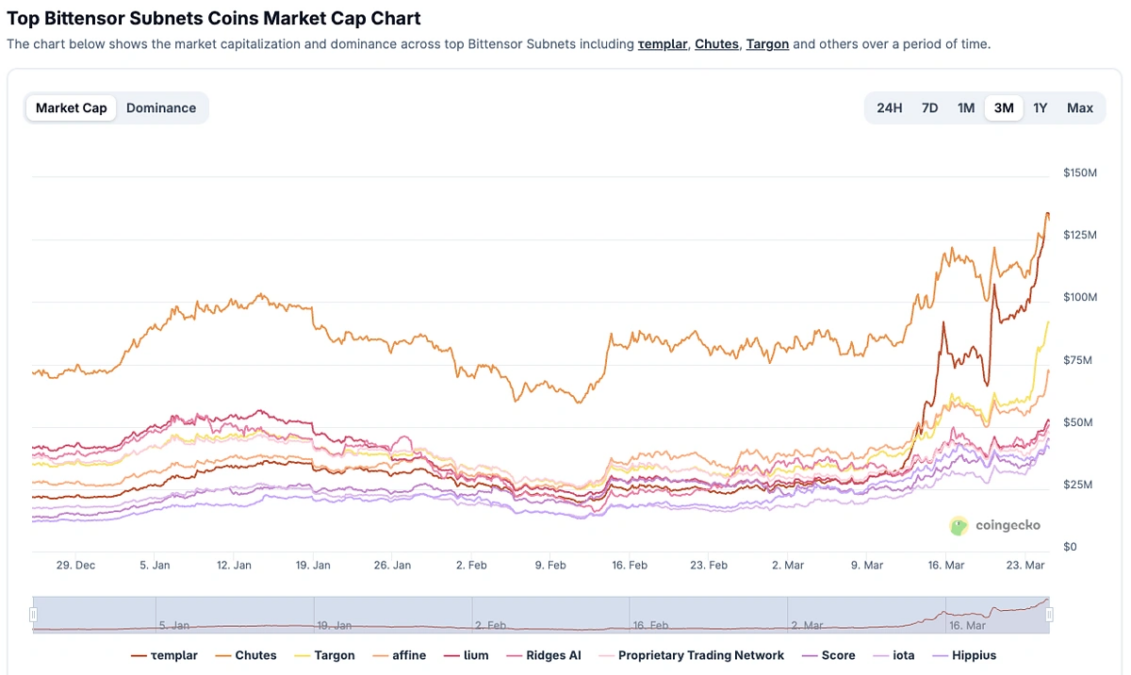
If either product is approved, it would create the first regulated U.S. investment vehicle offering direct TAO exposure. Registered investment advisors, pension funds, endowments, and institutional allocators restricted from holding native tokens would gain access through a wrapper subject to standard securities regulation.
Given TAO’s relatively thin liquidity compared to Bitcoin and Ethereum, even modest ETF inflows could have an outsized impact on available supply.
Supply dynamics: The post-halving structure
Bittensor’s first halving occurred on December 14, 2025, reducing daily TAO emissions from 7,200 to 3,600, a 50% cut in new token issuance. Like Bitcoin, Bittensor has a hard-capped maximum supply of 21 million tokens. As of May 2026, circulating supply sits at approximately 10.88 million TAO, or roughly 52% of maximum supply.
Approximately 68-70% of the circulating supply is currently locked in staking, according to on-chain data from Taostats and Coinbase. This creates a structurally thin float. Each new subnet registration requires 700 TAO (roughly $200,000 at current prices), and the planned expansion to 256 subnets could theoretically remove an additional $32 million worth of TAO from liquid circulation.
On April 20, 2026, BitGo and Yuma launched institutional-grade custody and staking for Bittensor subnet tokens, the first regulated access point allowing large institutional capital to participate directly in subnet economics. Barry Silbert, CEO of Yuma and chairman of DCG, called it “a big moment for subnet tokens.”
The combination of halved emissions, high staking rates, pending ETF products, and new institutional custody infrastructure creates a supply-demand setup that market participants are watching closely. However, it is worth noting that the thin float amplifies volatility in both directions, as the Covenant exit demonstrated.
Resilience After the April Storm
Some context matters here, because this Q1 institutional narrative isn’t landing in a calm market. It’s landing on top of a network that just lived through one of its messier months.
On April 9, 2026, Covenant AI, the operator behind Bittensor’s Subnet 3 (Templar), SN39, and SN81, announced its departure from the network. Founder Sam Dare published a statement on X, accusing Bittensor co-founder Jacob Steeves of maintaining effective centralized control over the protocol while presenting a decentralized front.
Dare alleged that Steeves unilaterally suspended emissions to Covenant’s subnets, removed the team’s moderation capabilities in community channels, deprecated subnet infrastructure, and applied economic pressure through large, visible token sales timed to coincide with operational conflicts.
Covenant subsequently liquidated approximately 37,000 TAO, worth roughly $10.2 million, into the market. TAO dropped 25% within six hours, erasing an estimated $650 million in market capitalization, with $9.1 million in leveraged long positions liquidated. Trading volume spiked to $1.72 billion on April 10, more than triple the monthly average.
Steeves responded on X the following day, stating that he does not have the ability to suspend emissions. He said his sales of alpha positions on Covenant’s three inactive subnets reflected standard market activity, amounting to less than 1% of what he had invested in Dare’s teams.
What followed the exit was arguably more significant than the crisis itself. Community miners, operating without central coordination from founders or the OpenTensor Foundation, rebuilt all three subnets from open-source code within days. Because Covenant’s subnets were research-focused rather than commercial, the network’s revenue-generating activity was not directly disrupted. By late April, TAO had recovered to the $260 range with on-chain staking rates holding near 70% of circulating supply.
In response to the structural vulnerability the exit exposed, Bittensor’s development team proposed BIT-0011, a Conviction Mechanism that ties subnet ownership to time-locked token commitments. Under this model, subnet control becomes a continuous competition based on a “Stake multiplied by Time” formula, recalculated every 30 days. The mechanism is designed to prevent unilateral exits of the kind Covenant executed and to give markets advance notice if founders begin unlocking tokens.
That kind of resilience is exactly what institutional allocators look for when evaluating whether a protocol can survive its own growing pains. A token that recovers from a governance shake-up while simultaneously announcing nine-figure capital inflows is a different risk profile than one that limps through every controversy.
The Caveats Worth Reading Carefully
Now for the part of this story that responsible reporting has to flag clearly.
Several of the headline figures driving this narrative, including the exact size of the Nvidia stake, the Polychain allocation, and the $43 million Q1 revenue number, have been amplified across multiple outlets, including MEXC, AInvest, BingX, and others. But primary on-chain verification of the Nvidia position remains limited, and neither Nvidia nor the OpenTensor Foundation has issued a direct on-the-record confirmation of the staking figures at the time of this writing.
A subset of voices on X has flagged the revenue numbers in particular as potentially overstated, pointing out that independently audited external revenue from top subnets like Chutes has historically come in lower than the headline figure suggests. Some critics have gone further, calling portions of the coverage “AI slop” recycled through SEO-driven crypto media without rigorous primary sourcing.
That doesn’t mean the underlying story is wrong. It means readers should treat the specific dollar figures as directionally indicative rather than conclusively verified, at least until audited dashboards or direct confirmations from the relevant parties are published. The directional thesis (institutional capital arriving, ETF filings advancing, subnet capacity doubling, revenue trending up) is well-supported across multiple independent sources. The exact size of each individual data point is where some skepticism is warranted.
Smart investors will be watching for three things over the next few weeks. Audited subnet revenue dashboards from OpenTensor or third-party analytics providers. Direct confirmation, or denial, of the Nvidia position through on-chain attribution or corporate disclosure. And clearer SEC signaling on the timeline for the Grayscale and Bitwise ETF decisions.
What This Means for Decentralized AI (DeAI)
Regardless of whether every headline figure holds up to scrutiny, Q1 2026 established several precedents for the decentralized AI sector.
Bittensor is now the first AI-focused crypto protocol with two spot ETF applications under active SEC review. Its halving mechanics, institutional custody infrastructure, and subnet-based compute marketplace represent the most developed tokenized AI network in production. The Covenant-72B training run, which produced a 72-billion-parameter model across 70+ independent contributors using commodity hardware, was confirmed as the largest decentralized LLM pre-training run on record in a March 2026 arXiv paper.
But the network’s economic sustainability remains an open question. If the gap between token inflation and organic revenue does not close, Bittensor risks becoming a well-capitalized protocol that subsidizes its own growth without building a self-sustaining business model. The Covenant exit also demonstrated that governance in decentralized AI networks is not a theoretical concern but a live operational risk with nine-figure consequences.
The next 60 to 90 days will be defining. The SEC’s ETF review window in August, the deployment of the BIT-0011 Conviction Mechanism, and whether audited revenue data materializes will collectively determine whether Bittensor’s institutional thesis moves from narrative to a fundamentally supported investment case.