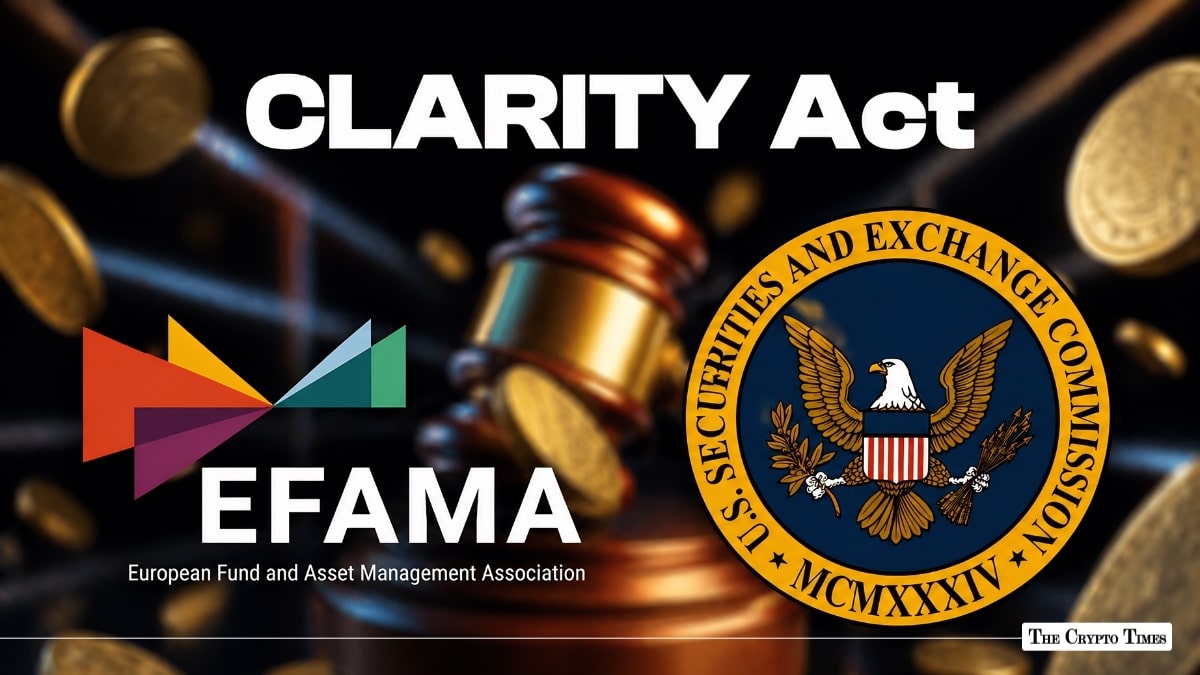
The U.S. Securities and Exchange Commission’s (SEC) Crypto Task Force staff met representatives of major European asset management groups on April 30 to discuss the Clarity Act, tokenization and cross-border policy alignment.
According to the SEC meeting memorandum, the participants included the European Fund and Asset Management Association (EFAMA), The Investment Association, BNP Paribas Asset Management, Irish Funds, Asset Management Association Switzerland and Generali Investments Holding S.p.A.
The meeting focused on “approaches to addressing issues related to regulation of crypto assets,” with the European representatives providing attached documents that were discussed during the meeting.
The agenda shows that the discussion was not limited to crypto trading platforms. It also covered tokenized financial instruments, tokenized Money Market Funds (MMFs), the SEC’s January statement on tokenized securities, the European Union’s Markets in Crypto-Assets Regulation (MiCA), the Distributed Ledger Technology (DLT) Pilot Regime and the U.S. CLARITY Act.
CLARITY Act and Stablecoin Rewards Enter the Discussion
One of the clearest U.S. policy angles in the document is the CLARITY Act. EFAMA’s proposed agenda said the meeting would provide an opportunity to discuss the latest developments around the bill, including the issue of whether stablecoin providers should be able to provide rewards through trading platforms.
That point is important because stablecoin rewards have become one of the most disputed questions in U.S. crypto market structure talks. Banks have pushed back against stablecoin yield-like products, while crypto firms argue that restrictions could limit competition and weaken the usefulness of regulated dollar tokens.
EFAMA also said it could provide an update on multi-issuance stablecoins in Europe, placing the U.S. debate beside Europe’s MiCA framework.
Tokenized Funds Move From Experiment to Policy Issue
The documents attached to the SEC memo frame tokenization as a growing asset management issue rather than a niche crypto experiment.
EFAMA’s tokenization guide says Distributed Ledger Technology is already being used across issuance, custody, trading and settlement, while asset managers are entering the market with tokenized MMF products. The report also estimates that tokenization could grow at around 20% annually and reach €2 trillion by 2030, with a possible accelerated scenario of €4 trillion.
The report argues that tokenized funds could reduce back-office costs, improve transparency, support fractional ownership and allow 24-hour access to investment products. It also identifies tokenized MMFs as one of the most mature use cases because they can be used for collateral management, repo transactions and margin calls.
Europe Pushes for Regulatory Harmonization
EFAMA’s policy recommendations focus heavily on regulatory harmonization, interoperability and cash-on-chain settlement.
The group said Europe’s DLT Pilot Regime should be amended to increase thresholds on eligible instruments, arguing that this could improve market interest, liquidity and trading volumes on DLT-based platforms. It also warned that divergent national rules could reduce cost efficiencies for fund managers trying to issue tokenized funds across borders.
EFAMA also supported aligning custody and administration rules under UCITS and AIFMD with MiCA’s crypto-asset custody framework. In its view, traditional financial regulation and DLT-specific frameworks may eventually need to converge as decentralized finance grows.
Why This Meeting Matters
The meeting shows that U.S. crypto regulation is being watched closely by traditional asset managers outside the United States, not only by crypto-native firms.
For the SEC Crypto Task Force, the discussion gives a direct look at how European asset managers are approaching tokenized funds, stablecoins, custody and settlement under MiCA and the DLT Pilot Regime. For European firms, the meeting opens a channel into U.S. policy debates at a time when the CLARITY Act could define how crypto assets, stablecoins and tokenized securities are treated in the world’s largest capital market.
The larger message is that tokenization is moving from proof-of-concept to regulatory coordination. The question is no longer whether traditional finance will experiment with blockchain-based assets, but how quickly regulators can build rules that allow those markets to scale without weakening investor protection.
Also Read: CLARITY Act’s April Fugazi: Trump Demands It, Everyone Says Yes, But Where Is It?