On April 28, the official X account of Monad—another so-called “high-performance EVM Layer 1” that raised hundreds of millions—went dark in the social media platform’s routine crackdown on spam and bots.
Firstly, this apparent take-down seems legit, given its handle boasting over 1.2 million followers, of which majority are bot accounts as we all know.
The suspension lasted several hours to nearly a day and after restoration the next morning, the project and its community framed the episode as a defiant comeback, with memes, victory posts, and triumphant narratives flooding the timeline.
Now this minor social media hiccup has once again put Monad on question: what the blockchain actually does and what significance it has within the broader crypto ecosystem?
Five months after its November 2025 mainnet launch, Monad confronts a harsher reality: impressive technology paired with minimal revenue, a token down roughly 40% from its all-time high, and tokenomics that heavily favor insiders.
While the chain demonstrates genuine engineering ambition, questions remain about whether hype can sustain it amid thin on-chain economics and looming dilution.
A brief suspension becomes narrative victory
The X suspension triggered an immediate 9% dip in the blockchain’s native MON token, reflecting the account’s central role in community coordination and announcements. Co-founder Keone Hon publicly stated there was “no abnormal activity” on their end and attributed the flag to an automated system. The account returned swiftly, likely after manual review.
For a project built on speed and performance claims, turning a routine platform enforcement into a celebrated “win” highlights a reliance on optics. Crypto observers noted the irony: a chain promising 10,000+ TPS celebrated basic account restoration while daily fees struggled to break $4,000. The episode underscores how early-stage L1s often prioritize social momentum over metrics in volatile markets.
Massive capital in vs. razor-thin revenue out
As of late April 2026 shows Monad’s DeFi total value locked (TVL) at approximately $320 million, with bridged assets pushing totals higher (stablecoin market cap around $433 million). Despite attracting such an attractive TVL amount within five months of mainnet, a closer look at Monad’s on-chain metrics reveals a fragile foundation.
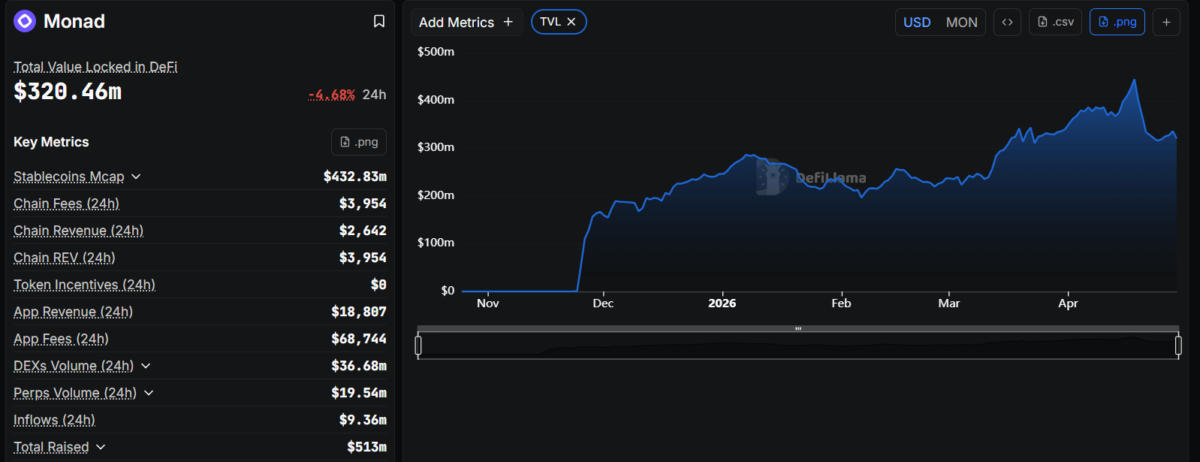
According to DeFiLlama, a substantial portion of this liquidity—roughly $642 million in bridged assets—consists of capital teleported from Ethereum, Solana, and other chains, dominated by stablecoins such as USDC. Much of the TVL sits in lending protocols like Morpho Blue ($143 million) and yield aggregators, where users park assets for passive returns rather than actively using the chain’s vaunted parallel execution engine.
This pattern suggests mercenary capital chasing temporary yields rather than genuine ecosystem building, raising concerns that the headline TVL figure overstates organic adoption.
Moreover, the disconnect between capital raised and actual economic activity is particularly stark. Monad has secured over $513 million in total funding, yet its 24-hour chain fees currently hover between $3,954 and $4,188, generating just $2,642–$2,753 in daily revenue for the network. This results in one of the lowest fee-to-TVL ratios among comparable Layer 1s.
Monad’s annualized revenue remains in the low six figures—a negligible return on the project’s massive valuation. Critics argue this reflects a high-performance “ghost chain”: technically capable of 10,000+ TPS but failing to drive sustained, fee-generating usage beyond low-gas speculative flows.
Its onchain behavior further underscores the gap between hype and reality. The daily DEX volume on the chain sits at approximately $36.7 million and perpetuals at $19.5 million, but much of this appears to be arbitrage, wash trading, or incentive-driven activity rather than organic user demand.
With network utilization reportedly below 1% of theoretical capacity and no breakout consumer applications or gaming ecosystems, Monad’s activity remains concentrated in basic DeFi primitives.
As incentives taper and major token unlocks approach in late 2026, the project faces a critical test: can it convert bridged liquidity and speculative interest into durable economic activity, or will it join previous high-hype L1s that faded once the initial capital inflows subsided?
Token performance: 40% below ATH reflects market caution
At the time of publishing, MON was trading around $0.029, down approximately 40% from its all-time high of ~$0.0488 reached shortly after mainnet in late November 2025. The token’s circulating market cap sits near $348 million, with fully diluted valuation (FDV) exceeding $2.96 billion.
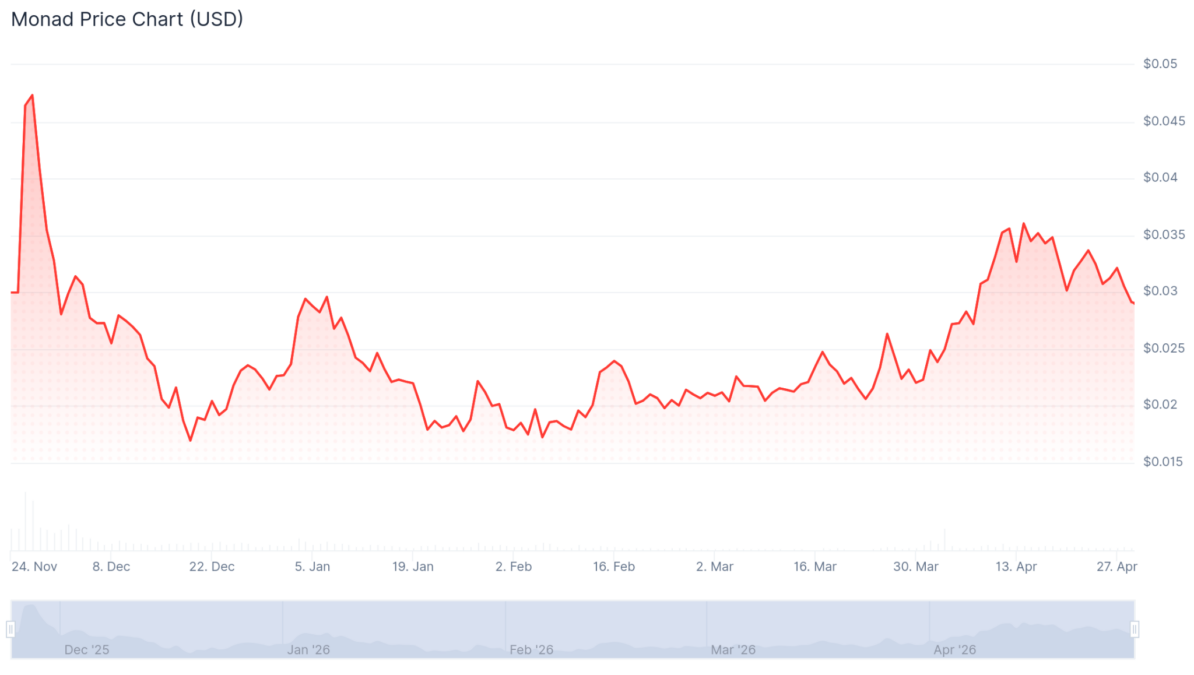
Token’s all time chart shows a downward trend since launch, reflecting post-hype gravity. The project’s large unlocks and broader skepticism toward high-FDV L1s have weighed on sentiment.
Even Arthur Hayes, one of the most prominent voices in the crypto industry, flagged it as a high-risk VC play susceptible to dilution. Retail participants who entered on scalability promises now hold positions well underwater.
Monad tokenomics: Insider-heavy structure fuels dilution fears
Tokenomics are the most important aspect for a blockchain as it is used to calculate both the project’s current and future state of economy. Monad has a total supply of 100 billion tokens, out of which, roughly 11.83 billion tokens are in circulation.
Here is its detailed description:

Monad’s tokenomics feature a balanced but heavily foundation-weighted distribution designed to support long-term ecosystem growth while aligning incentives through vesting. Ecosystem Development receives the largest share at 38.5%, fully unlocked at TGE and stewarded by the Monad Foundation for grants, incentives, validator delegations, and partnerships over many years.
The Team allocation of 27% has a 1-year cliff followed by 48-month linear vesting, as does the Investors portion at 19.7%. Smaller slices include Public Sale at 7.5%, Airdrop at 3.3%, and Treasury/Category Labs at approximately 4%.
At mainnet launch, roughly 49.4% of the supply was unlocked (primarily from ecosystem, public sale, and airdrop), with the remaining ~50.6% locked and vesting gradually through 2029 to limit immediate selling pressure.
At launch, only ~10.8–11.8% entered broad circulation. The large unlocked ecosystem bucket gives the foundation significant flexibility for grants and incentives, but also centralized influence.
Community criticism centers on the structure: high FDV, low initial float, and perceived favoritism toward VCs and KOLs over retail (the airdrop was notably small). No widespread confirmed large insider exits have surfaced due to vesting, but the design inherently sets up future sell pressure.
Various analysts have described it as a classic “VC coin” where early backers are positioned to realize gains while later holders absorb dilution risks.
Technical promise vs. economic and adoption hurdles
Monad’s core innovations—parallel optimistic execution, MonadBFT consensus, asynchronous pipelining, and MonadDB—earn technical respect. Full EVM compatibility enables seamless dApp migration, and the chain has onboarded DeFi primitives, DEXs, and partnerships.
Its TVL growth to over $300 million in months demonstrates capital attraction. Yet the path forward is narrow. Sustained organic usage, not incentive-driven TVL, will determine success.
Competition is fierce, and November 2026 unlocks loom as a key test. If revenue remains minimal and adoption fails to accelerate, the project risks joining prior high-hype L1s that faded after initial excitement.
The recent X suspension episode, while trivial in isolation, encapsulates Monad’s current phase: adept at narrative spin but challenged by translating technical edge into durable economic value.
Final words
Despite its genuinely impressive technical innovations and parallel execution architecture, Monad currently feels like yet another classic VC-driven Layer 1 project designed to extract capital from the broader crypto ecosystem—only with an extra step.
The project masterfully layers heavy marketing, social media drama, and narrative spin on top of the familiar playbook of massive funding, high FDV, low-float tokenomics, and mercenary liquidity.
While the engineering deserves respect, the thin on-chain revenue, reliance on bridged speculative capital, looming unlocks, and celebration of minor incidents like an X account restoration reveal a project still struggling to move beyond hype into sustainable value creation.
Until Monad can translate its performance promises into real economic activity and organic usage, it risks remaining just a more sophisticated version of the same old story.
Also read: Aave’s Real Test Isn’t the Bailout—It’s the Vote on Who Pays