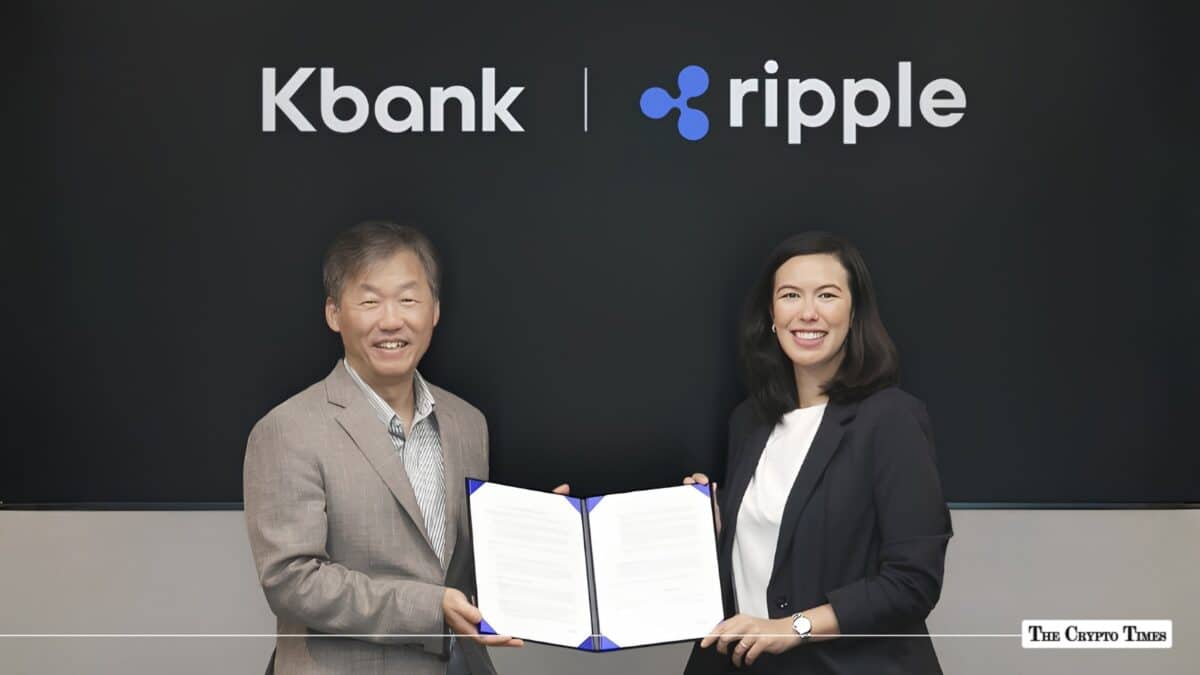
KBank, a leading South Korean internet-only bank and banking partner for exchange giant Upbit, has begun a strategic partnership with Ripple to test blockchain-based cross-border remittances. The bank confirmed on Monday that it will run a mutli-phase proof-of-concept (PoC) project to evaluate on-chain settlement systems.
As per a local report, KBank and Ripple will jointly test digital wallet-based remittance models and system integration. The collaboration aims to improve speed, cost and transparency in cross-border payments by using blockchain infrastructure. South Korea has been expanding regulated digital asset infrastructure and blockchain-based payment trials.
Onchain remittance tests enter second phase
KBank CEO Choi Woo-hyung and Ripple Asia Pacific Head Fiona Murray finalized the agreement in Seoul. The two sides are advancing technical validation in multiple phases.
Phase I tested app-based remittance structures, while the current Phase II is focused on deep system-level integration. Phase II examines direct on-chain transfers to markets including the UAE and Thailand. KBank is also testing virtual account linkage with its internal banking systems to assess whether blockchain settlement can replace traditional cross-border payment rails.
Palisade, a software-as-a-service (SaaS) wallet from Ripple, is being implemented in the second phase. The solution uses hardware security modules and multi-authorizations to ensure that regulations such as AML and OFAC checks can be carried out.
KBank previously tested its own wallet in the first phase. Ripple’s infrastructure is being evaluated for faster deployment through pre-certified security frameworks.
Regulatory push and expanding institutional adoption
The partnership is more than a simple remittance trial; it represents a defensive shift by South Korean banks ahead of the Digital Asset Basic Act. By establishing early-stage experiments in a regulatory sandbox, KBank aims to be the “first-mover” in the country’s regulated digital asset ecosystem.
This move mirrors other institutional wins for Ripple in the region. Ripple recently partnered with Kyobo Life Insurance on tokenized bond settlement. The project uses Ripple Custody to process bond transactions on-chain instead of manual systems. Ripple said institutional adoption in South Korea is increasing.
Moreover, KBank is Upbit’s sole banking partner in South Korea. The exchange has grown from 2 million users in 2020 to about 15 million, according to industry data. The new Ripple partnership therefore builds on its existing digital finance operations.
Additionally, this comes amid South Korea also testing blockchain-based government payment systems under a regulatory sandbox program as part of broader efforts to explore programmable money and on-chain infrastructure.
Also Read: Western Union Targets Crypto With USDPT Stablecoin Launch in May