
Aave Labs and Kelp DAO have taken the lead in a fresh governance push, urging Arbitrum DAO to release approximately 30,766 ETH—worth roughly $71 million—that was frozen from a Kelp DAO rsETH exploiter earlier this month.
The proposal, filed as a Constitutional AIP on April 25, marks the latest development in one of DeFi’s more complex recent incidents.
“This is proposed as a one-time measure given that the funds are already immobilized, the release destination is the sole remaining governance question, and releasing them to the ongoing coordinated recovery effort could make a significant positive impact,” the proposal reads.
The funds were seized by Arbitrum’s Security Council on April 21 using emergency powers and moved to a DAO-controlled address. Now, a group including Aave Labs, Kelp DAO, LayerZero, EtherFi, and Compound wants the community to approve their transfer to a dedicated recovery effort.
The Kelp DAO exploit and quick response
The trouble began on April 18 when attackers exploited Kelp DAO’s LayerZero-powered bridge, draining around 116,500 rsETH valued at approximately $292 million at the time.
The attack relied on forged cross-chain messages that allowed the minting and extraction of unbacked tokens. Those rsETH were subsequently used as collateral on Aave and other platforms to borrow blue-chip assets.
Arbitrum’s Security Council responded days later by executing a targeted upgrade to the Inbox contract. This allowed them to impersonate the exploiter’s transaction and redirect the ETH holdings without affecting other network activity.
This move demonstrated the chain’s technical safeguards but also underscored the unusual nature of such emergency interventions in a decentralized environment.
Read: A $292 Million Wake-Up Call: Inside KelpDAO Hack That Exposed DeFi’s Fragility
Broader recovery efforts of “DeFi United” initiative
In parallel with the Arbitrum proposal, a wider industry initiative called DeFi United has rapidly taken shape to address the rsETH backing shortfall.
Spearheaded by Aave Labs and KelpDAO in coordination with multiple protocols, the effort channels pledges, loans, and recovered assets into a dedicated relief vehicle aimed at restoring full backing for rsETH, unfreezing lending markets, and minimizing bad debt across platforms like Aave.
As of late April 27, the coalition has so far filled 102,542 ETH of the original 163,200 ETH shortfall, leaving a remaining gap of approximately 60,658 ETH.
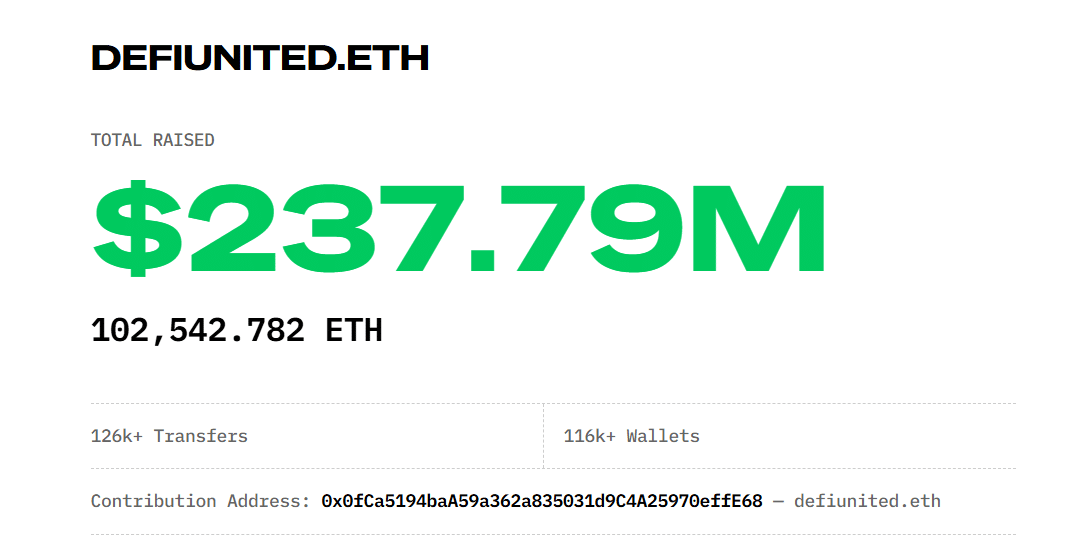
Confirmed public pledges total 43,500 ETH, including Mantle’s proposed 30,000 ETH credit facility to Aave DAO, Ether.fi’s up to 5,000 ETH, Aave founder Stani Kulechov’s personal 5,000 ETH, Lido’s 2,500 stETH, and contributions from Golem, Ethena, LayerZero, and others. Aave DAO is also advancing a separate proposal for a 25,000 ETH treasury contribution.
The frozen ETH on Arbitrum forms a critical piece of this puzzle. If released via the Constitutional AIP, it would flow directly into the DeFi United recovery multisig, further reducing the remaining shortfall and accelerating remediation for affected rsETH holders.
This coordinated response stands out as one of the fastest and most collaborative industry-wide recovery efforts in recent DeFi history, highlighting growing maturity in cross-protocol crisis management.
Recovery push gains momentum
The new proposal calls for sending the full frozen amount to a 2-of-3 Gnosis Safe controlled by Aave Labs, KelpDAO, and Certora. From there, the ETH would support a coordinated remediation plan designed to restore rsETH backing and limit losses for affected users across Aave’s Arbitrum deployment and the wider ecosystem.
Backers argue the frozen ETH represents a substantial portion—close to 40%—of the current shortfall in rsETH reserves. Releasing it, they say, would help reduce impairments on lending markets and bring faster relief to holders, rather than leaving the assets in limbo.
As per discussions, the plan currently includes strict conditions. First, the funds must be used solely for recovery, with any stalled progress requiring a return to Arbitrum governance. Second, an indemnification clause further protects Arbitrum entities and the Security Council from related claims.
As a Constitutional AIP, the proposal requires elevated support thresholds and a longer timeline—potentially 49 days if it advances through temperature check, Snapshot, and on-chain voting. Forum discussions are now active, with early feedback shaping the next steps.
The outcome could set an important precedent for how layer-2 networks handle recovered exploit funds and collaborate on cross-protocol recovery.
Also read: Black April 2026: $606M Stolen, $13B TVL Exodus in DeFi’s Darkest Month