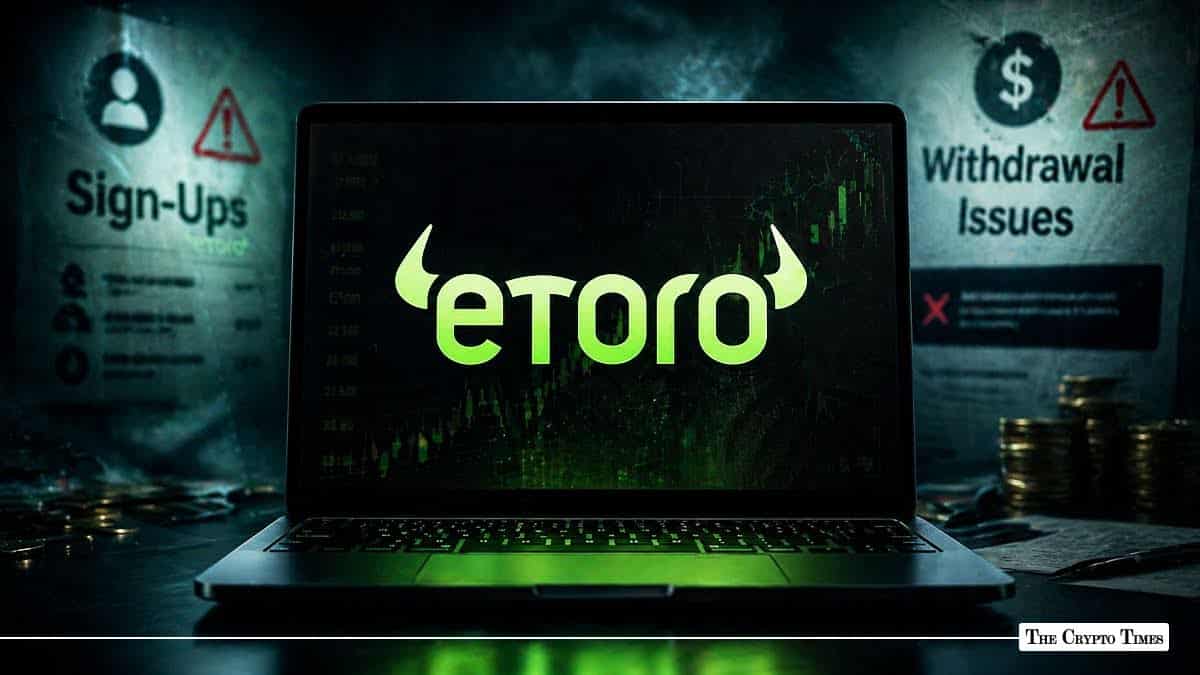
Something appears to be going wrong on r/Etoro, and the Israeli financial service provider’s reputation is taking a hit in real time.
Over the past week, the subreddit has been flooded with panicked posts, screenshots, and critical threads from users questioning whether eToro, one of the world’s most recognizable retail trading platforms, is genuinely safe to use. Accusations have ranged from weak security oversight to outright fraud. The word “scam” has appeared so often in recent threads that even longtime defenders of the platform are starting to back away from it.
A closer look at what users are actually posting reveals a two-track crisis. On one side, there has been an increase in reports of unauthorized account sign-ups tied to email addresses leaked in an unrelated data breach. On the other hand, a much older list of grievances about how eToro handles customer assets, withdrawals, and trading mechanics. Together, the two threads have combined into the worst public-trust moment the broker has faced in years.
Here’s what the community is actually saying and what eToro has said back.
The phantom account wave
The most immediate trigger for the recent outrage is the volume of users reporting unauthorized eToro accounts opened in their names.
Multiple posts on r/Etoro describe more or less the same scene. People wake up, check their inbox, and find welcome emails from eToro confirming that an account has been successfully opened, complete with a randomly generated username like “OGovqVX” or some similar string. The catch? They never signed up for one.
Some users who dug into the metadata behind these accounts found something even more alarming. The IP addresses associated with the unauthorized registrations were pinging from countries like Oman, Saudi Arabia, Qatar, Pakistan, and Ghana. None of which matched the affected users’ actual locations.
The bigger source of fury, though, isn’t just that the accounts exist. It’s that they could be opened at all without any meaningful verification step. Reddit users have repeatedly pointed out that eToro allows account creation and login without any initial email verification or two-factor authentication challenge, which they argue is a baffling security posture for a regulated brokerage.
One frustrated user summed up the sentiment in a thread that quickly racked up upvotes: “The ability to open an account and log in without email verification is bonkers for a company like this.”
The Betterment breach connection
As more affected users started comparing notes, a pattern emerged that gave the whole story a much sharper edge.
A significant chunk of the people receiving these unwanted eToro welcome emails were, it turns out, previous victims of the Betterment data breach. The overlap was too consistent to be a coincidence. The community’s working theory, which several users have laid out across multiple threads, is that bad actors are taking leaked email databases from older breaches and running them through automated scripts to mass-create profiles on eToro.
Why eToro specifically? That’s the part nobody on the subreddit has fully cracked yet. Some users speculate it’s tied to referral bonus farming. Others suspect the accounts are being prepped for later use in money mule operations or social engineering attacks. A few think it’s pure noise designed to overwhelm KYC queues. None of those theories has been officially confirmed.
What is evident is that exposed email lists can be misused, and users believe the signup process may not sufficiently prevent such attempts.
eToro’s response
To its credit, eToro hasn’t gone silent. The company’s official Reddit account, eToroTeam, has been actively replying to threads and individual posts, attempting to walk users through what’s happening and what isn’t.
The company’s core defense is technical. According to their replies, entering an email at signup creates only an initial profile, not a usable trading account. Full access requires identity verification through KYC, and any account that fails to complete that process gets restricted. As eToroTeam phrased it in one widely cited reply: “Entering an email at signup only creates an initial profile. It does not create a usable account. Full access requires identity verification, and accounts that don’t complete that process are restricted.”
In other words, eToro argues that the unauthorized “accounts” being reported are basically empty shells. They cannot fund, trade, or move money without clearing KYC, and the affected user’s actual identity and financial information were never compromised in the first place.
Many users aren’t buying that framing as cleanly as eToro would like. The complaints fall into two camps. First, users are uncomfortable that their email addresses are now permanently tied to unverified financial profiles on a major brokerage’s database, even if those profiles are technically restricted. Second, the process of actually getting these phantom accounts deactivated has been described as slow, repetitive, and reliant on email back-and-forth rather than any self-service option. Several users have posted screenshots of multi-day support exchanges just to close an account they never opened.
The deeper problem is one of perception. Even if eToro is technically correct that no real harm has been done, the optics of “anyone can spin up an account in your name and you have to ask permission to remove it” are brutal for a regulated financial platform.
The older complaints that just got louder
Here’s the part that’s making this week so much worse for eToro. The phantom account wave didn’t land in a vacuum. It landed on top of a long, ugly list of pre-existing grievances that the community has been quietly building for years, and the new crisis has given those complaints a much bigger megaphone.
Long-running threads on r/Etoro point to four recurring concerns, each of which has resurfaced with new energy this week.
- Asset ownership confusion: A persistent grievance is the belief that users don’t actually own the underlying assets they think they’re buying, particularly with certain stocks and cryptocurrencies. Users argue they’re often funneled into Contracts for Difference (CFDs) rather than the real asset, which means no voting rights, no ability to transfer holdings to another platform, and no way to direct register shares (DRS) for stocks where that matters. For investors who came to eToro thinking they were buying actual shares of Tesla or Apple, the realization that they hold a synthetic derivative has been jarring.
- Withdrawal delays: Multiple users have reported that withdrawals routinely take two to three weeks to clear, with some claiming even longer waits. Whether this reflects internal compliance friction, banking partner issues, or something more concerning about platform liquidity is the subject of plenty of speculation in the threads. eToro hasn’t publicly commented on the timelines, which only feeds the speculation further.
- Arbitrary position closures: A particularly troubling category of complaints involves users reporting that eToro has closed their open positions or liquidated crypto holdings with minimal notice. The reasons given range from “verification issues” to automated stop-loss triggers that the affected users insist they never set. Whether these closures reflect legitimate risk management, system errors, or something else is impossible to determine from the outside, but the volume of similar reports is hard to dismiss.
- High spreads and order flow concerns: Active traders on the subreddit have long pointed to eToro’s unusually wide bid-ask spreads compared to dedicated trading platforms. Combined with longstanding industry questions around payment for order flow (PFOF) practices, the perception is that retail traders are quietly paying hidden costs every time they click buy or sell.
None of these issues is new. What’s new is that they’re now being aired alongside the phantom account story, and the cumulative picture is a lot worse than any single complaint would be on its own.
The verdict from the community
It would be unfair to say the entire subreddit has turned on eToro. There’s still a contingent of users who defend the platform, particularly casual investors who use it for simple buy-and-hold strategies and have had no real issues. For someone making one or two trades a year and never trying to move assets off the platform, eToro genuinely works as advertised.
The vocal majority in this week’s threads, however, sees things very differently. The combination of slow customer service, restrictive asset ownership rules, opaque withdrawal timelines, and the new phantom account fiasco has done meaningful damage to community trust. Multiple users have posted that they’re closing their accounts. Others are urging friends and family who use the platform to migrate to dedicated brokerages or self-custody solutions for their crypto holdings.
So is eToro actually a scam? That’s a strong word, and one worth using carefully. eToro is a publicly traded, multi-jurisdiction regulated broker with a real business and real customers. Calling it a scam in the traditional sense isn’t accurate.
But “regulated and legitimate” and “trustworthy and well-run” are not the same thing. The community’s complaints, taken together, paint a picture of a platform whose security oversights, customer service responsiveness, and product transparency are falling well short of what its scale and reputation should demand. Whether eToro chooses to take this moment seriously and tighten up the most obvious gaps (mandatory email verification at signup, clearer asset ownership disclosure, faster withdrawal processing) will determine whether this week’s outrage becomes a turning point or just another flare-up that fades.
For now, the community’s advice to its own members has been blunt and consistent. Anyone receiving unexpected eToro emails should immediately secure their passwords across platforms and treat the leaked email list as actively dangerous. Existing users should carefully read the fine print on what they actually own when they click buy on stocks and crypto. And anyone deciding whether to open an eToro account this week probably has better options worth comparing first.
Disclaimer:
This report is based on claims, discussions, and testimonials shared publicly within the online community, primarily on Reddit’s r/Etoro forum. The allegations and opinions reflect user sentiment and do not represent the official position of The Crypto Times.