Crypto scammers never stop inventing fresh schemes to deceive investors, and the latest effort impersonating Arthur Hayes proves they’re still perfecting their well-worn tactics.
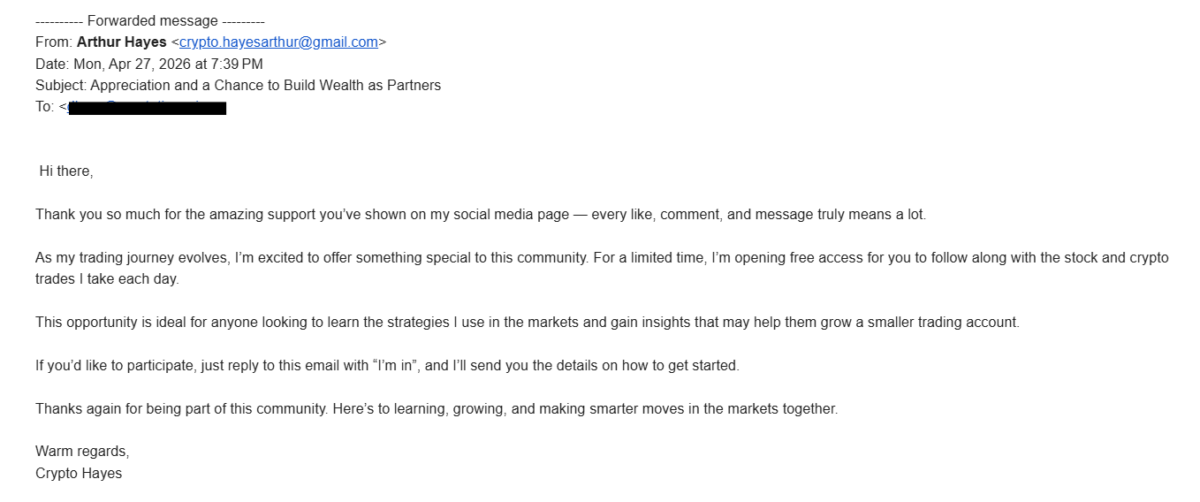
Promising exclusive access to the market moves of one of crypto’s most recognizable voices, a convincing email sent from the bogus address crypto.hayesarthur@gmail[.]com, thanks recipients for their social media engagement before dangling free daily stock and crypto trade signals to help “grow a smaller trading account.”
The email—forwarded to The Crypto Times, where it was quickly identified as fraudulent—offers insights for “growing a smaller trading account” with “limited time” access. This is a classic hallmark of phishing attempts designed to build trust before steering victims toward fraudulent platforms, signal groups, or wallet-draining schemes.
This latest finding underscores a persistent threat that has plagued the crypto industry for years. Impersonation scams targeting high-profile figures like Hayes, the former CEO and co-founder of BitMEX, have existed since the sector’s earliest bull markets.
Fraudsters routinely create fake email addresses, clone social media profiles, and deploy deepfakes to exploit the decentralized, high-trust environment where retail investors chase quick gains.
These operations rarely demand funds upfront. They typically begin with seemingly benign offers—free trade alerts, private communities, or copy-trading links—before escalating to requests for deposits, “verification” transfers, or access to bogus platforms.
Impersonation scams in crypto
This Hayes impersonation fits into a broader wave of celebrity and influencer scams that surged in 2025–2026. AI-powered deepfakes of Elon Musk promoting fake giveaways and crypto doubling schemes have stolen millions, with some YouTube livestreams reportedly pulling in over $5 million in minutes.
Similar deepfake videos have targeted figures like Vitalik Buterin, with one fake livestream attracting over 165,000 viewers promising instant portfolio doubling.
Other notable cases include hacked social media accounts (such as a university student government page impersonating Musk for a fake crypto casino) and sophisticated phishing emails mimicking wallet providers like Ledger.
Recent FBI reports show Americans lost a record $11.4 billion to crypto fraud in 2025, with AI-enabled impersonation scams driving a significant portion of the damage.
Security firms and regulators have long reported that such scams contribute to hundreds of millions in annual losses, aided by crypto’s borderless infrastructure and the near-impossibility of reversing on-chain transactions.
Hayes has repeatedly cautioned his audience about imposters, especially on Instagram and similar platforms. Genuine communications from the trader usually come through verified channels such as his Substack newsletter, official X account, or established website—not cold emails from Gmail addresses.
As cryptocurrency attracts broader mainstream participation, these longstanding fraud tactics continue to evolve while retaining the same core playbook. They prey on FOMO, the allure of insider access, and the relative inexperience of many new market entrants. Experts advise investors to verify every unsolicited offer directly through official sources and to approach any promise of easy trading alpha with deep skepticism.
In an industry built on innovation and rapid wealth creation, vigilance remains essential. When an unexpected email from a Gmail account claims to offer a famous trader’s secrets, the safest response is usually to delete it.
The Crypto Times reached out to Arthur Hayes for comments but have not received a response as of publishing time.
Also read: ‘Scam Altman’: Musk’s Jab Meets ZachXBT Claim as Worldcoin Faces Fresh Scrutiny