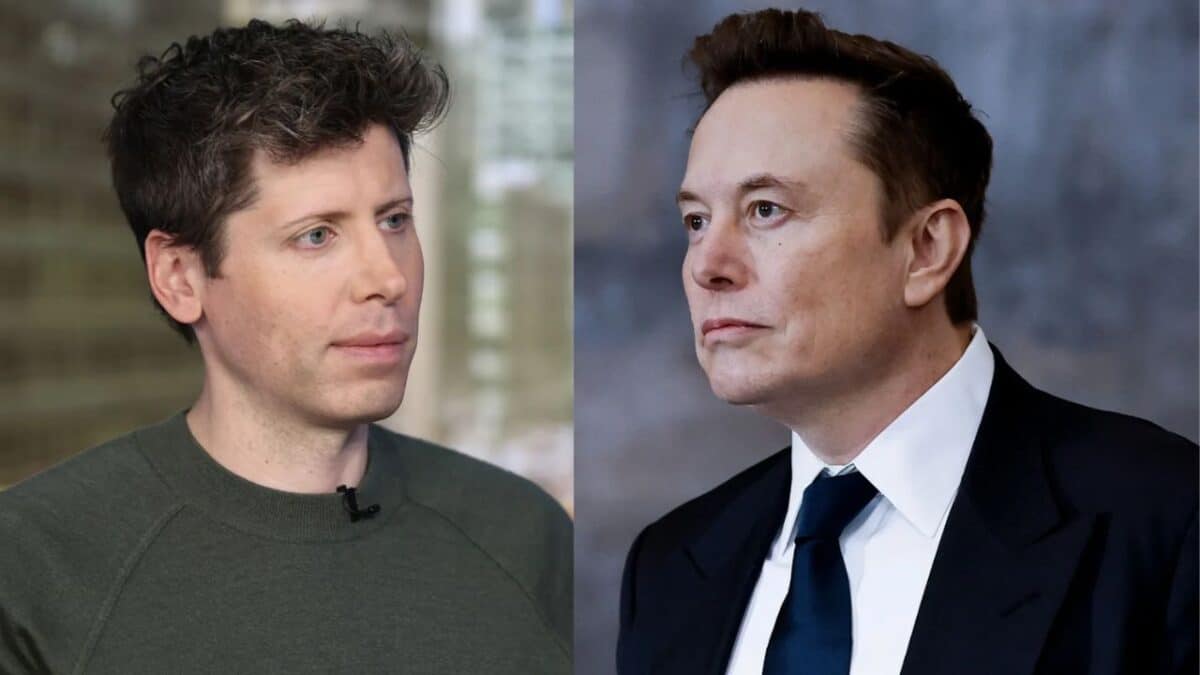
Jury selection began Monday morning in a San Francisco federal courtroom for what may be the most consequential tech trial in a generation. Elon Musk is suing Sam Altman, OpenAI president Greg Brockman, and Microsoft for up to $134 billion in damages, alleging he was deceived into funding a company that abandoned its nonprofit mission.
But as the courtroom drama unfolds, a fiercer battle is playing out online, where Musk, crypto investigators, and a growing chorus of critics are turning the spotlight on Altman’s other venture, the one almost nobody in mainstream media is talking about: Worldcoin.
Musk paid to boost journalist Ronan Farrow’s April 6 post on X promoting the New Yorker investigation, and reposted the article himself, writing: “Calling him ‘Scam’ Altman is accurate.” Hours earlier, he had posted separately calling Altman a habitual liar. His own AI chatbot Grok weighed in too, generatingdetailed breakdowns of the allegations when prompted by users on X. But the “Scam Altman” label didn’t originate with OpenAI. It was Worldcoin, now rebranded as World, that first earned Altman the nickname in crypto circles.
That narrative has been amplified by on-chain investigator ZachXBT, who wrote that Worldcoin launched with a “predatory low float” token model comparable to past failed crypto ventures, adding, “They have preyed on people from low income countries for biometric data by giving away small amounts of $WLD tokens.”
He further alleged that the system has led to the emergence of a black market for verified accounts, while token supply inflation and repeated OTC sell-offs by insiders continue to raise concerns within the crypto community.
How it started
Worldcoin was conceived in 2019 by Altman alongside Alex Blania and Max Novendstern. The pitch was bold: a blockchain-based universal basic income system using iris-scanning technology to verify every participant as a unique human. Users would stare into a silver, bowling-ball-sized device called the Orb, which scans irises and issues a cryptographic World ID.
In exchange, they’d receive small allocations of the native token, $WLD. The project raised over $250 million from investors, including a16z, Khosla Ventures, Bain Capital Crypto, and Blockchain Capital.
The problems started almost immediately.
“A Biometric Database from the Bodies of the Poor”
In April 2022, MIT Technology Review published an investigation that would define the Worldcoin controversy for years. The headline told the story: “Deception, exploited workers, and cash handouts: How Worldcoin recruited its first half a million test users.”
Reporters found that three of the five countries Worldcoin cited as successful testing locations, Indonesia, Sudan, and Kenya, were classified as low or lower-middle income by the World Bank. In one village in Indonesia, a 35-year-old furniture maker was woken up by his mother and told that a “social assistance giveaway” was happening at the local elementary school. What he found were Worldcoin agents aiming the Orb at villagers’ faces.
Critics argued the project was targeting low-income communities where individuals would trade biometric data for tokens without understanding the long-term consequences. Orb operators were paid for each user they signed up, and critics labeled the strategy of paying people to scan their irises as equivalent to bribery.
The Token: Predatory by Design
When $WLD launched on July 24, 2023, the tokenomics confirmed what skeptics feared. The total supply was 10 billion tokens, but it launched with a circulating supply of just 1.4%. Of those, 100 million were handed directly to market makers, giving insiders control over price discovery from day one. Despite minimal liquidity, WLD traded at a fully diluted valuation of $22 billion.
On-chain investigator ZachXBT called the token design “predatory” from launch day. By July 2024, he escalated, labeling it the “biggest scam token of the bull run” in a series of posts drawing on research by Bybit trader DefiSquared documenting alleged price manipulation by the Worldcoin team.
His findings showed that Orb Operators had been sending substantial sums of WLD to Binance. During a March 2024 price spike above $12, one operator was caught moving roughly $150,000 in WLD to Binance every three days. When Worldcoin posted on X about “building for every human,” ZachXBT replied that they were “allowing insiders to continue to profit off your scam token while larping as if you build tools for humanity.”
Today, $WLD trades at roughly $0.26, down 97.9% from its all-time high of $11.74 reached in March 2024. Only about 32.9% of the total supply is in circulation. Over 90% of all WLD is held by the top 100 wallets.
The black market for eyeballs
The system designed to prove human uniqueness spawned the opposite: a thriving underground trade in biometric credentials. As early as May 2023, a black market emerged on Chinese social media and e-commerce platforms, with sellers offering World App verifications sourced from developing countries like Cambodia and Kenya.
On Taobao, listings ranged from roughly $1.40 for a basic download to about $70 for full verification.
Worldcoin acknowledged the issue but downplayed it, saying there were only “a few hundred instances” of fraud among over 1.7 million signups. The problem didn’t stop. By September 2024, Singapore’s deputy prime minister warned citizens against trading World IDs, revealing that police were investigating seven individuals for suspected illegal account trading.
Hong Kong authorities raided six Orb operators earlier that year. Hackers also managed to install malware on several Orb operators’ devices, exposing login credentials on dark web marketplaces.
Insiders cash out while retail bleeds
While the token collapsed, insiders were quietly liquidating through OTC channels at an extraordinary scale.
In March 2026, Arkham Intelligence data revealed approximately 117 million WLD worth about $38.7 million were moved in OTC transactions, routed through Binance and FalconX, with roughly $35 million in USDC returning to related wallets. The team accepted approximately $0.30 per token while the market sat at $0.32.
Then in April 2026, a World Foundation subsidiary sold another $65 million in WLD through OTC deals as the token hit an all-time low. The average sale price of $0.27 represented a 76% discount to the $1.13 price WLD was trading at during a May 2025 raise.
On-chain analyst Mlm onchain reported on Telegram (27,134 subscribers) on March 28 that amultisig linked to the World Foundation sold 85.45M WLD for $25M through FalconX at $0.293, deposited another 81.26M WLD worth $22M to Binance, and had 40.65M WLD worth $10.85M still sitting in a wallet, likely to be sent next.
And the worst may be ahead. A major cliff unlock scheduled for July 23, 2026, covers roughly 52.5% of WLD’s total supply, equivalent to about 169% of the current float, with tokens vesting at approximately 4.79 million WLD per day. Analysts have widely flagged it as one of the most bearish unlock events in recent crypto history.
Governments Step In
Kenya’s High Court ordered Worldcoin to halt all biometric data collection and processing, mandating the deletion of all collected data within seven days. The ruling cited failures in data protection compliance and consent. Spain temporarily banned operations, citing GDPR violations. Singapore launched police investigations. Hong Kong raided operators. The Kenya ruling raised fundamental questions about informed consent, data exploitation, and what scholars called digital colonialism.
The New Yorker Exposé
On April 6, 2026, The New Yorker dropped a15,000-word investigation by Ronan Farrow and Andrew Marantz. Drawing on interviews with over 100 people, internal documents, Slack messages, and HR records, the piece detailed allegations of systematic deception by Altman at OpenAI. Multiple senior Microsoft executives told reporters that Altman had repeatedly misrepresented agreements and reneged on deals.Sources drew explicit comparisons to Sam Bankman-Fried and Bernie Madoff.
WLD dropped 2.9% to $0.2432 as the revelations hit social media, down over 10% in the prior seven days. BeInCrypto
The $134 billion trial
The courtroom battle that opened on April 28 is the culmination of a feud stretching back to OpenAI’s founding in 2015. Musk, who donated more than $44 million to OpenAI in its early years, claims Altman and Brockman deceived him about plans to transition from nonprofit to for-profit. He is seeking up to $134 billion in damages directed to OpenAI’s nonprofit arm, along with the removal of Altman and Brockman, and restoration of nonprofit status.
OpenAI countered that Musk pushed for a for-profit structure himself and left because he couldn’t assume total control, calling the lawsuit “motivated by jealousy, regret for walking away from OpenAI and a desire to derail a competing AI company.”
Musk offered to purchase OpenAI in February 2025 for $97.4 billion. Altman rejected the overture, countering that he would buy X for $9.74 billion instead.
The witness list includes Musk, Altman, Brockman, Microsoft CEO Satya Nadella, former OpenAI chief scientist Ilya Sutskever, former CTO Mira Murati, and Shivon Zillis, a former board member and mother of some of Musk’s children. The jury is expected to begin deliberations by May 12.
The SBF question
The crypto community has been drawing uncomfortable parallels between Worldcoin and the FTX collapse for months. Both relied on charismatic founders with outsized public profiles. Both employed tokenomics that overwhelmingly favored insiders. Both operated where regulatory oversight was weakest.
And both wrapped predatory financial engineering in the language of social good, FTX through “effective altruism,” Worldcoin through “universal basic income.” Worldcoin’s original backers even included Sam Bankman-Fried himself and the collapsed hedge fund Three Arrows Capital.
For the millions of people in Kenya, Indonesia, Cambodia, and beyond who traded their iris scans for a few dollars’ worth of $WLD tokens, tokens that have since lost nearly all their value, it is far more than a tech rivalry or a courtroom drama. It is the story of how Silicon Valley’s most powerful technologists exported a financial experiment to the world’s most vulnerable populations, wrapped it in the language of human dignity, and walked away with the proceeds.
Also Read: WLFI CEO Dismisses Justin Sun’s Lawsuit, Vows Swift Dismissal