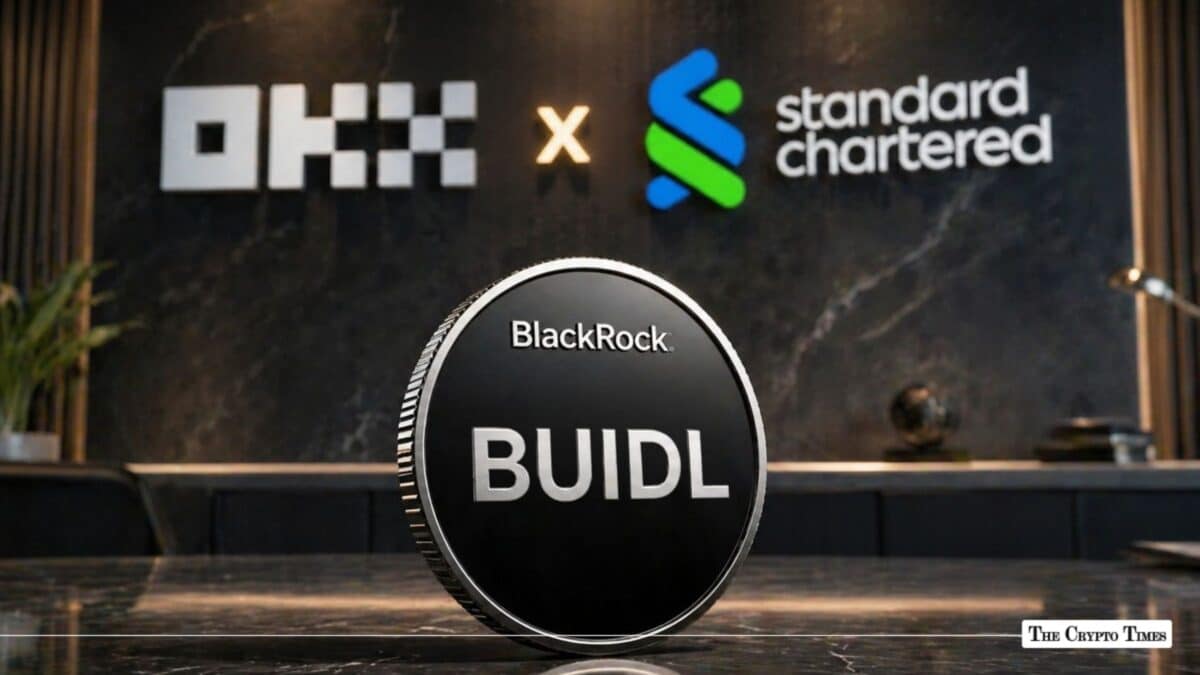
BlackRock has brought its $2.5 billion tokenized money-market fund to crypto exchange OKX, with Standard Chartered holding the underlying assets in regulated custody—the latest in a string of major exchange integrations for BUIDL — following Crypto.com and Deribit in June 2025 and Binance in November 2025.
This is the most direct sign yet that Wall Street’s largest asset manager and a globally systemically important bank are jointly building the institutional plumbing for crypto markets.
Under the arrangement, tokens of the BlackRock USD Institutional Digital Liquidity Fund (BUIDL) sit in regulated custody at Standard Chartered’s Dubai International Financial Centre entity while showing up as available collateral on OKX. Traders can post the fund as margin while it continues earning the underlying Treasury yield instead of leaving cash idle. Access at launch is restricted to investors in the Middle East.
Solving the Idle-Cash Problem
The mechanic addresses one of crypto’s longest-standing capital-efficiency drags. Cash and stablecoins posted as collateral on exchanges have historically earned virtually nothing, even as the same capital sitting in a money-market fund yielded 4–5% in the current rate environment. BUIDL—which invests in U.S. Treasuries and repurchase agreements and is designed to maintain a stable $1 net asset value—turns what would otherwise be dead margin into a productive Treasury position.
“This product was designed to minimize risk rather than add the layers of risk,” said Rifad Mahasneh, CEO of OKX Middle East and North Africa and Commonwealth of Independent States, to Bloomberg. “It becomes more efficient collateral and productive collateral.”
Two Paths: Off-Exchange and On-Exchange
The joint framework allows BUIDL to be used as collateral in two distinct configurations for the first time. In the off-exchange path, assets remain in Standard Chartered custody for OKX clients who prefer bank-grade custody and want to avoid placing collateral directly on a crypto exchange — a structural concern that hardened across institutional desks after the FTX collapse. In the on-exchange path, BUIDL is held directly on OKX as yield-bearing margin for traders running active leverage strategies who prioritize execution speed.
“Some of our clients prefer to keep custody in a custodian such as Standard Chartered. Some of our clients prefer to keep custody within OKX. For us, it is an agnostic question,” Mahasneh said. “The novel idea is that you can still generate yield on that custody in both cases.”
The Programme’s Origin: Franklin Templeton First, BUIDL Second
The integration runs through the same collateral-mirroring program that OKX and Standard Chartered launched on April 10, 2025, under the Dubai Virtual Asset Regulatory Authority (VARA) framework. That pilot named Franklin Templeton’s tokenized money-market fund—better known as BENJI—as the inaugural admitted asset, with Brevan Howard Digital among the first institutions to onboard. At the time, the partners signaled BENJI would be “the first in a series” of tokenized money-market funds offered through the framework.
BUIDL is now that next entrant. The program has since expanded geographically—Standard Chartered and OKX extended the framework to the European Economic Area in October 2025, after OKX secured its MiCA license—and had accumulated over $100 million in assets under custody as of that EEA expansion. Standard Chartered serves throughout as the independent, regulated custodian; OKX manages collateral and facilitates transactions through its VARA-regulated entity.
BUIDL’s Distribution Sprint Across 2025–2026
For BUIDL specifically, the OKX integration extends an exchange-collateral footprint that has expanded steadily across the past year. Crypto.com and Deribit went live as BUIDL collateral venues in June 2025, followed by Binance in November 2025, which added BUIDL as off-exchange collateral for institutional traders alongside a new BUIDL share class on BNB Chain.
By late 2025, BUIDL had also been integrated as collateral into Aave V4 and Sky (formerly MakerDAO), per OKX’s own 2026 outlook research—meaning roughly 30% of tokenized Treasuries on-chain (~$2.2 billion) are now actively used as DeFi or exchange collateral rather than sitting idle in wallets.
Launched in March 2024 and tokenized by Securitize, BUIDL was BlackRock’s first tokenized fund issued on a public blockchain. It has grown to the largest fund in its category, with roughly $2.5 billion in assets, and is restricted to qualified investors.
The RWA Backdrop
OKX — backed by Intercontinental Exchange, the New York Stock Exchange’s owner — is positioning itself as a primary venue for the convergence between traditional finance and crypto. The broader real-world asset (RWA) tokenization market has grown to roughly $30 billion, up about 400% since the start of 2025, according to RWA.xyz. McKinsey projects RWA tokenization will reach $2 trillion by 2030; Standard Chartered itself forecasts $30 trillion by 2034.
BlackRock’s push is driven from the top. CEO Larry Fink has repeatedly argued that every financial asset will eventually be tokenized—a view he reiterated in his most recent annual letter to investors.
The IMF Counterweight
Cutting against the institutional momentum is a notable warning from the International Monetary Fund. In April 2026, the IMF cautioned that moving trading infrastructure onto blockchain-based systems could accelerate financial crises beyond regulators’ ability to respond—a critique aimed at exactly the category of integration BUIDL represents. The fund’s argument: when the same Treasury-backed token can be margined on a crypto exchange, posted as collateral in DeFi protocols, and redeemed for the underlying fund unit, the velocity of stress propagation in a crisis becomes faster than current regulatory tooling can track.
The IMF position will likely shape the regulatory conversation around tokenized collateral through 2026, particularly as funds like BUIDL appear simultaneously in centralized exchange margin systems, DeFi lending markets, and traditional fund structures.
For now, though, the institutional flow is one direction. BlackRock, Standard Chartered, and OKX have built a working pipeline that lets a Treasury-backed token earn yield in three places at once—and the Middle East gets to use it first.