Key Highlights
- DeFiLlama statistics show that RWAs increased from $1B to $28B in three years.
- The market grew from $4.1B in early 2025 to $25.2B by March 2026.
- Tokenized funds account for $13.5B, followed by commodities valued at $5.9B.
Tokenized RWAs have grown from $1B to $28B in 3 years, as per DeFiLlama reports, indicating the fast development of blockchain-powered real-world assets as the segment attracts more interest from various financial players.
According to recent DeFiLlama statistics, the current active market of RWAs increased from about $4.1 billion at the beginning of 2025 to $25.2 billion as of March 2026, which is substantial growth within one year.
This particular growth comes after years of growth when tokenized RWAs have increased their overall valuation from about $1 billion to $28 billion. However, not all segments of the industry developed evenly; some experienced a fast boost, while others remained lagging behind.
Market overview
As per the report, tokenized funds stand out as the frontrunners, rising from $2.7 billion to $13.5 billion and constituting well over 50 percent of the overall market cap. The structure of such tokens usually resembles conventional financial products, facilitating their tokenization process.
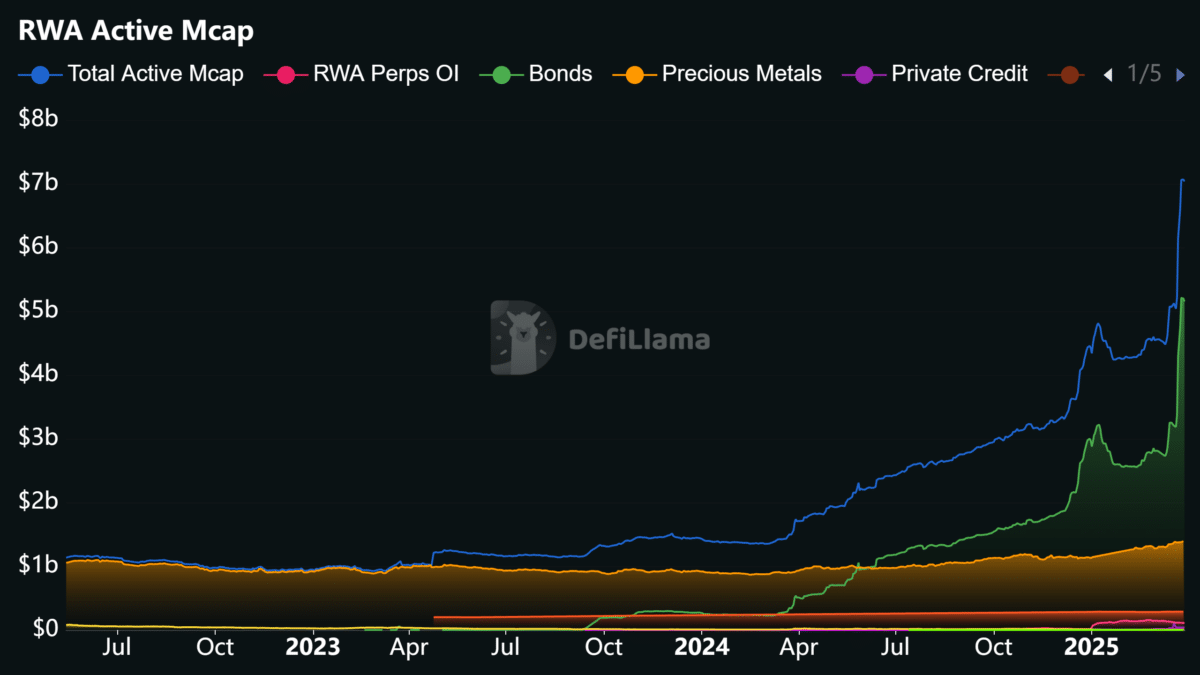
The commodity market ranks second in size, growing from $1.1 billion to $5.9 billion. A considerable portion of this expansion has been fueled by the tokenization of gold.
There has also been substantial development in private credit, which now stands at about $4.6 billion. But following this asset is difficult because it lies off-chain. Tokenized equities have also risen, from $200 million to $1.2 billion, suggesting higher interest in using blockchain technology to invest in stock markets.
Contrast to last year’s report
Last year, Animoca Research reported that tokenization can unlock some of the greatest opportunities in the financial sector. According to a report published in August by Andrew Ho and Ming Ruan, the addressable market of RWAs can be valued at about $400 trillion.
The key markets identified by Animoca include private credit, U.S. Treasury bills, commodities, equities, and bonds. “The estimated $400 trillion addressable TradFi market highlights the opportunity for RWA tokenization,” the authors noted in the report.
Utilization in DeFi remains low
In summary, funds, commodities, private credit, and tokenized equities constitute more than 95 percent of the entire RWA sector. On the other hand, tokenized real estate still constitutes a smaller share, rising from tens of millions to $300 million. It should be noted that valuing real estate might require a separate approach because not all of its worth could be captured by on-chain indicators.
Though there is an increased valuation of market capitalization, the utilization of these assets in DeFi is still quite low. Out of the total market capitalization of $28.6 billion of tokenized assets, only $2.81 billion is being utilized in DeFi applications.
Broader context
Tokenized RWAs depend on off-chain structures like custody providers and laws, which implies that tokens do not always stand for property rights but may indicate claims. It may make the process of validation and interchain interoperability more complicated.
The liquidity of each asset type varies substantially. While certain assets have a high degree of liquidity and accessibility, other assets are still fragmented between many issuers, various chains, and exchanges. Furthermore, regulatory limitations impact the industry, particularly in terms of lending and yield farming.
As the market continues to grow and change, tokenized RWAs should not be regarded as one homogenous market but as several unique asset types evolving in various circumstances.
Also Read: US Sanctions Cambodian Senator Kok An Over Crypto Scam Network