Key Highlights
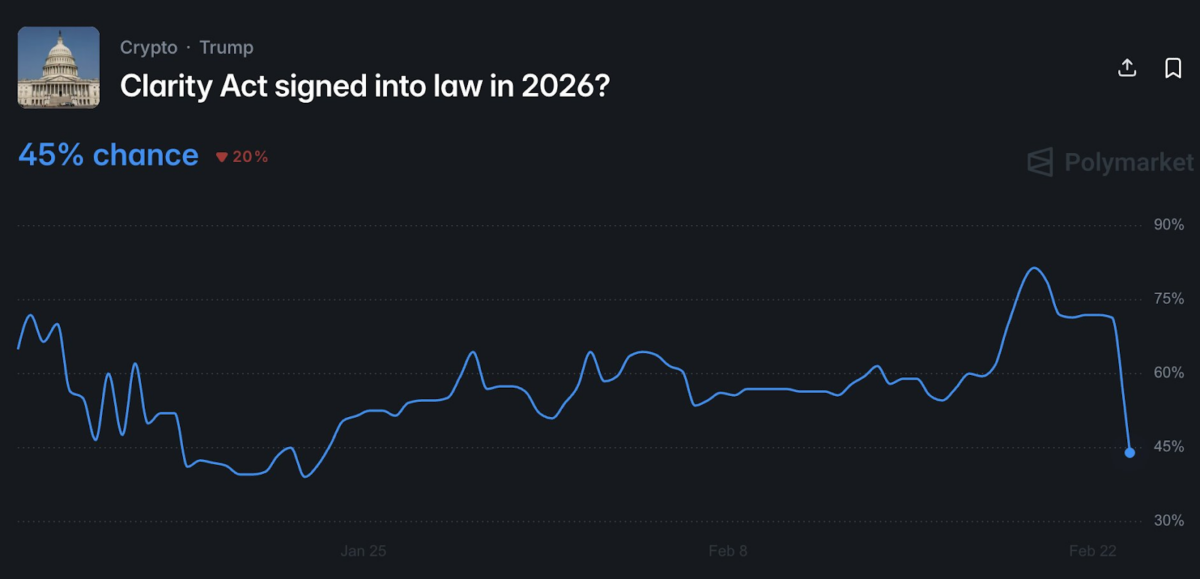
- Prediction markets show Clarity Act approval odds falling from about 72% to nearly 45%.
- Political disagreements over stablecoin regulation are slowing legislative momentum.
- Delays prolong uncertainty around SEC vs CFTC oversight of digital assets.
The probability of the U.S. Digital Asset Market Clarity Act becoming law in 2026 has dropped sharply, according to prediction market data, reflecting growing uncertainty around Washington’s crypto regulatory agenda.
Recent pricing on Polymarket shows approval odds falling from roughly 72% to near 45%, signaling that traders increasingly expect delays as lawmakers remain divided over stablecoin provisions tied to the broader bill.
The Clarity Act, which passed the House in July 2025 with bipartisan backing, seeks to establish a regulatory framework defining responsibilities between the U.S. Securities and Exchange Commission (SEC) and the Commodity Futures Trading Commission (CFTC).
The legislation is widely viewed as a cornerstone effort to bring legal certainty to crypto exchanges, token issuers, and DeFi platforms operating in the United States.
Stablecoin debate emerges as main roadblock
The decline in approval odds appears linked to ongoing disputes over stablecoin oversight, which has become one of the most politically sensitive parts of U.S. crypto legislation.
Lawmakers remain divided over reserve requirements, issuer eligibility, and whether banking regulators or market regulators should hold primary authority. Negotiations on these issues have slowed progress, creating uncertainty over whether the Clarity Act can advance alongside separate stablecoin bills currently under discussion.
Policy observers note that disagreements are less about crypto itself and more about financial control, particularly how dollar-backed stablecoins could reshape payment rails and banking competition.
Why markets are reacting
For crypto markets, delays matter almost as much as rejection. The Clarity Act has been viewed as a potential catalyst for institutional participation by clarifying compliance rules and reducing enforcement ambiguity.
Falling approval odds suggest traders are repricing expectations for regulatory clarity, which could postpone investment decisions by exchanges, custodians, and traditional financial firms waiting for clear operating guidelines.
Without legislative resolution, the current environment dominated by case-by-case enforcement and overlapping agency claims is likely to persist into 2027.
Broader impact
The slowdown highlights how U.S. crypto regulation is increasingly shaped by political negotiations rather than purely technical policy debates. While bipartisan support for market structure reform remains intact, stablecoins have become the pressure point determining legislative timing.
As a result, industry participants face a familiar scenario: high legislative attention but uncertain outcomes, leaving regulatory clarity still just out of reach.
Also Read: Democrats Vs. Trump: Stablecoin Regulation or Backend Deal for WLFI?