You know what a Fugazi is? It’s a sham. It’s fairy dust. It’s all nonsense.
This is exactly what is happening right now in Washington over the regulation of stablecoins right now.
A massive, shiny fugazi.
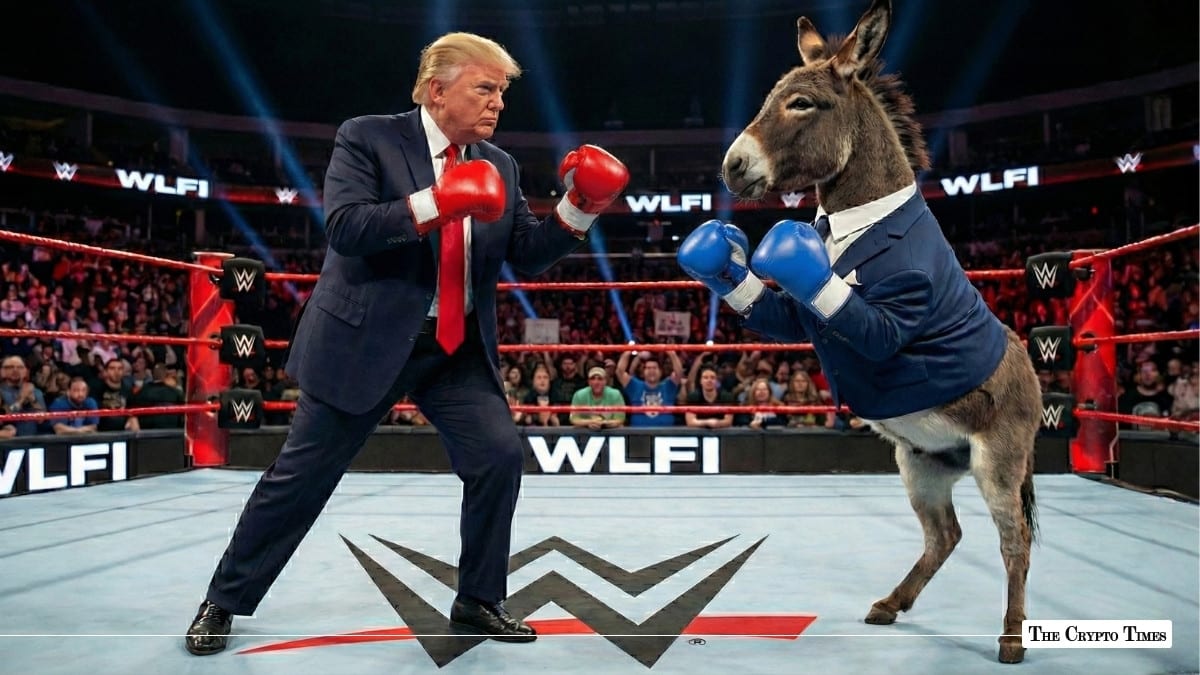
The debate is just not between Coinbase and the banks, there are more players in this sham and these are the ones who fight more dirty than the banks. This is coming directly between one in power and one trying to usurp them. This is a public debate between President Donald Trump and Democrats.
I call this debate a Fugazi cause Democrats aren’t trying to sell you some noble crusade against the dangers of crypto. Please. They are selling a conflict trade. They are looking at a Trump-linked stablecoin trying to get federal legitimacy, and they are moving in for the kill while the ink on the rulebook is still wet.
I am not making this up, just listen to the talking heads in Washington, they want you staring at the shiny object. They want you arguing about reserve ratio, technical oversight, and whether paragraph four says ‘issuer’ or ‘trust.’ That’s the song and dance for the cameras, the chumps, and also for the congressional hearings.
What this is, is Democrats seeing a way to hit Trump through the one place where politics, money, and regulation all collide at once. Everyone in crypto knows it: World Liberty Financial (WLFI) and its stablecoin USD1.
And Democrats played smart. They didn’t make noise when the project was launched, they went with flow when it was looking like just another side hustle for the Trump family. But, but, but! Then they smelled the whiff that it is now a money printing machine with a stablecoin (USD1), a trust— bank push, custody ambitions, and federal touchpoints.
So let me tell you again, this is not just a stablecoin debate. This is a Washington power story about who gets to stand next to the rulebook while their people are standing next to the cash register. And once Democrats frame it that way, the burden of proof changes. Now they don’t have to win a technical crypto argument. They just have to make the whole process smell wrong.
Why WLFI Became the Perfect Target?
Now let me begin with the most interesting part. WLFI didn’t become a target just because Democrats felt like picking a fight with another crypto name. That’s how this game works. In Washington they don’t swing hard unless it’s going for a homerun. A swing and a miss is frowned upon here.
WLFI is a beautiful setup. It sits perfectly well as a meatball: Trump money, Federal regulators, and a product that touches the dollar.
See a random token launch is pure, unadulterated, ear splitting noise! Washington sees a thousand of those and just shrugs it off. A meme coin pumps, a founder tweets, and some guys on a Telegram channel scream “to the moon”. And all this time nobody in Capitol Hill loses sleep.
But WLFI is not that trade.
The second it started moving from a ‘crypto project to financial infrastructure,’ the room changed, and with the President’s name attached to it, Democrats lost their patience. They could not hold their horses and started to speak against Trump’s ties to WLFI.
Let me give you a quick recap. Sometime earlier, The Crypto Times had reported that WLFI’s subsidiary, WLTC Holdings, filed with the OCC to launch a national trust bank. And if that gets approved, you’re not just talking about a token floating around the internet anymore—you’re talking about a federally supervised structure that can issue, custody, and convert USD1 like it belongs in the real banking conversation. The same coverage also noted WLFI’s claim that USD1 crossed $3.3 billion in circulation in its first year, which is exactly the kind of number that makes people in D.C. stop pretending this is theoretical.
And this is the part people keep missing: a token is one thing, but a charter is another thing entirely. A token is a market product. People can argue about it, dump it, defend it, and basically do whatever they want about it. But a charter?
A charter is legitimacy. A charter is federal oxygen. A charter is how you go from “these crypto guys want to be left alone” to “these guys want a seat at the table where the rules get written.”
That’s not a side hustle anymore. That’s a power move.
So when Democrats started pressing WLFI, they weren’t just attacking a coin. They were attacking the moment a Trump-linked crypto business tried to step through the velvet rope and into regulated finance. And in Washington, when a politically connected player gets close to that door, nobody asks nicely what’s going on. They start counting who gets paid, who signs the paperwork, and who’s standing in the room when the deal gets done.
How Trump Is Actually Linked to WLFI and USD1
Let’s kill the lazy defense right now: this is not just guilt by association.
The link Democrats are attacking is not symbolic. It is structural. It is financial. It is in the ownership stack.
The Crypto Times cited Reuters that Trump family-linked DT Marks DeFi LLC held about 60% of WLF Holdco LLC, which controls World Liberty Financial.
The Trump family has a claim on 75% of net revenues from token sales and 60% from World Liberty operations. That is roughly $400 million in fees going to Trump. His son Eric Trump also has a board-level role in the holdco structure. That is not branding. That is the cap table talking.
So when Democrats frame this as a conflict story, they’re not inventing the link. They’re selling the link. And frankly, it’s an easy sale because the facts line up in a way that any committee room can understand: ownership, revenue participation, family governance role, and a stablecoin strategy now pushing for federal supervision.
And once you stack those facts together, Democrats don’t need to prove USD1 is broken. They only need to keep asking the same question: who benefits if the rules are written this way? In Washington, that question hits like a sledgehammer.
Warren Didn’t Start With the Coin—She Started With the Referee
So to light a fire in the Trump camp, A Massachusetts professor and senior member of Democratic party, Sen. Elizabeth Warren picks up the phone to the OCC and says, “Whoa, whoa, whoa! You’re gonna give a federal bank charter to a guy whose family is literally running the casino?”
This is what made the strategy smart. She went straight for the process and urged the OCC to halt or delay review of the Trump-linked crypto bank bid, citing conflict concerns and arguing that a regulator should not be supervising a firm tied to a sitting President’s family while stablecoin rules are still being shaped.
That is not a product attack. That is a referee attack.
See what she did there? That is pure, unadulterated genius. She’s not trying to prove the product is a piece of junk by trying to make people doubt the officiating before the game even starts. And once the fight becomes, “Can regulators stay neutral here?” The entire conversation moves out of Crypto Twitter and into mainstream political gravity.
That is how a technical policy issue becomes a Washington liability.
UAE Deal Turned This Into a Full-Blown Pressure Campaign
Now the situation really starts to smell like Washington, as the story got the one thing every D.C. pressure campaign wants: a foreign money angle.
On February 5, House lawmakers launched a probe into a reported $500 million Abu Dhabi-linked investment in WLFI. It was reported that a UAE royal has a 49% stake in WLFI, including the allegations around how funds were split and where proceeds flowed. These reports moved the conversation from “Trump crypto project” into “foreign-linked money, political proximity, and who got paid.”
The D.C. lawmakers are seeking documents by March 1 and have tied the issue to national security concerns and possible legal questions.
As a result, the pressure widened further. On February 20, The Crypto Times also reported that House Democrats asked Treasury Secretary Scott Bessent to probe the Trump-backed World Liberty Financial over the UAE-linked stake, citing national security risks and conflict concerns while WLFI’s federal bank-charter push was still active. The report also placed the charter issue and USD1 strategy directly inside that broader probe narrative.
That is not random outrage. That is message discipline.
They hit the ownership angle. They hit the charter. They hit the foreign money. And then they tied it all back to USD1 and federal oversight.
That is not a press cycle. That is a squeeze.
Why USD1 is the Perfect Weapon in This Fight
USD1 is politically useful because it sits right in the middle of three different narratives at once.
Crypto people see a stablecoin. Banks see a deposit competitor. Lawmakers see a dollar-adjacent financial product tied to reserves, custody, and federal oversight.
It has all the signs waiting for a sham: USD1 issuance, custody, conversion, and reserve-linked operations inside a proposed OCC-regulated trust structure. That gives Democrats everything they need to keep this story hot because they can pitch it differently depending on the room they are in.
To crypto skeptics, it sounds like another politically connected financial experiment.
To institutional moderates, it looks like a charter-integrity problem.
To national security hawks, the UAE angle gives them a clean line of attack.
Same facts. Different audience. Strong sale.
The All Out Attack from Democrats
Senate Democrats Elizabeth Warren and Andy Kim separately called for a Committee on Foreign Investment in the United States (CFIUS) review of the reported UAE royal stake, arguing that the Treasury should examine whether the deal poses national security risks, including foreign access concerns and the reported 49% stake.
On February 19, over 40 lawmakers signed a letter led by Rep. Gregory Meeks of New York asked Treasury Secretary Scott Bessent for answers by March 5. The committee’s letter also referenced USD1’s role in a major Binance-linked transaction.
At the same time, Rep. Ro Khanna, in his role on the House Select Committee on China, launched his own investigation into WLFI and explicitly tied it to concerns that conflicts around the deal may have influenced U.S. policy involving China, including restrictions around advanced AI chips through third countries like the UAE.
How Trump and His Family Are Responding
When the reporters, whistleblowers, internet sleuth, and lawmakers start digging into the ownership, no one in Trump’s side panics. They just put up a wall.
Yes, you heard that right. Walls are their thing!
They don’t say the family isn’t making money. Everyone knows they’re making money, it’s a business, for Christ’s sake!
They say the assets are in a trust. Run by the kids. “Proximity is not control,” they tell the press. It’s a separation play. It’s a legal shimmy that keeps them in the game while the Democrats are left swinging at air.
The White House has a straight counter: the President is not personally involved in business deals in a way that implicates his duties.
WLFI is doing the same thing from the company’s side. World Liberty dismissed the probes as political harassment, which is exactly what you say when you want partners, investors, and counterparties to read the situation as a political attack, not a business weakness.
Now as simple as these sounds, it’s not. Remember this is a combative New Yorker who owns a billion dollar business. This is his second term as the President of the United States. He knows how to grab attention and shape narratives.
Earlier this week, Donald Trump Jr., Eric Trump, and the Witkoffs, hosted Mar-a-Lago at the World Liberty Forum. And at the WLFI spokesman David Wachsman framed it as standard cross-sector engagement designed to strengthen U.S. leadership in digital finance.
That’s not a legal defense. That’s a positioning defense. They’re trying to make this look like modernization, not influence peddling.
Politics, Crypto, Fugazi
That’s why this fight has teeth: both sides are using the same facts and selling completely different stories.
Democrats are trying to make every regulator and every voter ask whether this is neutral policy or a backroom deal with better branding.
The Trump Family and WLFI are trying to make everyone else ask a different question: whether this is regulation, or just politics trying to kill a business it can’t control.
Same table. Same chips. Different pitch. Just a Fugazi.